Gregory Zulu 55 Review
Packstack is reader-supported. When you buy through links on our site, we may earn an affiliate commission. This does not affect the independence or objectivity of our reviews.
A comfortable, feature-rich 55L ventilated pack for multi-day trips—but its 1,910g weight means it's built for loaded comfort, not gram-counting.
Overview
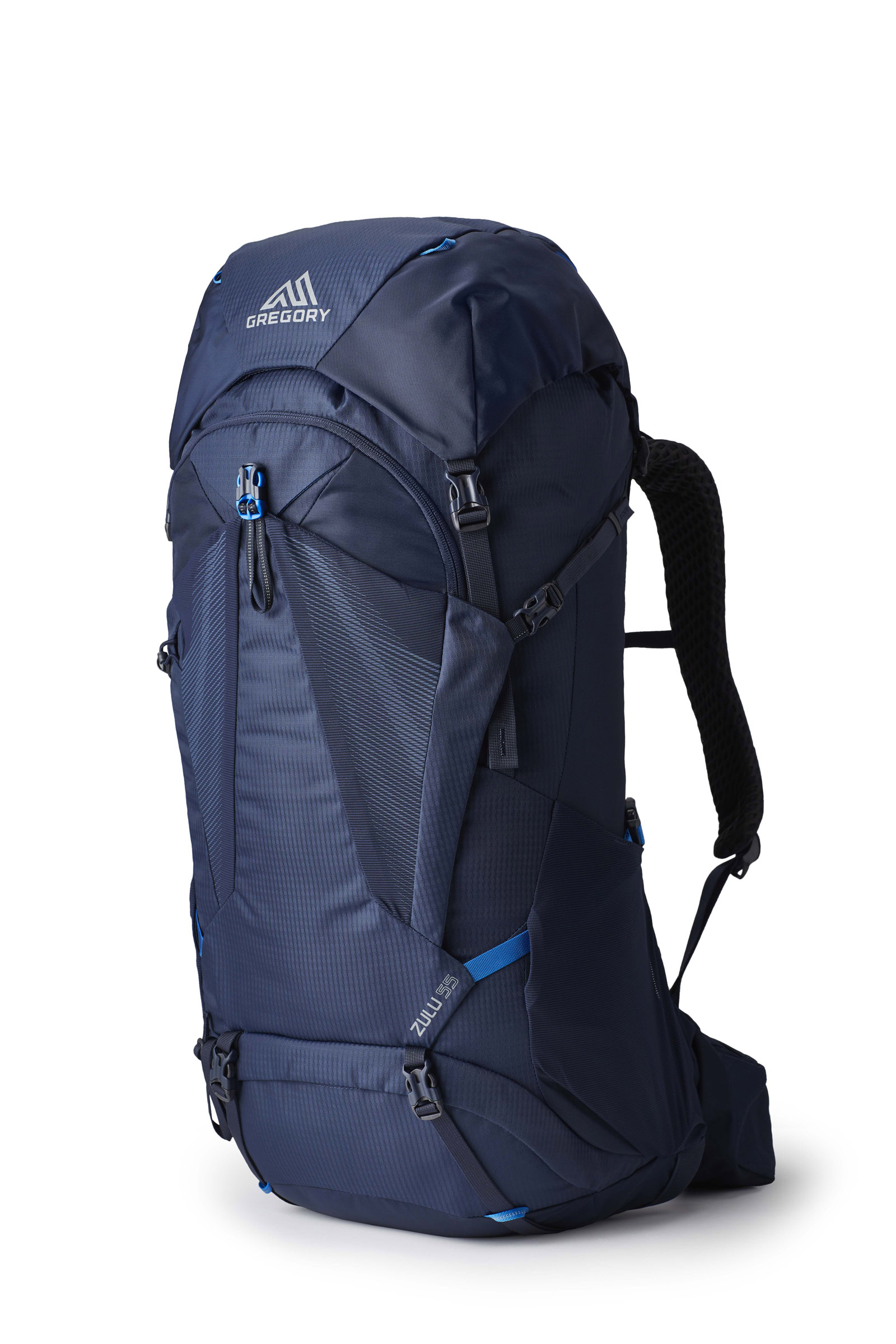
The Gregory Zulu 55 is a ventilated, adjustable-frame backpack designed for carrying big loads with or without a bear canister.
It targets the backpacker who wants a suspension system that actually works under weight — someone who’d rather carry an extra pound of pack than spend a week fighting an uncomfortable hipbelt.
While the Zulu 55 is not the lightest or most deluxe pack for its capacity, if you consider an extra pound or more of pack weight a smart tradeoff for an extensive feature set, good fit, and durability, it delivers the goods for trips up to about five days — at a competitive price for its quality.
Key Specs
| Spec | Detail |
|---|---|
| Weight | 1,910 g (4 lbs 3 oz) |
| Volume | 55L (M/L) / 53L (S/M) |
| Torso Adjustment | 3.5 inches |
| Torso Fit Range | S/M: 15–19 in / M/L: 18–22 in |
| Suspension | FreeFloat dynamic hipbelt |
| Frame | Perimeter spring steel + fiberglass anti-barreling cross-stay |
| Rain Cover | Included |
| Reservoir Compatible | Yes (Gregory 3D Hydro SpeedClip hanger) |
| Sizes | S/M, M/L |
| Max Carry | 50 lbs |
| Warranty | Limited lifetime |
Would the Zulu 55 earn its spot in your pack?
1910 g · 67.4 ozAdd the Gregory Zulu 55 to your gear closet and see exactly what it does to your base weight — then build your next packing list around it. Free, in about two minutes.
Free · No credit card · iOS & Android · Trusted by 3,000+ backpackers
Performance
Suspension & Fit
The FreeFloat hipbelt is the headline feature here, and it largely earns the attention. Gregory’s patented FreeFloat dynamic hipbelt links the hipbelt to the frame with a panel designed to move and flex with your body, while the 3D hipbelt design conforms to the shape of your body, seamlessly providing the padding and support needed to carry heavy loads. The redesigned frame features a perimeter frame with a fiberglass cross-stay to improve stability and prevent barreling, with flex panels located on the lower back panel, adjacent to the waist belt, that allow the hipbelt to pivot and flex with the natural movement of your body.
In practice, the hipbelt’s pivot action is real and noticeable on uneven terrain — though it’s worth calibrating expectations. The pivoting hipbelt is reasonably effective at minimizing side-to-side rocking, although not as effective as the actual mechanical devices used in the rotating hipbelts of high-end packs from some brands, which are also more expensive and sometimes heavier in a comparable pack capacity. That’s fair. For most three-season trips in the 25–35 lb range, the movement feels natural rather than intrusive.
The torso adjusts continuously but is marked in one-inch increments, and the hipbelt has a massive range for both sizes: the S/M adjusts 27–46 inches, and the M/L 29–51 inches.
That’s a wide net — but note that there are only two size shells, so if your torso falls near a size boundary, getting into a store to try both is worth the trip.
Ventilation
Full-length tensioned mesh creates space between your back and the pack to allow heat to escape and air to flow freely.
The trampoline-style panel works well enough on moderate days.
The suspension wasn’t the most breathable in the lineup, but carried the loads asked of it admirably. It still has a relatively breathable back panel.
If you’re hiking in high humidity or hammering steep terrain in summer heat, you’ll still sweat — but the standoff is meaningful compared to a pack that sits flush against your back.
The integrated mesh back panel and hipbelt are comparable to Osprey’s AntiGravity suspension system, but the Zulu is substantially lighter weight than the AG packs and has a less intrusive ventilation cavity that doesn’t pull you backward or interfere with packing the main compartment.
That’s a genuinely useful trade — the Atmos AG 65 checks in heavier and at a higher price.
Load Hauling
The Zulu 55 carried up to about 30 pounds very well on days of 12 or more miles, and was comfortable with nearly its recommended maximum weight — 40 pounds — when loaded with rock-climbing gear for hiking to crags in northern Spain.
Real-user reports back this up:
one user found it comfortable even with 41 pounds, of which 12 pounds was food and water.
Access & Organization
Packing and organizing gear in the Zulu is made easy with top access under the floating top lid, a front U-zip access panel, and a bottom sleeping bag compartment.
The U-zip front panel is one of the more genuinely useful features on this pack — it gives you near-full access to the main compartment without digging from the top.
The packs have six external pockets (not including the one under the lid), including capacious zippered hipbelt pockets that can fit a large smartphone and an energy bar or two each, a spacious zippered pocket on the floating lid, and a stretch-mesh front stuff pocket that can easily fit a rain jacket.
The two stretch-mesh side pockets are large enough to swallow a liter bottle and open on the top and side so you can reach into them while wearing the pack — though when the pack is stuffed full, jamming a wide-mouth liter bottle into those side pockets with the pack on becomes tricky.
One organizational quirk worth flagging: the rain cover is stored in a pocket on the inside of the pack that also has a key clip — so this pocket isn’t dedicated to the rain cover alone, and is now largely consumed by it. A dedicated external bottom pocket for the cover would be cleaner.
Bear canister compatibility
A BV500 can fit horizontally in the main compartment, but it makes the side pockets difficult to use — a BV475 size is preferable.
Durability
Typical of Gregory, the packs appear to be built for durability, with a combination of 210-denier nylon and 210-denier high-tenacity nylon, a double-layer bottom of high-density 630-denier nylon, and reinforced fabric at the frame’s bottom corners.
The current version also uses
heavier-duty, PFC-free recycled polyester to improve durability and reduce its carbon footprint.
A handful of user reports mention the back mesh stretching out after extended use — something to monitor, though it doesn’t appear to be a widespread failure mode.
Pros & Cons
Pros
- FreeFloat hipbelt genuinely moves with your body — less fatigue on varied terrain
- Three access points (top, front U-zip, sleeping bag hatch) make packing and retrieval efficient
- Adjustable torso with a wide range covers most body types across two sizes
- Large hipbelt pockets fit a modern smartphone
- Rain cover included
- Durable, sustainability-focused fabric construction
Cons
- At 1,910g (~4 lbs 3 oz), it’s a heavy choice for the volume — competitors offer more liters per gram
- Only two size shells (S/M and M/L); borderline torsos should try before buying
- Back mesh can loosen over time under heavy, repeated use
- Side pockets become awkward to use solo when the pack is packed out
- Rain cover stored in a multipurpose lid pocket rather than a dedicated bottom pocket
- No external daisy chains (U-zip panel precludes them)
Who Should Buy This
The Zulu 55 is the right call for backpackers who regularly carry 25–40 lb loads and want a back-ventilated suspension system that won’t break the bank. It’s particularly well-suited for three-season weekend to five-day trips, where you’re packing a heavier sleep system, real camp shoes, or group gear. It’s worth a close look for both first-time backpackers or an outdoor enthusiast looking for a new pack at a reasonable price. It’s not the right tool for ultralight hikers — if you’re routinely under 20 lbs base weight, the suspension overhead isn’t worth the weight penalty, and a frameless or lightweight framed pack will serve you better.
Verdict
The Gregory Zulu 55 is a well-executed, comfort-forward pack that earns its reputation for a stable, body-conforming carry. What really stands out is how natural it feels when you strap it on, especially the hipbelt — it doesn’t slip and doesn’t create a lot of pressure on the hips, even when packed heavy. The weight is the honest sticking point: at 1,910g, it costs you meaningful grams versus lighter alternatives with comparable volume, and that math matters on longer trips. If comfortable load hauling at a fair price is the priority, the Zulu 55 delivers — just pack accordingly.
Rating: 7.5/10