Fjällräven Kajka Review
Fjällräven's birch-framed Kajka hauls heavy loads in comfort and lasts for decades, but at 3,150–3,390 g it's built for expeditions, not base-weight diets.

Overview
The Fjällräven Kajka is a trekking pack built around a laminated birch-wood frame, a vinylon-and-recycled-polyamide shell, and a fit system that adjusts nearly everything but the owner’s opinion. It comes in 65 and 75 liter versions for hikers who regularly carry 15 kg or more and want a pack that outlasts several generations of gear. The trade-off is plain: it weighs 3,150–3,390 g empty, which puts it in a different universe from anything marketed to the ultralight crowd.
Key Specs
| Spec | Detail |
|---|---|
| Weight | 3,150–3,390 g depending on version |
| Volume | 65 L or 75 L |
| Dimensions (75 L) | 88 × 54 × 28 cm |
| Frame | FSC-certified birch wood |
| Outer fabric | Vinylon / recycled 500D polyamide |
| Lining | 210D polyamide |
| PFAS-free | Yes |
| Hydration compatible | Yes |
| Rain cover | Included |
| Torso sizing | S/M and M/L |
Versions compared
| Image | Version | Weight | vs. lightest |
|---|---|---|---|
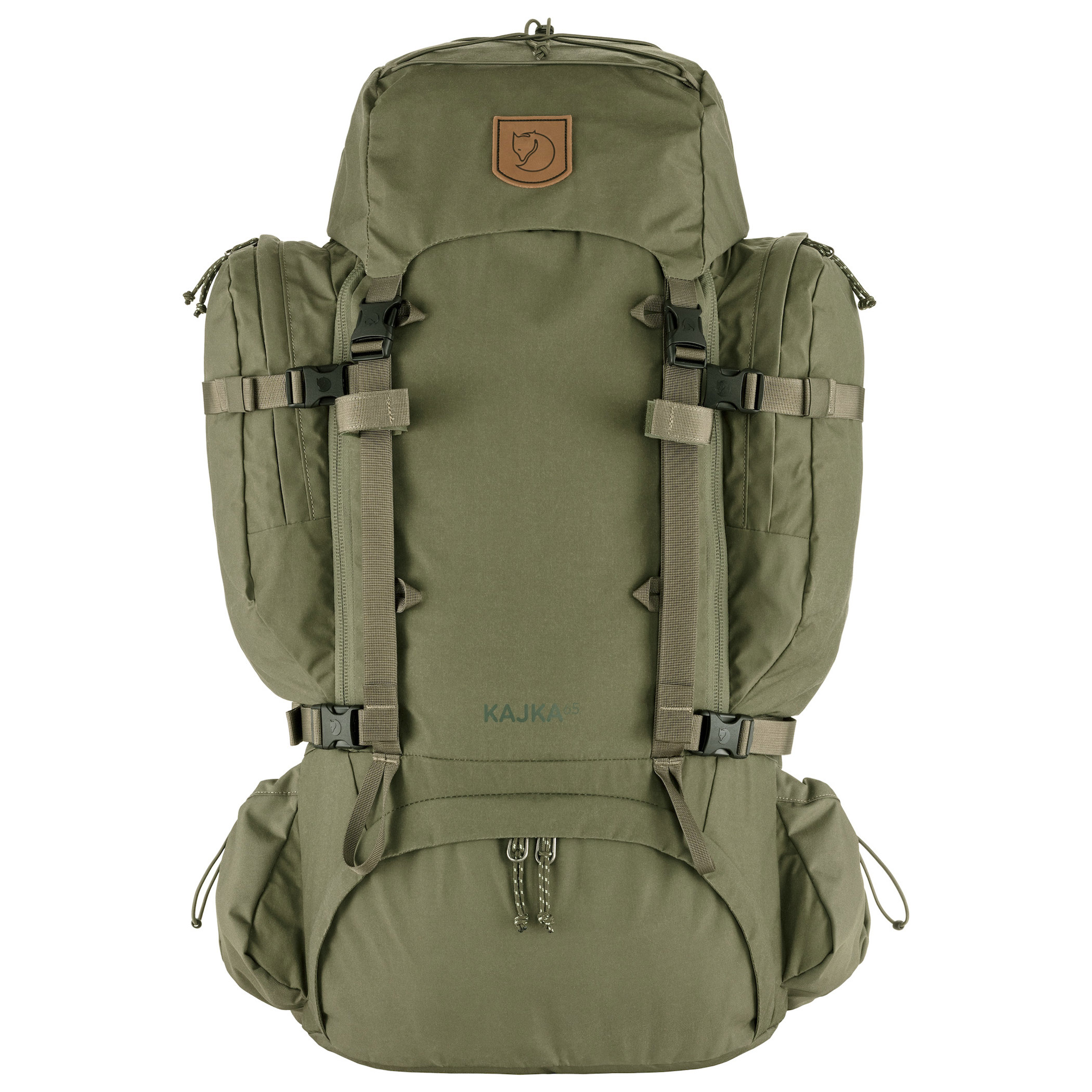 | 65 | 3150 g (111.1 oz) | lightest |
| 75 | 3390 g (119.6 oz) | +240 g |

Build your Gear Closet
View all of your gear in one place, create packing lists and hit the trail with confidence. Available on iOS, Android and the web.
Get StartedPerformance
The wooden frame. The birch frame looks like a nostalgia play, but it works as a load-bearing structure. Fjällräven says the wood carries a carbon footprint roughly 90 percent lower than an aluminum frame and trims the pack’s overall footprint by about 10 percent. The frame is a multi-layer lamination bonded with water-resistant glue. Testers describe the parallel wooden stays as behaving like a spring-steel frame, holding loads steady even at 60 pounds on steep trail. As a side effect, the pack makes no creaking or squeaking under weight, which is more than many metal-and-plastic suspensions can claim.
Carry comfort. This is the Kajka’s reputation, and owners back it up. Hikers who have compared it with the Arc’teryx Bora 95 and Gregory Denali Pro often rank it as the most comfortable large pack they have carried. The hip belt stays on the hips rather than sliding toward the tailbone. The load lifters move weight between muscle groups, and torso length adjusts easily. Shoulder-strap width is adjustable through snaps and Velcro, which few packs at any price offer. That matters for broad-shouldered hikers, and for anyone who swaps between a T-shirt and a down jacket on the same trip. S/M packs have slightly tapered straps with more room for the bust, while M/L packs use longer, untapered straps. One hiker carried well over 15 kg through four days in the Fisherfields and credited the strap-width adjustment with a large improvement in comfort.
Ventilation. The back panel is padded and flush, with no suspended mesh. Most owners find it fine at a relaxed pace or in cool shoulder-season weather, but warm when hiking hard in summer. The gapped lower-back design gets some credit for keeping it tolerable. Sweaty hikers on hot trails should expect a damp back.
Access and organization. The main compartment loads from the top through a drawcord closure with a snow-lock collar. A large U-shaped zipper opens the front panel, so gear at the bottom is reachable without unpacking the top half. A bottom compartment can keep wet clothing away from dry. A removable partition divides the main compartment. Other features include zippered side pockets, mesh hip-belt pockets, hydration routing, and a rain cover. The lid has three zippered pockets, one meant for a first-aid kit, and it detaches to serve as a waist or chest pack. Buyers of the 65 single out that detachable lid for hut visits and side trips from camp. Owners also praise the side compression system, which cinches loads without blocking pocket openings.
Durability. Everything on the Kajka is oversized: fabric, zippers, buckles. A professional wilderness guide in Tasmania reports using it for work, citing its durability and its capacity to carry more than expected. The current design was reworked with repairability in mind. The lining is 210D polyamide, and the whole pack is PFAS-free. Some owners find the zippers stiff out of the box, and the mesh hip-belt pockets can snag on brush.
The weight. Reviewers across the board call out the same flaw: it is heavy. Active-Traveller marked the 65 down for its 3.2 kg weight while still scoring it 9 out of 10 overall. Owners who like the pack tend to say the comfort makes the weight tolerable, which is a fair summary and also an admission.
Choosing a Version
The 65 and 75 share the same frame, fabrics, fit system and feature set. What changes is 10 liters of volume and 240 g, or about 24 g per added liter. Both are offered in S/M and M/L torso sizes, so volume and fit are separate decisions.
The 65 at 3,150 g suits trips of roughly five to eight days in three-season conditions, where food, clothing, first-aid and hygiene kits fit comfortably in the main bag and side pockets. It is also the better pick for anyone prone to filling every liter available. The 75 at 3,390 g suits winter trips, expeditions, long resupply-free stretches, and anyone carrying bulky shared gear. Its extra volume is also the more forgiving choice for a bulky down layer and a bear canister. A hiker unsure between the two should choose the 65, since the lighter pack is also the one that limits how much weight gets carried.
Pros & Cons
Pros
- Excellent load transfer and carry comfort with 15 kg and above
- Adjustable shoulder-strap width and torso length fit a wide range of builds
- Front-panel, top and bottom access make organizing easy
- Vinylon and 500D polyamide shell, with oversized zippers and buckles built for decades of use
- FSC-certified birch frame with a much lower carbon footprint than aluminum
- PFAS-free; included rain cover and detachable lid that doubles as a waist pack
- Designed with repairability in mind
Cons
- 3,150–3,390 g empty is far heavier than most packs in this volume range
- Flush back panel runs warm in summer or at pace
- Roughly $400 for the 75, a premium price
- Zippers can feel stiff when new
- Mesh hip-belt pockets can snag on brush
Who Should Buy This
The Kajka fits the traditional multi-day or expedition trekker who regularly carries 15 kg or more and cares more about durability and comfort than pack weight. It also suits hikers with broad shoulders or unusual torso dimensions who have struggled to get a good fit from mainstream packs. Thru-hikers, fastpackers, and anyone counting base-weight ounces should look elsewhere. A lighter frameless or framed ultralight pack will serve them better, as will Fjällräven’s own lighter Singi line.
Verdict
The Kajka is a heavy, comfortable, and thoroughly overbuilt pack, and the birch frame is the real thing. It is the right choice for hikers who need to carry heavy loads and want a pack that will last for years. Everyone else will pay for that durability in every mile.