Exped Thunder 70 Review
The Exped Thunder 70 is a 1,600g, feature-rich 70L trekking pack with triple-access and an adjustable aluminum stay — a smart choice for winter and multi-week trips but not a true ultralight option.
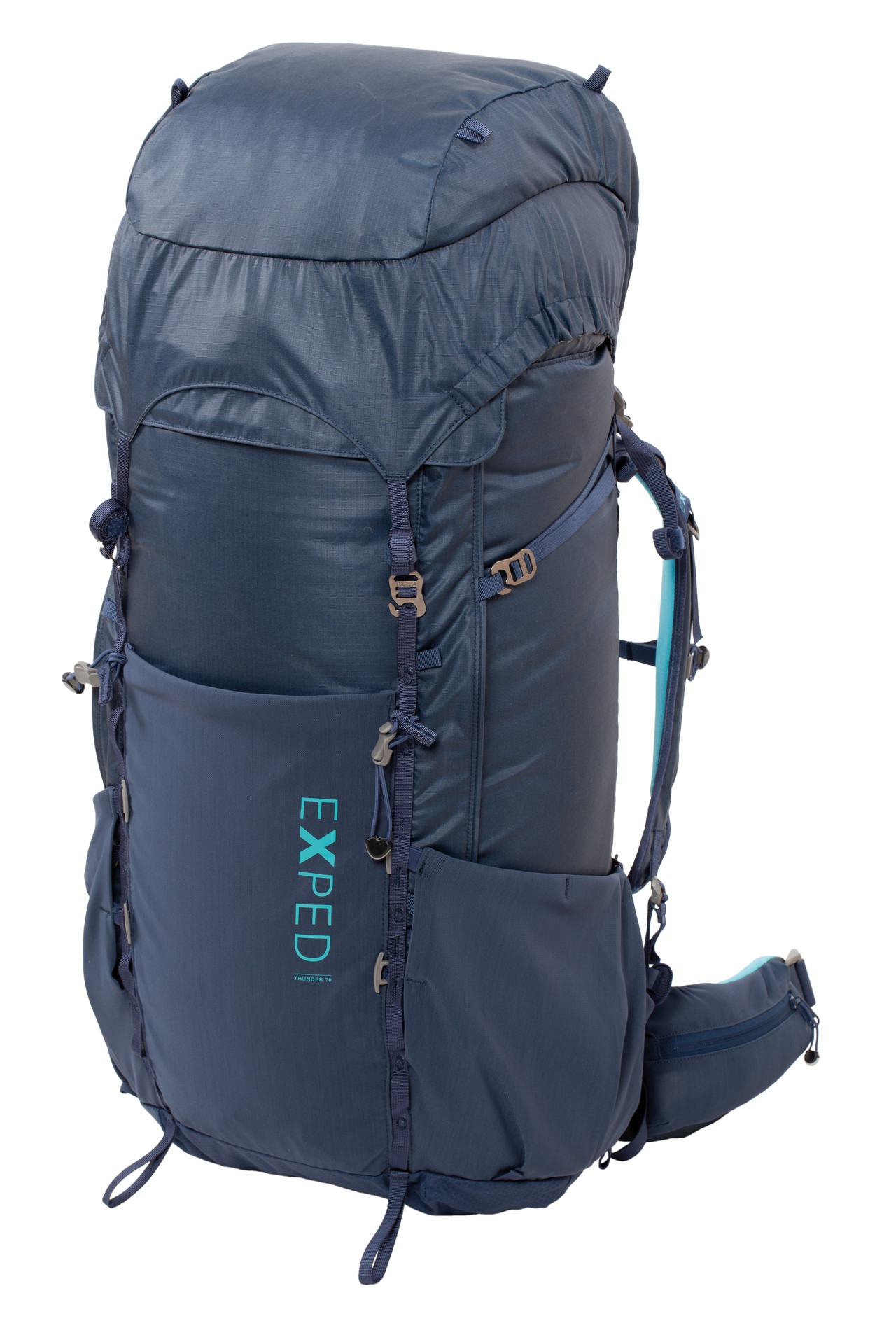
Overview
The Exped Thunder 70 is a versatile trekking backpack with excellent load transfer — and in relation to its volume and features, it keeps the weight impressively low for multi-day touring or longer treks.
The Thunder range sits between Exped’s seriously beefy Expedition packs and the much lighter Lightning range
, making it the middle-ground choice for hikers who need high capacity and load-bearing structure without the full penalty of an expedition frame. It targets winter backpackers, heavy resupply stretches on long trails, and anyone who regularly hauls 12–20kg.
Key Specs
| Spec | Value |
|---|---|
| Weight | 1,600g (3 lbs 6 oz) |
| Volume | 70L |
| Material | Recycled 210D Robic ripstop nylon, PU coated (1,500mm water column), Oeko-Tex 100, PFAS-free |
| Frame | Single 6061-T6 aluminum stay, height-adjustable |
| Access | Top (drawstring + spindrift collar), front panel (dual YKK zippers), side loading |
| Torso Range | 41–58 cm (height-adjustable) |
| Dimensions | 84 × 36 × 29 cm |
| Max Recommended Load | ~24 kg |
| Pockets | 2 side stretch, 1 front stretch, 2 lid (inner + outer), 2 hip belt |
| Attachment Points | Daisy chains, 2 ice tool / trekking pole loops, 4 base loops |
Would the Thunder 70 earn its spot in your pack?
1600 g · 56.4 ozAdd the Exped Thunder 70 to your gear closet and see exactly what it does to your base weight — then build your next packing list around it. Free, in about two minutes.
Free · No credit card · iOS & Android · Trusted by 3,000+ backpackers
Performance
Load Carry and Suspension
The Thunder 70’s calling card is its suspension-to-weight ratio. At 1,600g it sits in the lightweight category for a 70-litre pack, while the back system — anchored by one aluminum stay running down the middle of the panel — links with a shoulder yoke adjustable for your torso length at the top, and channels weight down into an ergonomically shaped foam hip belt at the bottom. The padding arrangement manages to keep the middle of the back panel just off your spine, so you get a little airflow too.
The hip belt is consistently the most-praised feature. Multiple users note it as “super comfortable” and never a struggle to cinch, contrasting it favorably with stiffer belts on competing packs. The system is effective enough to manage loads of up to around 24kg, though that’s very much the upper ceiling.
There’s a real asterisk on the shoulder straps, though. The pack carries loads to about 15kg well, but beyond that the shoulder straps become the limiting factor — they’re a bit thin and have limited padding, and by the second week of a hard trail carry, shoulders were feeling the strain even with most weight transferred to the hips. This is the single most consistent complaint across reviewers. If you’re regularly hauling 18–20kg for weeks at a time, you’ll want to try these straps on with a loaded pack before committing.
Access
The Thunder 70 combines top-loading simplicity with the organizational ease of a panel loader.
You can go in through the classic drawstring entry under the lid, or use the dual zips running down either side of the front, allowing straight access to the main compartment — and those zips are covered by wired storm flaps, though there’s no internal storm flap.
In practice, most users report relying on the top opening and treating the front panel as a bonus for travel or layered packing scenarios.
On a long hiking trip it’s easy to never need the front zip if you pack logically; but for general travel — pulling out mid-layer clothing buried lower in the bag — it’s a genuinely useful feature.
The side-loading option also lets you slide long items (sleeping pads, tent poles) in without fully unpacking the top.
Weather Resistance
The pack is made from hard-wearing ripstop nylon coated in PU and is water-resistant, but the pack itself is not seam-taped.
In practice,
the zipper access is well battened down and didn’t noticeably reduce weather resistance in heavy rain, but in sustained driving rain, some water does eventually penetrate. A pack liner or dry bags should be used whenever rain is expected.
That’s standard advice for most packs in this class, but it’s worth stating plainly: don’t expect to skip the liner on a wet-weather expedition.
Organization and External Storage
The extendable lid has two zippered pouches, each large enough for a puffy or a substantial lunch — and removing it altogether saves around 8 oz.
The pack has two tiers of compression straps including a set that threads through the water bottle pockets, so compression still works with a bottle in place — and the straps are long enough to hold snowshoes on the side of the pack, though that makes side pocket access difficult.
One weak point: the side stretch mesh pocket bottoms are not reinforced with additional fabric and are prone to tearing when brushing through dense vegetation.
If you’re doing heavy brush or off-trail travel, this matters.
Exped uses aluminum hooks to secure webbing rather than plastic buckles
— they’re more durable but take a session or two to become second nature.
It takes a bit of getting used to the hook system compared to quick-release buckles, but once you get the strap keepers dialed, there are no flapping loose ends on the trail.
Pros & Cons
Pros
- Genuinely competitive weight for a structured, full-featured 70L pack
- Outstanding hip belt comfort and load transfer
- Three access modes (top, front panel, side) add real versatility
- Height-adjustable suspension fits a wide range of torso lengths (41–58cm)
- Daisy chains, base loops, ice tool/pole loops ready for technical and winter use
- Removable lid (save ~8 oz when not needed)
- Recycled fabric; PFAS-free and Oeko-Tex 100 certified
- Velcro strap keepers keep webbing tidy and out of your face
Cons
- Shoulder straps are noticeably thin and under-padded for loads above ~15kg
- Not seam-taped; requires a pack liner or cover in sustained rain
- Side pocket mesh bottoms vulnerable to abrasion from vegetation
- Suspension adjustment system is functional but takes some initial fiddling
- At 1,600g, it’s firmly in “lightweight” territory — not a choice for the gram-counting ultralight crowd
- Dark interior colorways make finding gear awkward without a headlamp
Who Should Buy This
The Thunder 70 is a strong fit for four-season trekkers and mountaineers who need a high-capacity, durably built pack that won’t destroy them on the scale. It excels on winter routes, food-heavy stretches of long trails, and base camp approaches where loads routinely push 15kg. It would make a solid choice for long-range routes like the Colorado Trail or a CDT thru-hike, where rugged durability and multiple access options matter. It’s less compelling for UL-minded three-season hikers who can keep base weight under 10 lbs — at that point, the frame and structure are more liability than asset.
Verdict
The Exped Thunder 70 delivers an unusually good balance of weight, structure, and access options for a 70L pack. Its blend of useful but not over-the-top features and comparatively low weight makes it an attractive choice for winter backpacking, and it has a good feature set for summer trekking too. The thin shoulder straps are a real limitation under heavier loads, and the lack of seam-taping means you need to manage waterproofing yourself — two issues Exped could fix without breaking the design. At 7.5/10, it’s a pack worth serious consideration for anyone who needs high volume with a minimal frame penalty, as long as you go in knowing its limits.