Eagle Creek Pack-It Isolate Compression Cube Review
Eagle Creek's Pack-It Isolate Compression Cube squeezes clothing flat with a second zipper at 54–82 g, but it suits travel-style loads more than minimalist thru-hikes.

Overview
The Pack-It Isolate Compression Cube is a thin, translucent nylon packing cube with a second zipper that cinches around the perimeter and flattens the contents. It was designed for suitcases, but its weight, 54 g for the Small and 82 g for the Medium, puts it within reach of backpackers who carry a lot of soft goods: big down jackets, spare clothing for town stops, or a full change of camp layers. The trade-off is familiar to anyone who has weighed a stuff sack against a cube: this one is organized and tidy, but it is not the lightest way to carry clothes.
Key Specs
| Spec | Detail |
|---|---|
| Weight | 54–82 g depending on size |
| Material | 100% ocean-recycled 70D nylon, PU1, C0 DWR, made without PFCs/PFAS |
| Compressed size (S) | 10 x 7 x 1 in |
| Expanded size (S) | 10 x 7 x 3 in |
| Compressed size (M) | 14 x 10 x 1 in |
| Expanded size (M) | 14 x 10 x 3 in |
| Capacity (S) | 1 L compressed / 3 L expanded |
| Capacity (M) | 2 L compressed / 7 L expanded |
| Closure | Angled main zipper plus perimeter compression zipper |
| Extras | Top handle, easy-grab zipper pulls, translucent fabric |
| Price | $25 (S), $30 (M), $50 (S/M set) |
Versions compared
| Image | Version | Weight | vs. lightest |
|---|---|---|---|
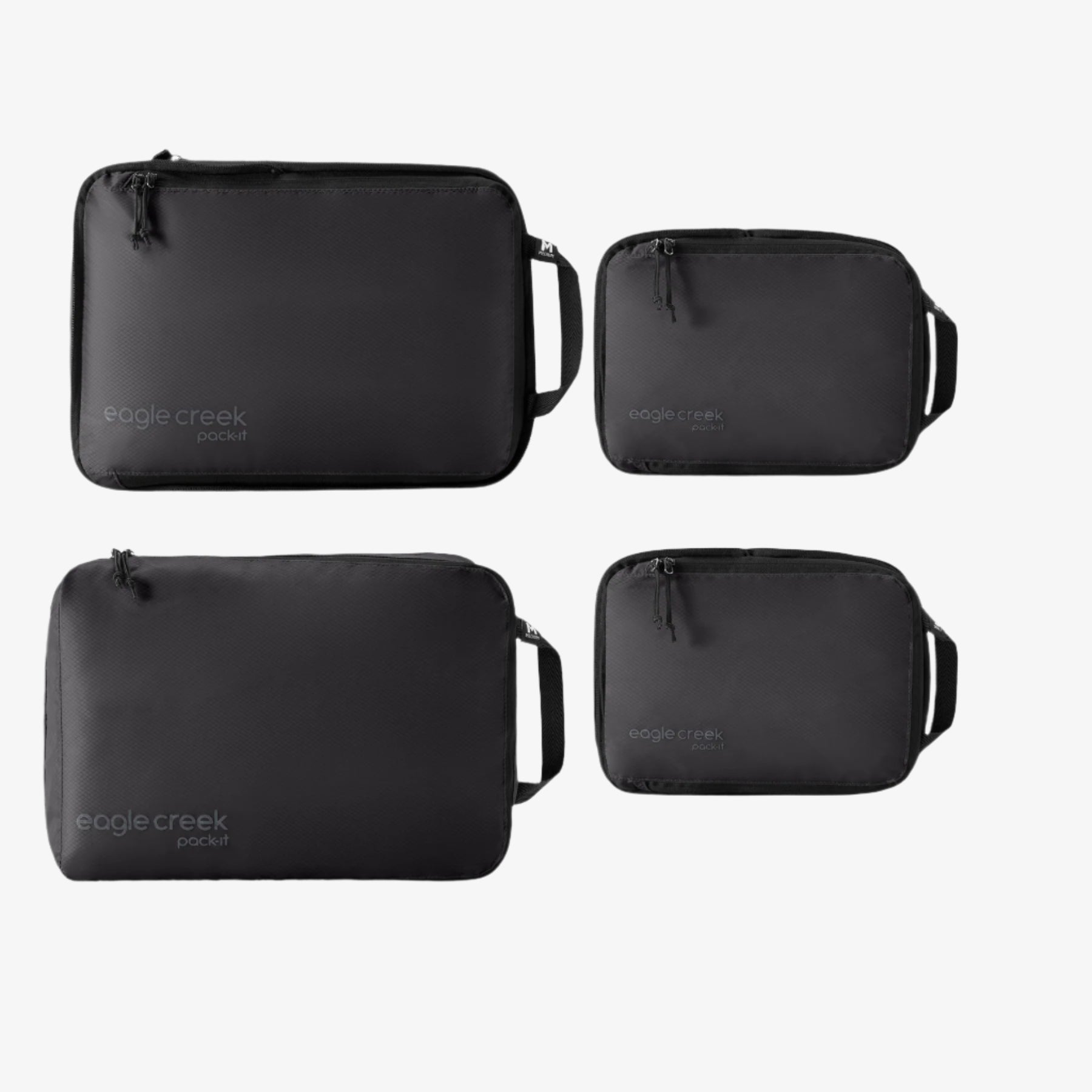 | Small | 54 g (1.9 oz) | lightest |
| Medium | 82 g (2.9 oz) | +28 g |

Would the Pack-It Isolate Compression Cube earn its spot in your pack?
82 g · 2.9 ozAdd the Eagle Creek Pack-It Isolate Compression Cube to your Gear Closet and see exactly what it does to your base weight, then start packing for your next trip.
Free · No credit card · iOS, Android & web · Trusted by 3,000+ backpackers
Performance
Compression. The cube’s party trick is the second zipper. Fill the cube, close the angled main zipper, then run the compression zipper around the edge. Air squeezes out and the cube drops from 3 inches of loft to roughly 1. Reviewers at Matador Network praised the strength of that zipper and noted that a small pull tab next to it helps with leverage on a full cube. Pack Hacker’s testers, who scored the Isolate line 8.0 out of 10, called the compression system effective and the zippers reliable.
Compression here is mechanical rather than magical. It flattens soft, lofty items such as T-shirts, fleece, swimwear and a down layer. It will not shrink a sleeping bag the way a strap-based compression sack does. Travel and Time makes a related point about the brand’s cubes in general: compression saves volume, not weight.
Weight and fabric. Eagle Creek calls the 70D recycled nylon its lightest packing cube material, and travel experts quoted by NBC Select describe the Isolate cubes as among the lightest on the market. The translucent fabric lets owners see what is inside without unzipping. Pack Hacker found the fabric durable enough for travel knocks, though a bit crinkly and loud when empty. The same testers noted some loose threads on day one. The zippers drew better marks: smooth and sturdy-feeling enough to last.
Organization. The angled zipper opening opens clamshell-style, so a cube can be packed flat from above rather than fed through a small hole. That helps when stacking or rolling shirts and trousers. A top handle makes the cube easy to pull out of a duffel or the bottom of a pack. The water-resistant coating gives some protection against spray and damp, but the cube is not a dry bag. The zipper is not waterproof, and it should not be trusted to keep a down jacket dry through a day of rain.
On trail. A zippered cube is a poor match for a thru-hiker whose entire kit is a puffy, a rain shell and a spare pair of socks. A basic stuff sack does that job in fewer grams, and it usually compresses a down jacket harder. The Isolate cubes make more sense when the load is larger: a week of clothes for a trip that mixes trail and town, a bear-canister-limited pack where flat packing matters, or a family trip where every person’s clothes need a separate home. The Medium’s 7 L expanded volume is generous for that kind of duty. The Small, at 54 g and 1 to 3 L, is closer to backpacking scale and fits a down vest, base layer or sleep clothes.
Durability and price. Eagle Creek backs its gear with its No Matter What warranty, which Travel and Time describes as a lifetime guarantee covering damage as well as manufacturing defects. At $25 for the Small and $30 for the Medium, the cubes cost considerably more than generic packing cubes and far more than a basic stuff sack. Pack Hacker’s reviewers noted they are less cost-effective than earlier versions of the line. Owners on Eagle Creek’s own site rate the Medium 4.9 out of 5, with comments centering on build quality and compression.
Choosing a Version
Small (54 g). Measures 10 x 7 x 3 in expanded and 10 x 7 x 1 in compressed, with 1 L of capacity when squeezed and 3 L when full. Eagle Creek lists lightweight tops, T-shirts, swimwear and down vests and jackets as its use cases. This is the version for backpackers: a sleep-clothes bundle, a puffy, or a socks-and-underwear kit.
Medium (82 g). Measures 14 x 10 x 3 in expanded and 14 x 10 x 1 in compressed, holding 2 L compressed and 7 L expanded. It handles trousers, multiple shirts and bulkier down jackets. That makes it a better fit for travelers with a duffel or a 40 L-plus pack, and for hikers combining a trail section with a few days of city clothes. On a typical ultralight pack, it takes up a lot of room.
The set. Pairing both sizes costs $50, saving $5 over buying them separately, and weighs 136 g in total.
Pros & Cons
Pros
- Light for a compression cube: 54 g (Small) and 82 g (Medium)
- Perimeter zipper flattens clothing from about 3 in to about 1 in
- Angled clamshell opening makes packing and retrieving clothes easy
- Translucent fabric shows contents at a glance
- Recycled 70D nylon made without PFAS, with water-resistant treatment
- Backed by a lifetime warranty that covers damage
Cons
- Heavier than a stuff sack or dry bag for the same job
- Compresses soft goods, but not as tightly as a strap-style compression sack
- Water-resistant, not waterproof
- Crinkly fabric, and some testers found loose threads out of the box
- Expensive at $25–$30 per cube
Who Should Buy This
The cube is for hikers and travelers who carry more clothing than a thru-hiker’s base-weight list allows. Think section hikers with a town day, bikepackers, or anyone moving between a backpack and a suitcase. It is also for people who value a tidy pack and can easily find what they need. Gram-counting thru-hikers, and anyone who needs real waterproofing for insulation or a sleeping bag, should look at a sil-nylon stuff sack or a roll-top dry bag.
Verdict
The Pack-It Isolate is among the better compression cubes for light packers, with a strong zipper, a useful opening and a warranty to match. It is a travel organizer first and an ultralight tool second, and at its price a simple stuff sack is the better deal for a stripped-down kit. Buy the Small for a down layer and the Medium for mixed trail-and-town trips.