Big Agnes Prospector 50L Review
Big Agnes's Prospector 50L pairs a cored aluminum perimeter frame with duffel-style back access. It carries well, but it's heavier than true ultralight packs.
Overview
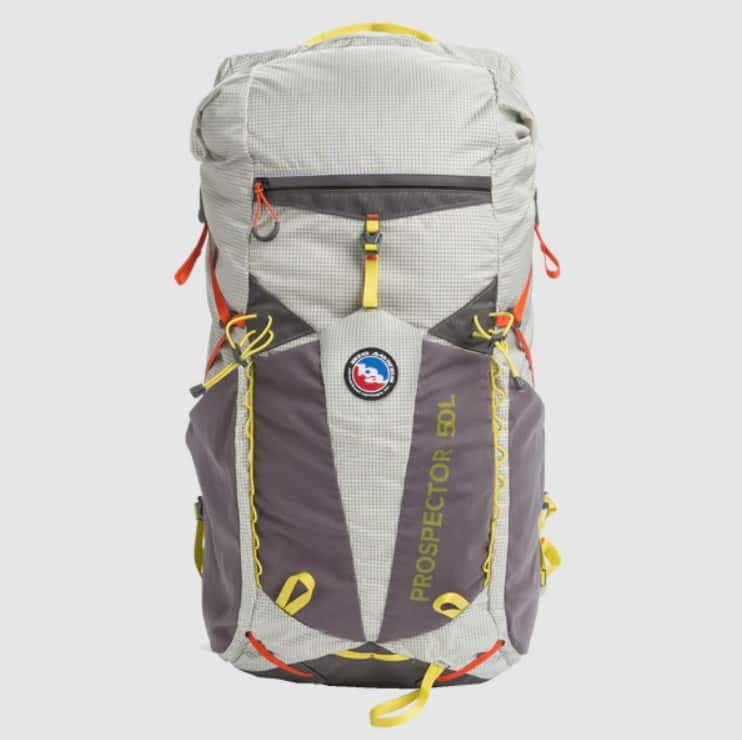
The Prospector 50L was Big Agnes’s first serious entry in the backpack market. It’s a 50-liter overnight and weekend pack with a roll-top, a full-zip back panel for duffel-style access, and a cored aluminum perimeter frame. It suits hikers who want a stable, well-organized carry at a moderate weight. The trade-off is that at roughly 1.4 kg it sits well above the cottage-industry frameless packs.
Key Specs
| Spec | Detail |
|---|---|
| Weight | 1,399 g |
| Volume | 50 L (3,051 cu in) |
| Frame | Cored aluminum perimeter frame |
| Suspension | Load Wrangler body-mapped foam back panel, Open Range Hip Belt |
| Compression | Hoist Compression System |
| Main fabric | Mipan recycled nylon |
| Access | Roll-top plus full-zip back panel |
| Hydration | Internal 3 L reservoir sleeve with hose port; reservoir not included |
| Pockets | Two stretch-mesh side pockets, zippered front pocket, stretch front pocket, two removable hip pockets (1.6 L total), removable 7 L “Trash Can” |
| Attachment | Daisy chains, ice axe and trekking pole loops |
| Recommended max load | 40 lb |
| Sizes | Men’s medium and large (women’s equivalent is the Sun Dog 45) |

Would the Prospector 50L earn its spot in your pack?
1399 g · 49.3 ozAdd the Big Agnes Prospector 50L to your Gear Closet and see exactly what it does to your base weight, then start packing for your next trip.
Free · No credit card · iOS, Android & web · Trusted by 3,000+ backpackers
Performance
Carry and load transfer. The Prospector’s strength is how it handles weight. The Open Range Hip Belt threads behind the Load Wrangler back panel to send load toward the lumbar, and the Hoist system pulls the load inward and upward. Reviewers at Ultralight Outdoor Gear, a UK retailer whose guide-photographers carry heavier-than-average kits, tested it on long approaches in the Cairngorms and along steep ridgelines on Arran. They called it one of the most comfortable packs they’d used in recent years. With multiple days of kit aboard, it never felt strained, even on boulder sections and short scrambles. A Backcountry buyer who logged roughly a dozen big outings credited the stiff back panel and the many cinch points with spreading load so well that the pack seemed to carry lighter than its contents.
Comfort, with caveats. Not everyone is convinced. Wilderness Magazine in New Zealand rated overall comfort as average and found the molded back panel not to its taste. It did praise the hip belt: well padded, with dual buckles for fine tuning, and no pressure points under a heavy load. The back length can’t be adjusted, which the magazine flagged as a possible deal-breaker. The full-zip panel is the likely reason. Fit therefore depends on picking the right size the first time. Ventilation is modest too. The UK testers used it in cooler months and noted it could get sweaty in warm weather.
Fit for smaller frames. Owners on the narrower end report mixed results. One 5’9” reviewer with a size medium said the fit was perfect. A commenter at 5’10” and 150 lb said the hip belt wouldn’t cinch tightly enough to sit on his iliac crests. Slim hikers should try the belt before committing.
Access and organization. The duffel-style back zip is the pack’s best trick. It lets hikers reach items at the bottom without unpacking from the top, and one Wilderness Magazine reviewer called it a boon for packing and organization. The side stretch pockets are generous enough that the UK testers said the pack felt larger than its 50 liters. A Colorado Trail-bound owner reports pulling Smartwater bottles from the side pockets while walking. The hip pockets, 1.6 L combined, swallow a phone and snacks, or a map, compass and locator beacon. The tradeoff is that bottle access can be awkward for some users. One owner called it his main complaint, though the large pockets and the bladder sleeve softened it.
Durability and weather. The recycled nylon and webbing earned praise for toughness. The UK reviewers described even the mesh sections as sturdy, and one owner who put 50 miles on it over hilly terrain says it stays planted and looks durable. No rain cover is included, so a pack liner or separate cover is needed. The roll-top helps, but the full-length back zipper is not a place to trust in a downpour without a liner.
Weight. The claimed weights are about 3 lb 1 oz for the medium and 3 lb 3 oz for the large. Wilderness Magazine lists 1,450 g and points out that this is more than half a kilogram heavier than ultralight alternatives. Both the UK testers and Wilderness say the extra grams buy a padded harness and tough fabrics. The Prospector is a lightweight pack by traditional standards and a heavy one by the standards of the r/Ultralight crowd.
Pros & Cons
Pros
- Aluminum perimeter frame and Hoist compression carry loads steadily, including over rough ground
- Full-zip back panel gives duffel-style access to the whole interior
- Big stretch pockets and removable hip pockets make for easy on-the-move storage
- Tough recycled nylon and wide webbing hold up
- Removable 7 L Trash Can and internal 3 L reservoir sleeve with hose routing
Cons
- At about 1.4 kg, it’s well above frameless ultralight packs
- Back length isn’t adjustable
- Molded back panel isn’t to everyone’s taste and ventilates modestly
- Hip belt may be loose on very slim hikers
- No rain cover included, and the back zipper is an extra water path
- Roughly $430 at launch in some markets, which is a lot for a first-generation pack (price per Wilderness Magazine)
Who Should Buy This
This is a pack for hikers who carry 25 to 35 lb at the start of a trip and want a frame that stays stable at that weight. It suits weekend peak-baggers, hikers in transition from a 3 lb-plus pack, and anyone tired of digging for gear through a roll-top. Thru-hikers with base weights under 10 lb should look to frameless or minimal-frame designs, which save 400 g or more. Those with narrow waists should try the hip belt first. Hikers who want to adjust torso length should also look elsewhere.
Verdict
The Prospector 50L is a well-built, load-stable pack with a back-access design few ultralight options match. Its weight and non-adjustable back length keep it out of the true ultralight category, and fit will make or break it for some hikers. For a moderate-weight overnighter or weekender who values access and support over grams, it’s a strong choice.