Berghaus Freeflow II 35+8 Review
A ventilated, frame-heavy UK hillwalking pack that trades weight for a genuinely sweat-free back — here's how it holds up against ultralight expectations.
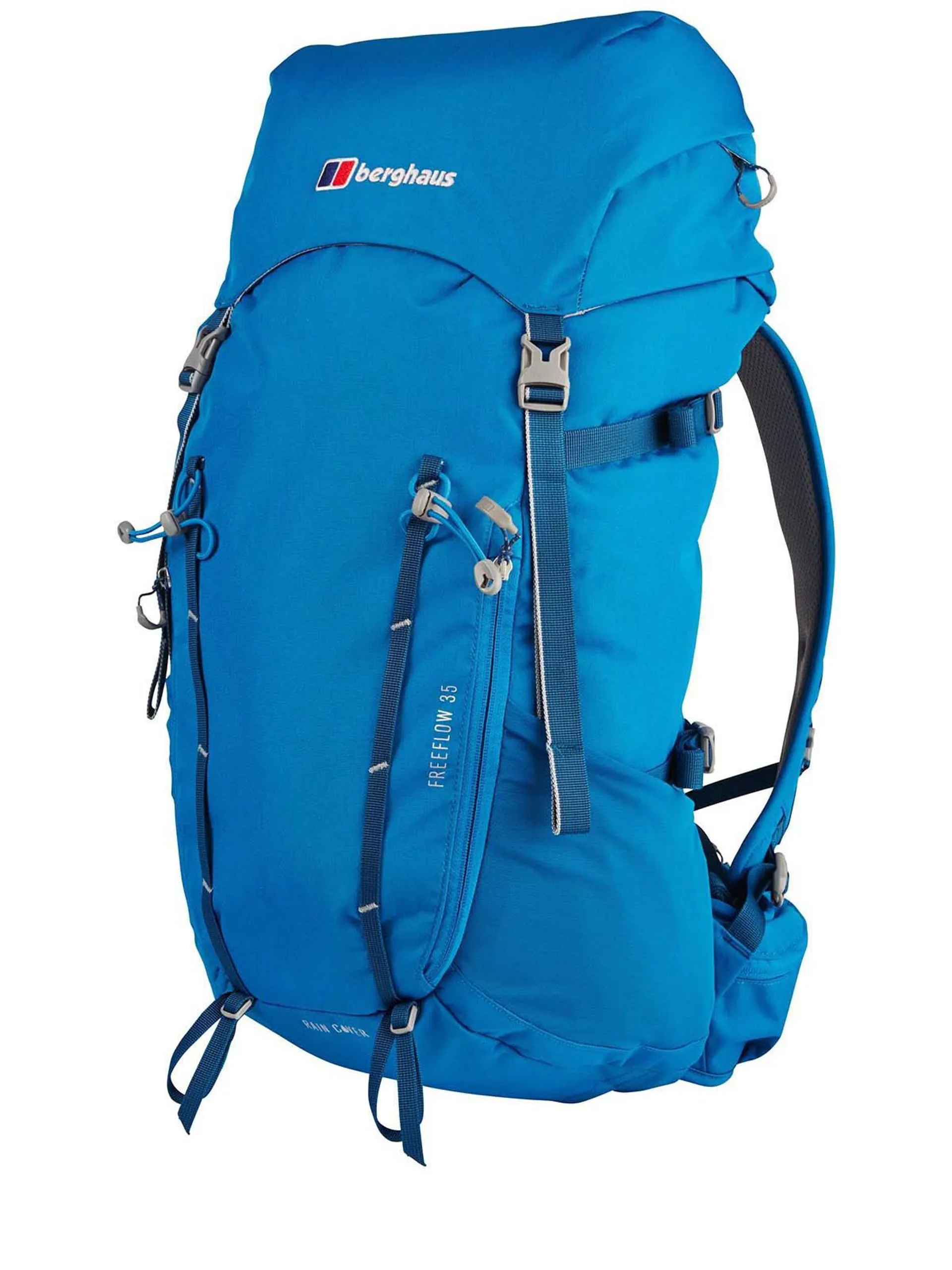
Overview
The Freeflow II 35+8 is Berghaus’s take on a ventilated day-and-a-half pack, built around a rigid plastic framesheet and a mesh back panel that holds the bag off your spine. It’s a long-running UK hillwalking staple rather than a thru-hiking pack, and it’s aimed at day hikers, Munro-baggers, and casual scramblers who’d rather carry an extra half-pound of frame than deal with a sweaty back. If you’re chasing a sub-2-lb base weight pack, this isn’t it — but it’s worth understanding what it does well before writing it off.
Key Specs
| Spec | Value |
|---|---|
| Capacity | 35+8L (43L total via side pocket expansion) |
| Weight | 1,450 g (3.2 lb) |
| Dimensions | 63 x 34 x 27 cm |
| Frame | Rigid plastic framesheet + metal “hourglass” stay |
| Back system | Freeflow mesh, fixed air gap |
| Rain cover | Included, stored in dedicated pocket |

Build your Gear Closet
View all of your gear in one place, create packing lists and hit the trail with confidence. Available on iOS, Android and the web.
Get StartedPerformance
The whole point of the Freeflow system is the gap it creates between the mesh panel and your back, and by most accounts it actually delivers on that. Its firm frame keeps it off of your back, avoiding that cold sweaty area where most rucksacks rest on you. That’s the pack’s one unambiguous win — if a soaked back is your main complaint with backpacks, this addresses it directly.
The trade-off is stability. Having little material in contact with your back helps with ventilation and cooling, but with heavier loads it can make the pack more unstable than others. That instability shows up specifically on technical terrain: multiple UKClimbing forum users reported that the Freeflow helps stop your back getting drenched in sweat, but it really throws off your centre of gravity for scrambling and climbing, taking a while to get used to. Another climber put it more bluntly — the weight sits too far back and pulls you off balance compared to traditionally seated packs (per UKClimbing forum posts). If your hikes involve any scrambling, helmet use, or off-trail balance work, factor that in; one climber even noted the loaded hood was bulky enough behind their head that it interfered with looking up while wearing a climbing helmet, per UKHillwalking forum discussion.
Packing is the other recurring gripe. The Freeflow features an incredibly sturdy frame in the form of a plastic framesheet — super strong and rigid so it’ll support heavy weights, but its inability to bend means you’ll struggle to pack this into a larger travel bag. Because the frame has a built-in curve to create the air gap, you’re loading gear around a bend rather than straight down, which several owners flagged as fiddly — one forum poster went as far as comparing it to “packing round a corner essentially.” The framesheet also means the +8L expansion doesn’t come from vertical compression — the freeflow frame won’t compress vertically since there’s a coated metal hourglass skeleton attached to the backboard, though there’s a little springy play; most of the +8 expansion comes from the full-length zipped side pockets instead.
On the organization side, it’s a genuinely thoughtful daypack layout. The main pocket capacity of 35 litres puts it in large-daypack territory rather than backpacking-pack territory — long and thin due to the Freeflow system, but big enough for a day’s clothing, lunch, and emergency snacks, with an extra base pocket for waterproofs and quick-access items linked to the main compartment by a zipper. The hood is large enough to take an SLR camera and reachable on the move, with an internal zippered pocket for valuables. Build quality on the strap retainers, D-rings, and compression webbing gets consistent praise — closure is via a drawstring and toggle plus sturdy webbing compression straps, and it all feels well built with nice finishing touches.
Durability is where reports get genuinely mixed. Several long-term owners (via forums like The Windy Munro and UKHillwalking) reported years of trouble-free daily use, but there’s a persistent thread of zip failures — one UKHillwalking poster said their 35+8 only lasted a year before they had to replace the zips after six months, and another mentioned a returned unit where all the zips had gone and a strap broke after only one trip. That’s not universal, but it’s common enough across independent threads to flag as a real risk, especially on packs bought secondhand or well-used.
Pros & Cons
Pros
- Genuinely effective ventilation — keeps your back noticeably drier than a standard panel-loader
- Sturdy, well-finished build with a full-length side zip, base access pocket, and camera-friendly hood
- Includes a proper rain cover with its own storage pocket
- +8L expansion via side pockets adds real flexibility for overnight or long-day loads
Cons
- At 1,450 g for 43L, it’s roughly double the weight of comparable ultralight packs
- Rigid, curved framesheet makes packing more awkward than a straight-loading pack
- Doesn’t compress vertically, so a half-empty pack stays bulky
- Shifts center of gravity backward — a real liability for scrambling, climbing, or uneven terrain
- Multiple independent reports of zip and strap failures within the first year of use
Who Should Buy This
This is a pack for UK hillwalkers and day-trippers who run hot and prioritize a dry back over gram-counting — think Munro-baggers, mountain bikers, or casual multi-day walkers doing straightforward trail miles. It’s a poor match for anyone doing technical scrambling, climbing approaches, or serious thru-hiking, where the rearward weight bias and lack of packability become real problems rather than minor quirks.
Verdict
The Freeflow II 35+8 does exactly one thing well — keeping your back dry — and does it at the cost of weight, packability, and balance. For ultralight or thru-hiking use it’s a hard pass, but as a budget-friendly ventilated daypack for hot-weather UK hillwalking, it’s earned its long production run for a reason. I’d rate it a 5.5/10 for this audience specifically; bump that up a couple points if ventilation is your single biggest pack complaint and weight isn’t.