Zpacks Large Food Bag Review
A 43g DCF roll-top food bag designed for 5–6 day carries — ultralight, water-resistant, and a thru-hiker staple, with a few real-world caveats to know.
Overview
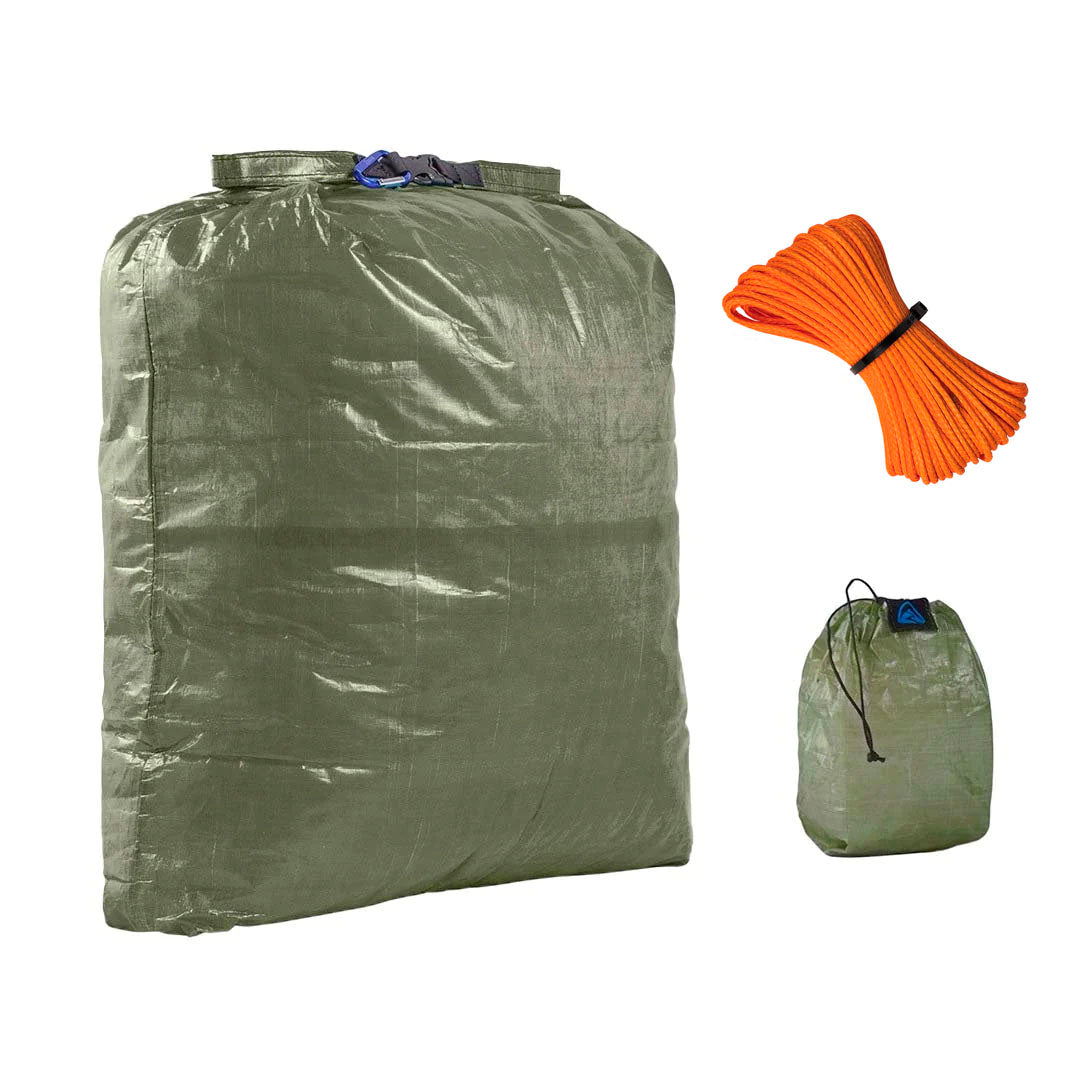
The Zpacks Large Food Bag is a 14-liter, roll-top stuff sack made from 1.6 oz/sqyd Dyneema® Composite Fabric (DCF), built specifically to handle the rigors of bear bagging and multi-day food carries. At 43g (1.52 oz), it’s about as light as a dedicated food bag gets without resorting to a plain kitchen bag. It’s aimed squarely at thru-hikers and long-distance backpackers who need enough space for 5–6 days of resupply and want something that can take a beating on the way up and down a bear hang night after night.
Key Specs
| Spec | Value |
|---|---|
| Weight | 43g (1.52 oz) |
| Material | 1.6 oz/sqyd Dyneema® Composite Fabric |
| Volume | 14L / 850 cu in |
| Flat Dimensions | 16.75” W × 20” H |
| Full Dimensions | 11” W × 6” D × 13” H |
| Food Capacity | 5–6 days |
| Seams | Fully taped |
| Closure | Roll-top with stiffened collar + carabiner loop |
| Includes | Carabiner |
| Warranty | 2-year limited |

Would the Large Food Bag earn its spot in your pack?
43 g · 1.5 ozAdd the Zpacks Large Food Bag to your Gear Closet and see exactly what it does to your base weight, then start packing for your next trip.
Free · No credit card · iOS, Android & web · Trusted by 3,000+ backpackers
Performance
Fabric and construction. The food bags are made from thicker 1.6 oz/sqyd Dyneema® Composite Fabric to stand up to the abuse of bear bagging and to resist abrasion from heavy, pointy food items. For context, the regular Zpacks dry bags use thinner 1.0 oz/sqyd material — so this is a meaningfully heavier spec, not just marketing copy. The 1.6 oz/sqyd DCF is thicker and stronger than their other stuff sacks to resist abrasion and punctures. Seams are fully taped, and the food bags will keep water out in typical backpacking conditions where the bag is not submerged. That’s a practical, honest claim — don’t expect a river crossing to go well, but rain and damp shelters are no issue.
Closure system. The bags have a stiffened opening to make rolling the top down easy and secure, and you can squeeze out the air and roll down the top to compress your gear as needed. A carabiner is included for hanging the bag from a loop near the roll top. The stiffened collar is a genuinely useful detail — floppy DCF openings are a recurring annoyance on lesser sacks, and this one stays open when you’re rummaging around at the end of a long day.
Capacity and fit. The rectangular shape fits well in all Zpacks backpacks, either standing vertically or sideways depending on the pack volume, and the wide opening makes it easier to dig through the bag and find what you need. That last point matters more than it sounds. I’ve used long, tubular food bags that require unpacking half your snacks to reach the bar you actually want — the wide rectangular opening on this bag is a real quality-of-life win. One experienced user called it “probably the most expensive per-ounce item” they bought, but praised the capacity and the wide opening versus long skinny bags that require emptying to reach items at the bottom.
Bear hanging and rodent resistance. The fabric is strong enough to discourage most small rodents, but the bag should still be hung out of reach overnight. DCF is pretty durable, but it is still no match for hungry bears — it may deter rodents, but with enough time, persistent pests can still chew through. This is not an Ursack. The bag’s effectiveness as food protection is entirely contingent on a well-executed hang. If you’re in a corridor with heavy bear pressure — Yosemite Valley, parts of the Sierras — you’ll need a certified canister or IGBC-approved bag regardless. For thru-hikes on the Pacific Crest Trail or Arizona Trail, where bears are a more sporadic threat, the weight savings could very well be worth the lack of certification.
Odor. DCF doesn’t block scent — worth knowing up front. Lining the food bag with an odor-resistant layer will significantly help keep it off the olfactory radar of any furry forest dwellers; LOKSAK OPsak liners are a popular choice among backpackers for being lightweight, reusable, and reliable. If you’re in serious bear country, budget for an OPsak insert.
Long-term durability. One veteran thru-hiker reported being on their second Zpacks food bag, having completed multiple thru-hikes with each — the first lasted about 5,000 miles before being deemed too deformed, de-laminated, and full of holes. Five thousand miles is a serious run for any piece of gear, and that’s a reassuring data point. That said, as is common with DCF food bags, there is noticeable stretching and warping around the collar over time, due to the collar being rolled and then hung under weight. Purely cosmetic in most cases, but it’s the nature of the material under load.
Trail ubiquity. It’s almost comical to open an AT shelter bear box and see dozens of these blue food bags crammed inside — they’re at the top of ubiquitous thru-hiker gear, making it hard to distinguish which one is yours in a crowd. A minor gripe, but if you share shelters regularly, a piece of tape or a color-coded carabiner helps. Zpacks does sell silicone color-band identifiers separately for exactly this reason.
Pros & Cons
Pros
- At 43g, it’s exceptionally light for a purpose-built, 14L food bag
- 1.6 oz/sqyd DCF is meaningfully tougher than standard Zpacks dry bag material
- Fully taped seams provide reliable water resistance in real conditions
- Stiffened collar and wide rectangular opening make packing and rummaging practical
- Rectangular shape packs cleanly in most ultralight packs, vertically or sideways
- Carabiner included — ready to hang out of the box
- Proven multi-thru-hike durability, with reports of 5,000+ miles of use
- Available as part of a Bear Bagging Kit with cord and rock sack
Cons
- Not bear-resistant; effectiveness depends entirely on hang quality and location
- Not odor-proof — a pairing with an OPsak liner adds cost and weight (though minimal)
- Ubiquitous blue color means yours will look like everyone else’s at busy shelters
- DCF collar stretches and warps over time under bear-hang loads
- Price-per-ounce is high compared to silnylon or Opsak-only solutions
- Not appropriate for areas requiring certified bear-resistant storage (no IGBC certification)
Who Should Buy This
This bag is a natural fit for thru-hikers and long-distance backpackers who are comfortable with bear hangs, operate primarily outside of mandatory-canister zones, and want to minimize system weight without sacrificing durability. It’s particularly well-suited to AT, PCT (outside the Sierra), CDT, and similar corridor trails where bear boxes or hang-friendly trees are reliably available. If you’re new to bear hangs or frequently travel in high-pressure grizzly or black bear areas, consider pairing this with an OPsak liner or upgrading to a certified bag like the Ursack AllMitey for higher-consequence situations.
Verdict
The Zpacks Large Food Bag has earned its place as the de facto food bag for serious thru-hikers — not through marketing, but through years of proven performance across long-trail miles. It’s not a replacement for certified bear-resistant storage where regulations demand it, and it doesn’t block odors on its own. But for what it is — a tough, ultralight, water-resistant hang sack that fits your pack cleanly and lasts thousands of miles — it’s hard to argue against it. Rating: 8.5/10.