Gossamer Gear Lightrek Hiking Umbrella Review
Gossamer Gear's 164 g chrome Lightrek is a full-size trekking umbrella that thru-hikers rely on for desert shade, with limits in wind and thick brush.
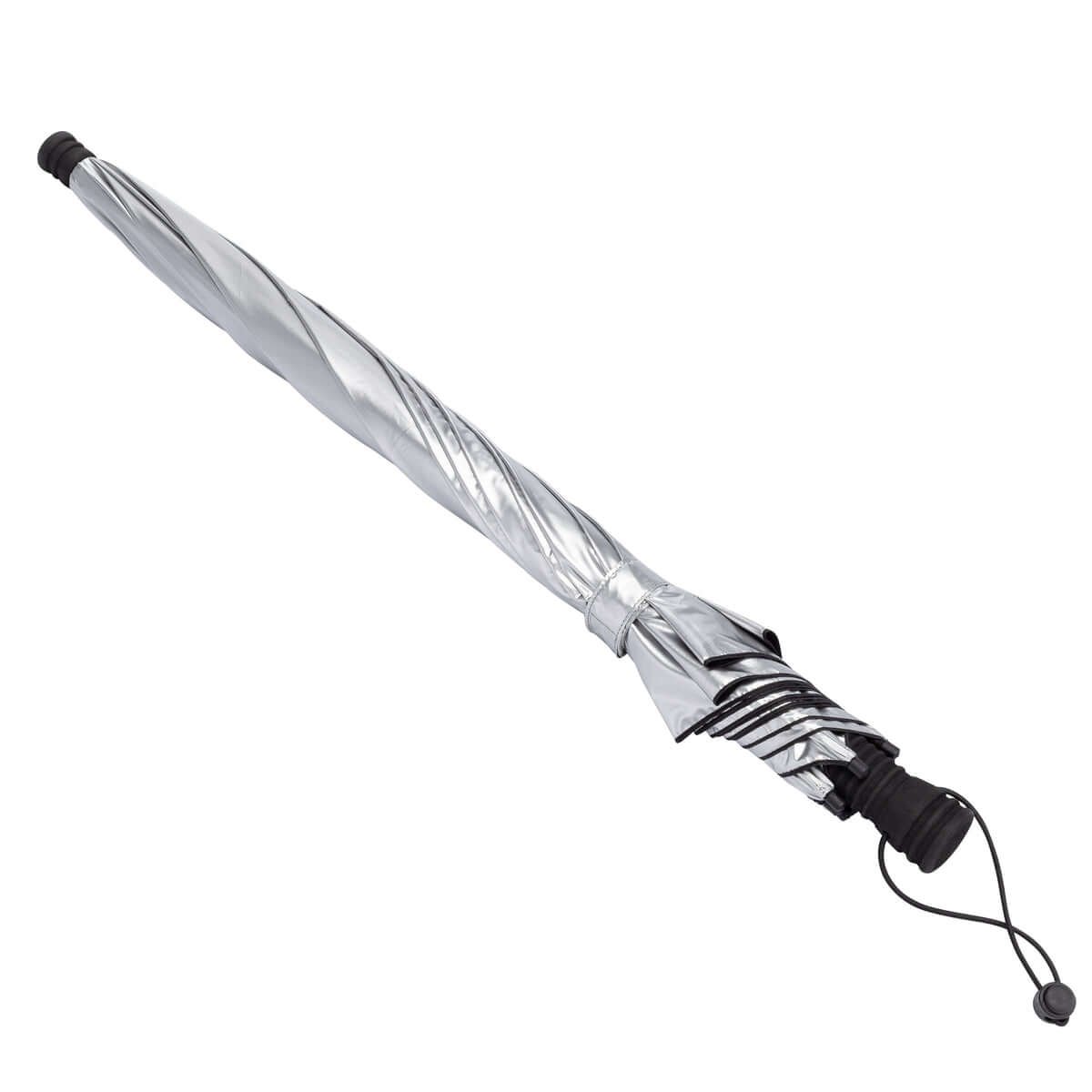
Overview
The Lightrek is a full-size trekking umbrella with a reflective chrome canopy, a black underside and an aluminum frame, built for hikers who want shade on exposed trail and a rain option that isn’t a jacket. At 164.4 g (5.8 oz), it is the lightest full-size umbrella in its class, according to Treeline Review. The trade-off is simple: a fixed, trekking-pole-length shaft that doesn’t collapse, and a canopy that gives up in serious wind.
Key Specs
| Spec | Detail |
|---|---|
| Weight | 164.4 g (5.8 oz) |
| Canopy diameter | 37.5 in (95 cm) |
| Extended length | 25 in (63 cm) |
| Closed size | 25 in long x 1.75 in wide (63 x 4.5 cm) |
| Fabric | 100% polyester, PFAS-free coating |
| UPF rating | UPF 50+ |
| Frame | Aluminum |
| Handle | EVA foam, with elastic cord and 3M reflective wrist strap |
| Shaft | Fixed, no telescoping or locking mechanism |

Build your Gear Closet
View all of your gear in one place, create packing lists and hit the trail with confidence. Available on iOS, Android and the web.
Get StartedPerformance
Sun. This is the Lightrek’s reason for existing. The reflective top surface sheds solar heat, while the black underside cuts glare bounced up from the ground or water. Gossamer Gear says it lowers the felt temperature by up to 15 degrees, and independent testers land in the same range. The Trek’s reviewer put it at 10–15 degrees cooler on average, and Ultimate Gear Lists cites a similar drop in the shade underneath. The brand has long been a staple on the PCT and Arizona Trail, and desert hikers tend to describe the effect in blunt terms: open it overhead and the heat disappears. One owner reported that it blocked the sky well enough to interfere with a satellite communicator worn on the shoulder.
Rain. It works, with caveats. Owners say it handles light to moderate rain and keeps the hiker and pack drier than a rain jacket alone. One buyer’s enthusiasm was specific: a jacket is a poor choice for hard, sweaty effort in the rain, and an umbrella is not. Coverage is generous for a 164 g object, roughly 7.7 square feet by Treeline Review’s measurement. But when the umbrella is clipped to a pack strap instead of held, a few European users noted that one shoulder or arm can still get wet. The Lightrek suits drizzle and showers more than a sustained downpour.
Wind. This is the weak point, and nearly every reviewer says so. One review pegged the practical limit at about 8 mph when strapped to a pack and 10–13 mph when held. A hiker in the Alps said it never flipped inside out, but at an estimated 40+ km/h near a ridgeline, managing it demanded too much attention and it went back in the pack. Treeline Review lists wind resistance as a downside relative to sturdier competitors. A Backpacking Light reviewer who carried one on the Hayduke Trail and the CDT called it best for calm or moderate conditions. One owner tied a cord from the rib tips to his waist as a makeshift guyline on an exposed ridge. It worked, though he admitted it felt silly.
Carry and hands-free use. There is no collapsing mechanism, which means nothing to jam or bend, but the umbrella stays 25 in long in the pack. Owners stash it where trekking poles go: in a deep side pocket with a bungee over the top, or between the hip belt and hip pocket with the top held by a shoulder-strap loop. The optional hands-free clamp is what makes it practical for walking, and reports are mixed on how well it holds. A Backpacking Light reviewer found the clip occasionally slipped in light wind. A Philmont trekker used the extra clamp for ten days and had no complaints, though he wished the shaft were about 4 in longer for forward visibility. Others have lost an umbrella to a snag in tight, brushy terrain, so it fits open country better than overgrown trail.
Durability. With no moving parts besides the ribs, there’s little to fail. One long-distance hiker logged 160 days on the CDT and Hayduke with the same model and called it durable. Simplicity cuts both ways, though: there is no lock, and the canopy stays open by tension, so it can fold when pushed by gusts.
Value. Treeline Review lists the price at $43, about $2 less than comparable umbrellas. Gossamer Gear also sells a gold version with a carbon fiber shaft and faux cork grip that weighs about the same and costs about $10 more, according to The Trek.
Pros & Cons
Pros
- 164.4 g for a 37.5 in canopy, lightest in its class
- Cuts felt temperature by roughly 10–15 degrees in direct sun
- UPF 50+ canopy with PFAS-free coating
- Few mechanical parts to break
- Reflective wrist strap and a compatible hands-free clamp
- Low price for what it does
Cons
- Poor in gusty wind and on exposed ridgelines
- Fixed 25 in length means it can’t be stowed inside a pack
- Easy to snag or lose in thick brush
- Clip attachment can slip in light wind
- Forward visibility can suffer with a pack-mounted setup
Who Should Buy This
Thru-hikers and section hikers crossing open desert, high-UV terrain or long exposed stretches will get the most from it, particularly if the hands-free clamp keeps trekking poles free. It also suits anyone who is willing to bring a 5.8 oz item for rain comfort in mild conditions. Hikers who spend most of their time on windy ridgelines, in dense forest, or in storms should look at sturdier, heavier umbrellas or skip the category and rely on a shell.
Verdict
The Lightrek does one job better than anything else at its weight: it turns a blazing trail into a shaded one for under 6 oz. It gives up wind tolerance and pack space for that, and the clamp is worth buying alongside it. Desert-bound ultralighters should buy it, and everyone else should check the forecast first.