Sunnyside Denatured Alcohol Review
A thorough look at Sunnyside Denatured Alcohol as a backpacking stove fuel — covering burn performance, efficiency, safety, and where it fits in the alcohol-fuel landscape.
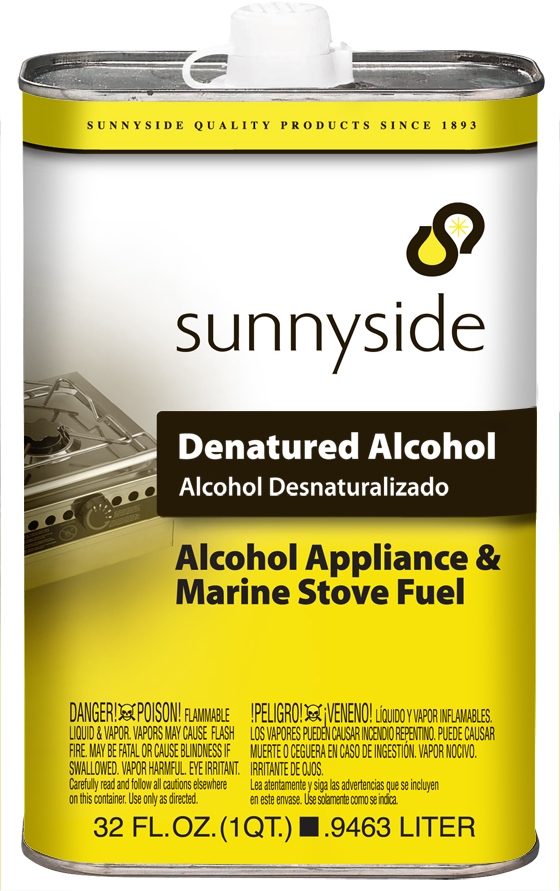
Overview
Sunnyside Denatured Alcohol is a hardware-store staple that doubles as one of the most widely used fuels for ultralight alcohol stoves. It’s a blend of roughly equal parts ethanol and methanol, sold in sizes from a pint all the way up to 55 gallons — the SKU 834G5 being the 5-gallon pail. On trail you’d never carry the bulk container; you decant a measured amount into a small HDPE fuel bottle before a trip. It’s a solid, affordable choice for 3-season thru-hikers and minimalists running a cat-can or commercial titanium burner, as long as you’re not hiking in California.
Key Specs
| Spec | Value |
|---|---|
| Composition | ~49% ethanol, ~50% methanol, ~0.87% MIBK |
| Specific Gravity | 0.789 |
| Density | 6.57 lb/gal (~789 g/L) |
| Flash Point | 50°F (10°C) |
| Freezing Point | -173°F |
| Color / Odor | Clear / Mild |
| Available Sizes | Pint · Quart · 1-gal · 2.5-gal · 5-gal · 55-gal |
| Fuel Weight (listed, per cook) | 22.7 g (~0.8 fl oz) |
| California Availability | Not for sale |

Would the Denatured Alcohol earn its spot in your pack?
23 g · 0.8 ozAdd the Sunnyside Denatured Alcohol to your Gear Closet and see exactly what it does to your base weight, then start packing for your next trip.
Free · No credit card · iOS, Android & web · Trusted by 3,000+ backpackers
Performance
Burn Quality
Sunnyside describes this as “a clean burning fuel that produces an odorless and smokeless flame.” That’s mostly accurate — the burn is cleaner than isopropyl rubbing alcohol and leaves no soot on your pot. “Odorless” is generous; there’s a faint alcohol smell during use, but nothing that lingers on gear the way white gas does.
The real-world catch is the near-invisible flame. Denatured alcohol burns with a pale blue flame that’s essentially invisible in daylight. Before you refuel mid-cook, always check with a snuffer cap or wave your hand carefully above the burner — skipping this step is how people get burned.
Efficiency
The listed per-cook fuel weight of 22.7 g (~28 ml, just under 1 fl oz) is on the generous-but-realistic side. In testing documented across the ultralight community, an efficient stove (ion-type or siphon burner with a close-fitting windscreen) can boil 2 cups of water on around 11–15 g of denatured alcohol at room temperature. Less optimized setups — penny stoves, loose windscreens — climb toward 18–22 g per boil. Cold water bumps those numbers up meaningfully too; plan on roughly an extra 0.8 g per 10°F drop in water temperature.
Sunnyside’s formula is about half methanol by volume, which puts it in a middle tier for energy content. Pure ethanol fuels (like Klean-Strip Green or high-proof grain alcohol) deliver roughly 10% better fuel economy. That difference is modest over a weekend, but across a week of twice-daily boils the gap adds up to a meaningful extra ounce or two of fuel carried. If you’re on a multi-week thru-hike and squeezing every gram, it’s worth noting.
Cold Weather and Altitude
Alcohol stoves lose efficiency below about 40°F, and Sunnyside is no exception. At sub-freezing temperatures boil times stretch noticeably and you burn more fuel per cook. Hiking above 11,500 ft similarly increases boil times due to reduced oxygen. Pre-warming your fuel bottle in an inside jacket pocket before cooking helps at both low temps and elevation, but if you’re regularly camping in winter conditions or high alpine terrain, a canister or white-gas stove is the more pragmatic tool.
Wind Sensitivity
Alcohol stoves are notoriously wind-sensitive, and you will need a windscreen with Sunnyside. Without one, even a moderate breeze can dramatically extend boil times and waste fuel. A well-fitted windscreen and reflective ground pad make a real difference — treat them as required kit, not optional accessories.
Availability on Trail
This is one of alcohol fuel’s genuine advantages. Denatured alcohol turns up in the paint department of most hardware stores (Home Depot, Ace, Tractor Supply), making resupply practical on routes near small towns. Yellow-bottle HEET is a viable substitute available at gas stations when denatured alcohol isn’t on the shelf. The important caveat: Sunnyside Denatured Alcohol is not for sale in California, where it has been banned since January 1, 2019, due to VOC regulations. If you’re planning a PCT section or any California trip, plan around HEET (yellow bottle, methanol) or marine stove fuel sold at West Marine and REI locations in the state instead.
Pros & Cons
Pros
- Clean, soot-free burn — pots stay cleaner than with isopropyl or methanol alternatives
- Widely available at hardware stores outside California, affordable in bulk
- No pressurized canister waste — empty HDPE fuel bottle is easy to recycle or reuse
- Works across a range of alcohol stoves without modification
- Very low cost per trip — a quart covers many weeks of trail cooking
Cons
- Near-invisible flame in daylight is a genuine safety hazard — requires careful refueling discipline
- ~50% methanol content means slightly lower energy density than purer ethanol fuels
- Banned in California; not a viable resupply option on CA routes
- Performance degrades notably below 40°F and at high altitude
- Wind sensitivity requires a dedicated windscreen — adds system complexity
- Contains toxic methanol — keep away from food/water containers and never store in unmarked bottles
Who Should Buy This
Sunnyside Denatured Alcohol is a good match for 3-season thru-hikers and weekend backpackers running an alcohol stove system outside California. It shines most on routes through the Eastern US, Rockies, and Pacific Northwest where hardware stores are accessible between resupply points. Budget-conscious hikers who want to buy a gallon before a long trip and mail drops to themselves will get excellent value. If you’re based in California, or frequently hike at elevation above 11,000 ft in cold conditions, look elsewhere.
Verdict
Sunnyside Denatured Alcohol is a dependable, inexpensive, and widely available stove fuel that does exactly what it promises for 3-season use. It’s not the highest-efficiency alcohol fuel you can buy — the methanol-heavy blend trails pure ethanol fuels by about 10% — but for most hikers that gap is academic next to the convenience and cost. The invisible flame is the one thing worth taking seriously; build the habit of using a snuffer cap and never refueling without confirming the stove is cold. Rating: 7/10.