Suunto Vertical Review
Suunto's Vertical pairs free offline maps and dual-band GNSS with week-plus battery life for backpackers, at the cost of a clunky interface and a premium price.
Overview
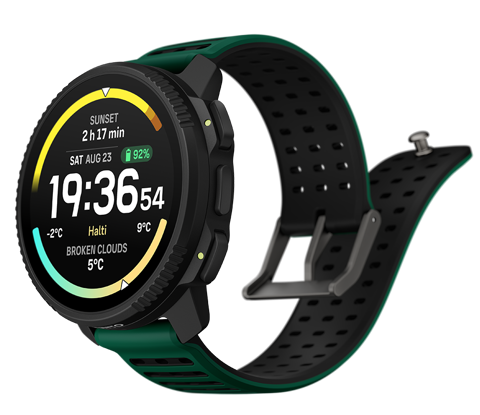
The Suunto Vertical is a 49 mm GPS adventure watch with free offline color maps, dual-band GNSS and a barometric altimeter, built for long backcountry trips rather than gym sessions. It was the Finnish brand’s first endurance watch with real mapping, and it set out to take on the Garmin Fenix and Coros Vertix. The trade-off is a big, slightly dated-feeling watch with a stiff interface, in return for battery life that makes a charger optional on most week-long trips.
Key Specs
| Spec | Detail |
|---|---|
| Weight | 74–86 g depending on case material |
| Case | 49 × 49 × 13.6 mm |
| Case materials | Stainless steel, or Grade 5 titanium with solar |
| Display | 1.4 in transflective color touchscreen, 280 × 280, always-on |
| Glass | Sapphire |
| GNSS | Dual-band: GPS, GLONASS, Galileo, BeiDou, QZSS |
| Storage | 32 GB |
| Battery, GPS best accuracy | 85 hours (solar versions); 60 hours (stainless steel) |
| Battery, Tour mode | 500 hours |
| Battery, daily use | Up to 60 days |
| Sensors | Barometric altimeter, compass, optical heart rate |
| Sport modes | 95+ |

Build your Gear Closet
View all of your gear in one place, create packing lists and hit the trail with confidence. Available on iOS, Android and the web.
Get StartedPerformance
Battery. This is the Vertical’s headline, and owners say it holds up. Suunto rates the watch at 85 hours in its most accurate GPS mode on the solar versions, and 500 hours in Tour mode, which still tracks with reasonable accuracy. Road Trail Run’s tester measured 50-plus hours in the full-accuracy dual-frequency mode, and about 11 days when logging 105 minutes of GPS a day. A long-term owner writing for The Photo Hikes gets a full week between charges while hiking 10–25 km daily with map navigation running. That reviewer needed to charge the older Suunto 9 Peak every two to three days under similar use. After almost two years, the same owner reports no noticeable battery degradation.
The solar claim is more modest in practice. Suunto says sunny days add at least 30% more power. Owners describe it as slowing drain rather than recharging the watch, and say not to count on it mid-hike, especially under tree cover.
GPS accuracy. Testers agree on this one. Coach called the multi-band GPS accurate, and DC Rainmaker’s review found it very good overall, with only minor bobbles on an intense mountain section, including downhill running. The chipset is the same one used in the Suunto 9 Peak Pro, so the leap is in how Suunto uses it, not new silicon. Long-term owners also single out barometric altitude accuracy and compass responsiveness as strengths.
Maps and navigation. Free offline outdoor maps are the other reason to buy. Coach rated them the best of any brand outside Garmin. Switchback Travel found the navigation still falls short of Garmin’s high-end watches. Downloads are slow, and the maps are sparse on points of interest, which fits their job of keeping a hiker on track in the woods rather than finding a café. Routes planned in the Suunto app, with heatmaps and surface-type data, sync to the watch.
Build and wearability. The sapphire glass and titanium or steel case hold up to abuse, and The Great Outdoors’ tester called the build quality excellent. At 49 mm it is large, and Switchback notes that it comes in one size only, which may be too much for smaller wrists. The silicone strap draws mixed reactions. Optical heart rate works best when the watch is worn tight.
Software. This is where the Vertical shows its age. Reviewers describe an interface that is stiff and a bit clunky. The watch often struggles to decide between touchscreen and button input, and there is a lot of swiping between everyday screens. Tom’s Guide also flagged a weak blood-oxygen reader, limited customization and a pixelated display. It is not a smartwatch, and it doesn’t try to be.
Choosing a Version
The two cases differ in more than looks. The stainless steel model weighs 86 g and has no solar charging, so its best-accuracy GPS rating drops to 60 hours. The Grade 5 titanium solar version weighs 74 g, gets the 85-hour rating and adds the solar bezel. At launch the steel model started at $629 and the titanium solar version was around $839.
Twelve grams is noticeable on a wrist over a multi-week hike, and the longer GPS rating helps on very long days with tracking left on. For thru-hikers and gram counters, the titanium solar version is the better pick. The steel version suits anyone who charges every few days and would rather save around $200.
Pros & Cons
Pros
- Battery life that outlasts most rivals: 85 hours of best-accuracy GPS, 500 hours in Tour mode
- Accurate dual-band GPS, including in forest and on steep descents
- Free offline color maps with 32 GB of storage
- Sapphire glass and a rugged steel or titanium case
- Barometer and compass perform well for mountain use
- Battery showed no degradation after two years in one long-term review
Cons
- 49 mm case in one size is bulky for smaller wrists
- Stiff interface that mixes touch and button input awkwardly
- Maps are less capable than Garmin’s top-end navigation
- Solar charging adds little in real-world use
- Weak blood-oxygen sensor and limited customization
- Premium price, especially for the titanium solar version
Who Should Buy This
The Vertical suits backpackers, thru-hikers and alpine trekkers who care most about battery life and accurate tracking, and who want maps on the wrist without a subscription. It rewards people who treat the watch as a navigation tool and don’t need apps or music. Anyone who wants a polished everyday smartwatch, a slim case or deep structured-training analytics should look elsewhere. Buyers who want an AMOLED screen can consider the newer Vertical 2, which trades battery life for a brighter display, rated at roughly 65 hours of GPS.
Verdict
The Suunto Vertical delivers what a long-distance hiker needs: GPS that holds a track, maps that work offline, and a battery that often goes a week without a charger. The software is dated and the case is large. For backcountry use, those flaws matter less than the endurance. The titanium solar version is the one to buy.