Suunto Vertical Review
The Suunto Vertical is a premium expedition GPS watch with dual-band GNSS, free offline topo maps, and class-leading battery life — built for backpackers and endurance athletes.
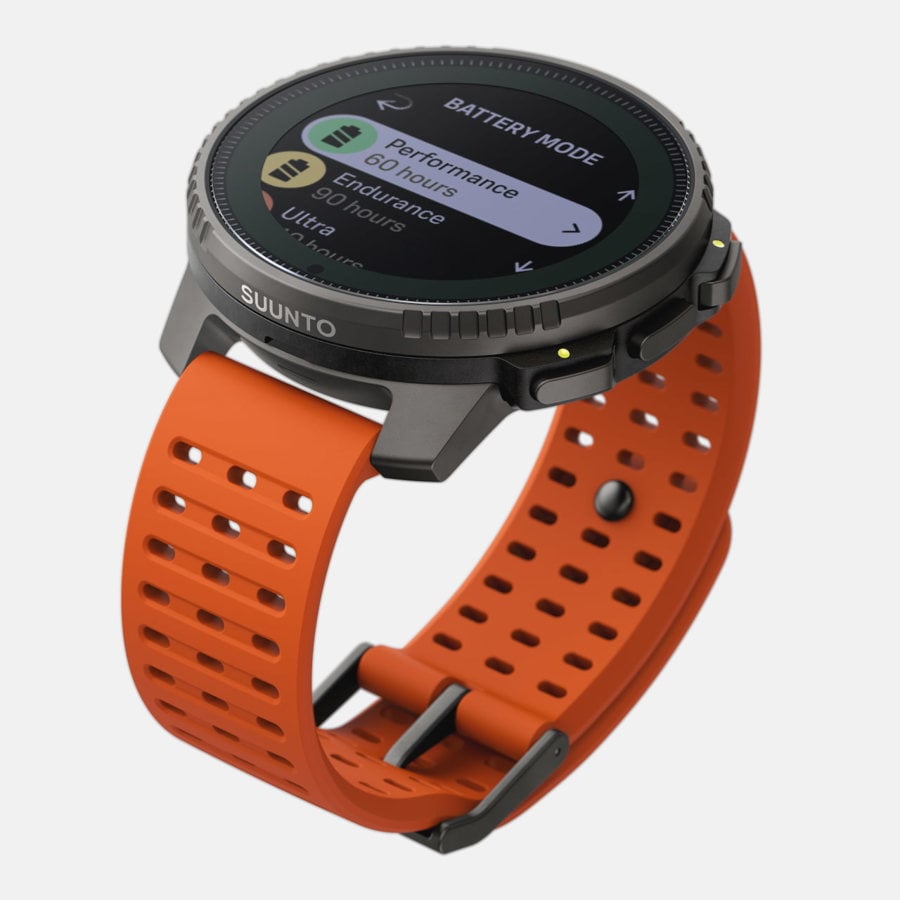
Overview
The Suunto Vertical is Suunto’s flagship adventure watch, squarely aimed at long-distance hikers, backpackers, ultrarunners, and anyone who spends multi-day stretches off-grid. It competes with the likes of the Garmin Fenix and Enduro and the Coros Apex and Vertix, featuring dual-frequency GPS, solar charging (on select variants), 24/7 heart rate monitoring, and offline topographic maps downloadable via Wi-Fi. The lineup comes in three flavors — Stainless Steel, Steel Solar, and Titanium Solar — with the titanium variant saving 12 grams and adding solar charging for a meaningful premium.
Key Specs
| Spec | Value |
|---|---|
| Weight | 86 g (steel) / 74 g (titanium) |
| Case Diameter | 49 mm |
| Case Thickness | 13.6 mm |
| Display | 1.4” transflective MIP, 280×280 px |
| GPS Battery Life | 60 hrs (steel) / 85 hrs (solar/titanium) |
| Daily Use Battery | Up to 60 days (solar) |
| GPS | Dual-band GNSS |
| Water Resistance | 100 m |
| Storage | 32 GB |
| Offline Maps | Yes (free, global topo) |
| Sensors | Altimeter, Barometer, Compass, OHR, SpO2 |
| Solar Charging | Solar/Titanium variants only |
| Price (MSRP) | $629 (steel) / $699 (steel solar) / $839 (titanium solar) |

Would the Suunto Vertical earn its spot in your pack?
86 g · 3.0 ozAdd the Suunto Vertical to your Gear Closet and see exactly what it does to your base weight, then start packing for your next trip.
Free · No credit card · iOS, Android & web · Trusted by 3,000+ backpackers
Performance
Battery Life
Battery life is the Vertical’s headline act — and it earns the billing. In hard daily use including runs, hikes, races, and sleep tracking, at least one tester consistently got 2+ weeks (336+ hours) of use and could have gotten more. The Suunto Vertical over-delivers on its battery life claims. That matches what I’d expect from a well-tuned MIP display, which sips power compared to AMOLED alternatives. Battery life is easily the best of any GPS watch many reviewers have tried — with default settings, the advertised 85 hours of GPS-on time on the Titanium Solar is achievable, and tweaking unnecessary features pushes that further. The solar contribution is also more transparent than on competing watches: the solar aspect puts data front and center so you know how much charge the sun is “paying back,” rather than leaving you guessing.
GPS and Accuracy
The Vertical uses dual-band GNSS, and if you haven’t used a dual-band watch yet, you’re missing out — they’re much more accurate.
Real-world testing from Outdoor Gear Lab confirms this:
the Vertical did great in both HR and GPS testing, returning a heart rate difference of +/- 3.70 BPM and a GPS difference of +/-0.08 miles on a known 2.80-mile course — one of the most accurate results they logged.
OHR accuracy is solid for steady-state efforts but worth pairing with a chest strap for high-intensity intervals where wrist-based sensors typically struggle.
Maps and Navigation
This is where the Vertical genuinely differentiates itself from most of the competition. Suunto Vertical offers free offline maps, while the Fenix 7 only offers this in the more expensive variants. Download happens over Wi-Fi via the Suunto app, and the 32 GB of storage is more than generous: one long-term user had all of Northern Italy, Switzerland, Austria, the French Alps, Sweden, Norway, and Iceland installed and was still nowhere near capacity — making it ideal for international trekking and alpine adventures. On-trail readability is strong: the topographic maps are clear and readable even in bright summer sun with glare overhead, and the terrain is easy to read. The one real criticism that keeps coming up from multiple reviewers: there are no text labels on trails or features, which means the map is more useful for quick checks than for making detailed navigation decisions, and you can’t zoom out very far. That’s a real limitation in unfamiliar terrain — the Garmin Fenix maps are more legible for that use case.
Build Quality and Wearability
The Titanium Solar’s construction is outstanding: the screen is sapphire crystal, the bezel is Grade 5 titanium, and the case is glass-fibre reinforced with polyamide.
One tester wore it through months of hiking, trail running, and climbing, took knocks including direct screen impacts, and reported
the watch didn’t have a single scratch and still looked box fresh.
At 49 mm, it’s unambiguously large — some reviewers with smaller wrists found it overwhelming on the wrist — but
the 49 mm case adds slightly more screen real estate without fully stepping up to a 51 mm case, allowing the watch to feel readable without feeling overly clunky.
The larger diameter and pronounced buttons also make it easy to use with gloves on
— a detail that matters on a cold summit more than any spec sheet.
Interface and App
The control scheme combines three physical buttons with a touchscreen. Three pronounced, distinct buttons offer control of the screen when the touchscreen is unavailable — gloves, water, and so on. That three-button layout is cleaner than Garmin’s five-button system aesthetically, but it’s a genuine ergonomic trade-off: navigating menus isn’t as easy as Garmin’s five-button system, though once you learn the flow, Suunto’s simplified menus keep daily use relatively straightforward. The Suunto app holds up well: it’s thoughtfully organized and easy to learn, with no connectivity issues, and syncing activities and routes with Strava and other third-party planners is seamless. Early firmware versions had notable sluggishness and bugs, but those complaints have since been fixed by software updates.
Missing Features
A few gaps are worth naming. The watch has no onboard music storage — it only serves as a controller for a connected smartphone — and features like ECG or NFC payments are absent, which are now common on competing smartwatches. That 32 GB of storage sitting idle while you can’t queue up an offline playlist is a strange design decision. The charging cable is also a recurring gripe: the included cable clips on magnetically, but it’s a weak connection that can fall off or fail to charge. It’s a minor annoyance that becomes a real problem on a long trip if you’re not careful about seating it properly.
Pros & Cons
Pros
- Battery life that consistently beats manufacturer claims — 2+ weeks of real daily use
- Free global offline topo maps with 32 GB storage (no subscription, no upsell)
- Dual-band GNSS accuracy competitive with the best in class
- Sapphire glass and titanium build that shrugs off hard use
- Solar charging is visible and quantified on the watch face
- Clean, well-designed Suunto app with solid third-party connectivity
- Hybrid touchscreen + button control works well with gloves
Cons
- Topo maps have no text labels on trails or features; limited zoom-out range
- Three-button layout takes getting used to coming from a five-button Garmin
- Magnetic charging cable is fiddly and unreliable — a frustrating weak point on an expensive watch
- No onboard music storage despite 32 GB of available space
- SpO2 sensor has been reported as temperamental at altitude, where you need it most
- 49 mm case will be too large for smaller wrists; Suunto offers no smaller variant
- Expensive, especially the Titanium Solar at $839
Who Should Buy This
The Vertical is built for people who actually live in the backcountry for extended periods — someone who upgrades specifically for battery life and topographic maps, and finds this watch replacing both a dedicated handheld GPS and a previous sport watch on multi-day trips. It’s especially compelling if you travel internationally for treks and want free maps across entire regions pre-loaded on your wrist. Ultrarunners doing events over 24 hours and expedition-style backpackers will find the battery-life-to-weight trade-off hard to beat. If you’re a serious expeditioner, this is a great watch worth looking into — but if you’re an average person tracking fitness, steps, and sleep, there are far cheaper ways to accomplish that.
Verdict
The Suunto Vertical is a genuinely excellent expedition watch that earns its reputation on the two things that matter most for long-haul backcountry use: battery life and navigation. The free global topo maps with 32 GB of storage is a competitive advantage that Garmin doesn’t match at this price point without an extra subscription or an upgraded model. The gaps — no music storage, fiddly charger, unlabeled map features, limited customization — are real, and they keep this from being a clean recommendation over a Fenix 7 for users who care about those things. For thru-hikers, alpine trekkers, and ultra-distance athletes who need a watch to last a week between charges without fuss, though, this is one of the most capable tools on the market.