Garmin Tempe Review
Garmin's 9 g ANT+ sensor puts a thermometer where your watch can't: away from your skin. It's accurate to a degree or two and runs a year on a coin cell.
Overview
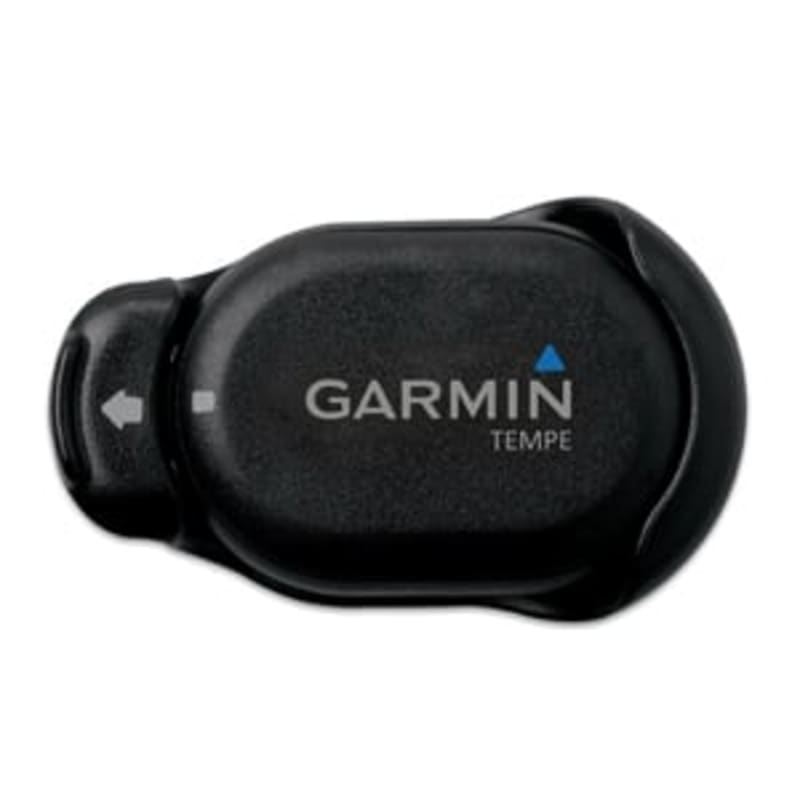
The Tempe is a 9 g ANT+ temperature sensor that clips to a pack strap, belt loop or shoelace and sends readings to a paired Garmin watch or handheld. It fixes a real problem: the thermometer inside a watch spends its day strapped to a warm wrist and reads accordingly. The trade-off is that it’s one more small thing to clip on, pair and keep track of, and its readings are good to a degree or two rather than a lab-grade fraction.
Key Specs
| Spec | Detail |
|---|---|
| Weight | 9 g |
| Wireless protocol | 2.4 GHz ANT+ |
| Battery | CR2032, 3 V, user-replaceable |
| Battery life | Up to 1 year |
| Water resistance | 10 m (32.9 ft) |
| Operating temperature range | -20°C to 60°C (-4°F to 140°F) |
| Category | Ambient temperature sensor for Garmin devices |

Would the Tempe Wireless Temperature Sensor earn its spot in your pack?
9 g · 0.3 ozAdd the Garmin Tempe Wireless Temperature Sensor to your Gear Closet and see exactly what it does to your base weight, then start packing for your next trip.
Free · No credit card · iOS, Android & web · Trusted by 3,000+ backpackers
Performance
Accuracy. The case for the Tempe is placement. A watch sensor reads a blend of air and arm; the Tempe reads air, provided it’s hung somewhere with airflow. One long-term owner on Trailspace clips it to the rearmost part of the backpack, where body heat has the least influence, and compares that favorably with the readings from sensors built into devices. Garmin’s own manuals say the same thing: mount it on a strap or loop exposed to ambient air.
How close is “accurate”? Garmin Forums users cite a tolerance of roughly 1 to 2 degrees. Owners’ experience matches that. One reviewer found it slightly off from what hiking partners’ devices showed, by a degree or two. A Trailspace reviewer noted that a Tempe inside a pack’s brain read 11 degrees while a second unit mounted outside the pack read 9. Placement matters more than the sensor. Older Garmin handhelds also display and log whole degrees only.
Tinkerers have found a workaround. Owners on the Garmin forums run the sensor through a Connect IQ data field that applies an offset and trims the first minutes of data, and report that corrected values track a reference thermometer well.
Response time. Don’t expect an instant read. The sensor updates about once a minute, and one owner says it takes roughly ten minutes for the casing to match outside air. Another cyclist measured about three minutes to settle after leaving an indoor bike parking area. In practice, that means a pack-mounted Tempe is fine for logging a day’s temperature curve or checking the morning chill from inside the tent, and poor for catching a quick change.
Connection and range. There are no buttons and nothing to configure. Owners describe pairing once and having the sensor reconnect automatically, with a Garmin watch typically picking it up within about a minute of starting an activity. One Trailspace user reports enough range to read the temperature from inside a tent while the sensor stayed on a bike. One eBay buyer, however, reported a unit that dropped its connection repeatedly and suspected a non-genuine or faulty sensor, so buy from an authorized seller.
Cold limit. The rated floor is -20°C. A Trailspace reviewer took it to -24°C and found it kept working, but the Garmin unit logged readings below the rated range as +70°C. For deep-winter use, that glitch matters. Garmin’s rated range is the one to trust.
Durability and battery. The 10 m water resistance means rain, river crossings and sweat are non-issues. The CR2032 is user-replaceable and rated for up to a year of use. One owner says the battery cover takes a little finesse to open and close. The included clip fits belt loops and stays put all day, but it won’t wrap a wide belt. On a thru-hike, a shoelace or pack-strap loop is the more practical home.
Availability. Garmin Forums posters report the Tempe has been discontinued, with some users hoarding spares. The Ruuvi tag is a frequently suggested alternative. At about 36 g, it’s roughly four times heavier, and it needs a different approach to get data onto a watch.
Pros & Cons
Pros
- 9 g, light enough to ignore on a pack strap
- Reads air rather than wrist, avoiding body-heat bias
- Pair-and-forget operation with automatic reconnection
- Waterproof to 10 m
- User-replaceable CR2032 lasts up to a year
- Temperature graphs show up in activity logs
Cons
- Roughly 1–2 degree accuracy, with readings that vary by mounting spot
- Slow to equilibrate after a temperature change, up to about ten minutes by one owner’s account
- Out-of-range cold readings can log as +70°C
- Only works with ANT+ Garmin devices
- Reported as discontinued, so supply and pricing can be uneven
- Battery cover is fiddly
Who Should Buy This
Garmin watch or handheld owners who log long days and want a temperature curve they can trust more than their wrist sensor. It suits section hikers and thru-hikers who clip a gram-counted accessory to a pack strap and like the numbers in their track files. Skip it if the device you carry isn’t ANT+ compatible, if you need precision beyond a degree or two, or if you hike in conditions well below -20°C. Anyone who wants a quick, reliable “what’s the temperature now” read would be better served by a simple pocket thermometer.
Verdict
The Tempe does one job at 9 g: it reports air temperature instead of arm temperature. It’s slow and only roughly accurate, but with a good mounting spot it beats a watch’s built-in sensor. A solid buy for Garmin loyalists who can find one at a fair price, and a pass for everyone else.