Garmin Instinct Solar Review
Garmin's Instinct Solar is a rugged, button-driven GPS watch that rarely needs a charger, with no topo maps and a modest display as the trade-offs.
Overview
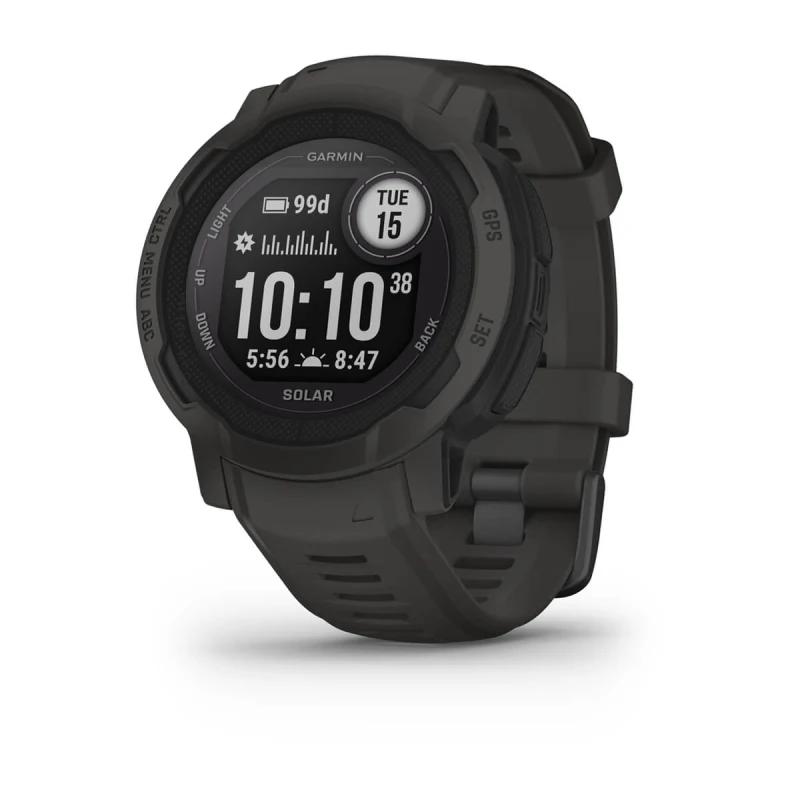
The Garmin Instinct Solar is a rugged, solar-charging GPS watch for people who want to leave the charger at home. It comes in two sizes, the 45 mm Instinct 2 Solar and the 40 mm Instinct 2S Solar, and both skip color screens, topographic maps and onboard music in favor of toughness, simplicity and a power budget that stretches across weeks. The headline trade-off: navigation is breadcrumb-only, so this is a watch for following a line, not for reading terrain.
Key Specs
| Spec | Value |
|---|---|
| Weight | 43–53 g depending on size |
| Case size | 40 mm × 40 mm (2S) to 45 mm × 45 mm (2) |
| Thickness | 13.3 mm (2S) to 14.5 mm (2) |
| Display | Monochrome transflective MIP; 0.9 in (23 mm) on the 2, 0.79 in on the 2S |
| Battery, smartwatch mode | Unlimited with solar (3 hrs/day at 50,000 lux); 28 days without solar on the 2 |
| Battery, GPS | Up to 48 hrs with solar on the 2; 30 hrs without |
| Battery, UltraTrac | Up to 370 hrs with solar on the 2 |
| Water rating | 100 m (10 ATM) |
| GNSS | GPS, GLONASS, Galileo |
| Sensors | Barometric altimeter, 3-axis compass, Elevate Gen 4 optical heart rate |
| Build standard | MIL-STD-810 |
| Connectivity | Bluetooth, ANT+ |
Versions compared
| Image | Version | Weight | vs. lightest |
|---|---|---|---|
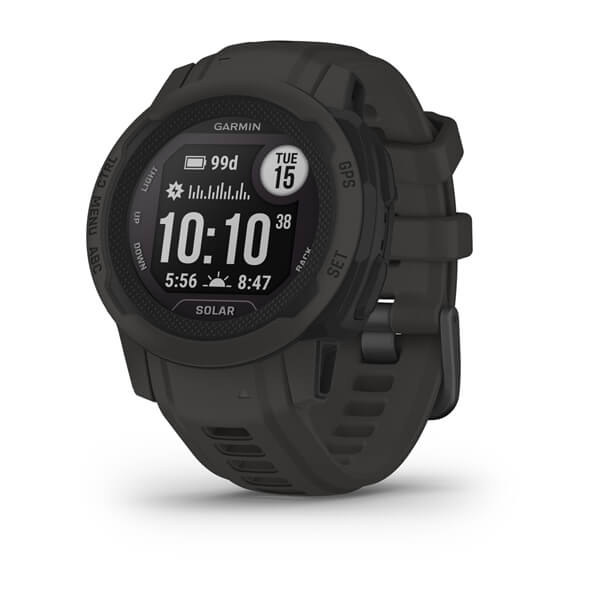 | 2S | 43 g (1.5 oz) | lightest |
| 2 | 53 g (1.9 oz) | +10 g |

Build your Gear Closet
View all of your gear in one place, create packing lists and hit the trail with confidence. Available on iOS, Android and the web.
Get StartedPerformance
Battery and solar charging
The Instinct’s reputation rests on its battery, and it largely earns it. Garmin’s “unlimited” smartwatch claim assumes three hours a day in 50,000-lux conditions, which is bright but not desert-bright. Wearers who keep the watch in smartwatch mode and spend normal time outdoors may never see a charging cable. One long-term user reported 45 days away from civilization without a recharge, using GPS, alarms and breadcrumb navigation regularly.
During recording, the physics are less generous. The panel can’t out-produce the draw of GPS, so solar slows the drain rather than pushing the percentage upward. The 48-hour GPS figure assumes strong, steady sun that few real hiking days deliver, though the result is still frugal. UltraTrac mode stretches the range much further by reducing GPS update frequency, at the cost of tracking precision. That suits a slow, steady trail walk better than a technical scramble.
Settings matter. Leaving the pulse-ox sensor on continuously can cut a quoted 28 days of smartwatch life to about five. Set it to occasional readings unless continuous SpO2 data is the point.
GPS and navigation
The watch tracks GPS, GLONASS and Galileo together, which helps fix speed and accuracy under tree cover and in canyons. Testers found position accuracy within a few meters once a fix was locked, and tracks stayed consistent across varied terrain.
Navigation is breadcrumb-only. That works for following a pre-loaded route or backtracking to the trailhead, but anyone expecting the map display of a Fenix or a dedicated handheld will be disappointed. Routes are also capped at 50 waypoints, so courses beyond roughly 20 km get trimmed. It’s workable for day hikes and frustrating on long traverses.
Build, comfort and controls
A fiber-reinforced polymer case and a scratch-resistant Power Glass lens keep the weight down while meeting MIL-STD-810 and a 100 m water rating. At 53 g, the larger watch wears lighter than it looks. Five physical buttons handle everything, with no touchscreen to misread. On a wet trail, in gloves, or mid-scramble, that means the watch does what the wearer intended.
Screen and health tracking
The monochrome transflective display gets sharper as the sun gets brighter, which is the opposite of AMOLED behavior and the right call for a trail watch. The cost is area: stack several data fields on one page and the small screen gets cramped enough that runners may have to slow down to read it.
Heart-rate readings compared favorably to a chest strap in testing, and the Elevate Gen 4 sensor is the same generation found on the Fenix 7 lineup. Beyond the basics, the watch covers sleep metrics, VO2 max estimation and more than 40 activity profiles, including multisport and triathlon, with data syncing through Garmin Connect and on to Strava.
Choosing a Version
The two sizes share the same software, sensors and button layout. What changes is the hardware around them.
Instinct 2S Solar (43 g). The 2S has a 40 mm case, 13.3 mm thickness, a 20 mm band and a 0.79 in display. It suits smaller wrists, and its lower weight and profile make it less intrusive during sleep tracking and under a jacket cuff. The trade-offs are a smaller battery, a lower-resolution screen (156 × 156 against 176 × 176) and a smaller area to catch light, which blunts the solar benefit during GPS use. Reviewers who tested it suggest it is the one model where the solar upcharge buys the least.
Instinct 2 Solar (53 g). The 45 mm watch has the larger screen, the bigger battery and the full “unlimited” and 48-hour GPS figures quoted above. It is the better pick for long trips, for anyone who stacks data fields, and for larger wrists. The 10 g penalty is hard to feel on the arm.
The rule is simple: choose the 2S only if the 2 doesn’t fit comfortably. Otherwise take the 2 for its battery and screen.
Pros & Cons
Pros
- Essentially unlimited smartwatch-mode battery with regular sun exposure
- MIL-STD-810 build and 10 ATM water resistance
- Light for its durability, at 43–53 g
- Five buttons that work with gloves, in rain and on the move
- Readable in direct sunlight
- Full multisport tracking and a deep Garmin Connect ecosystem
- Two sizes cover a wide range of wrists
Cons
- Breadcrumb navigation only, with no topographic maps
- 50-waypoint route cap trims longer routes
- Solar slows GPS drain instead of reversing it, so the 48-hour figure needs ideal sun
- Small display gets crowded with multiple data fields
- No multi-band GPS, which arrived on the Instinct 2X and Instinct 3
- Proprietary charging cable
- Continuous pulse-ox sharply reduces battery life
- The 2S gives up battery and solar benefit for its smaller size
Who Should Buy This
Thru-hikers, backpackers and adventure travelers who want a watch that survives a week-long route without a wall outlet will find the Instinct Solar a good fit. It is also a sensible all-rounder for people who hike one day and run or paddle the next. Dedicated runners chasing structured training plans should look at the Forerunner line, and anyone who wants maps on the wrist should look at the Fenix series. The Instinct 3 Solar adds multi-band GPS and a built-in flashlight, so buyers should compare it against the 2 Solar, which may be discounted.
Verdict
The Instinct Solar delivers on its core promise: a tough, capable GPS watch that can be worn for weeks without hunting for an outlet. The solar story is more nuanced than the marketing implies, but on exposed ridgelines and open trails the battery benefit is real. It earns an 8 out of 10, with points off for the 50-waypoint cap and the absence of multi-band GPS.