Garmin Instinct 2 Solar Review
Packstack is reader-supported. When you buy through links on our site, we may earn an affiliate commission. This does not affect the independence or objectivity of our reviews.
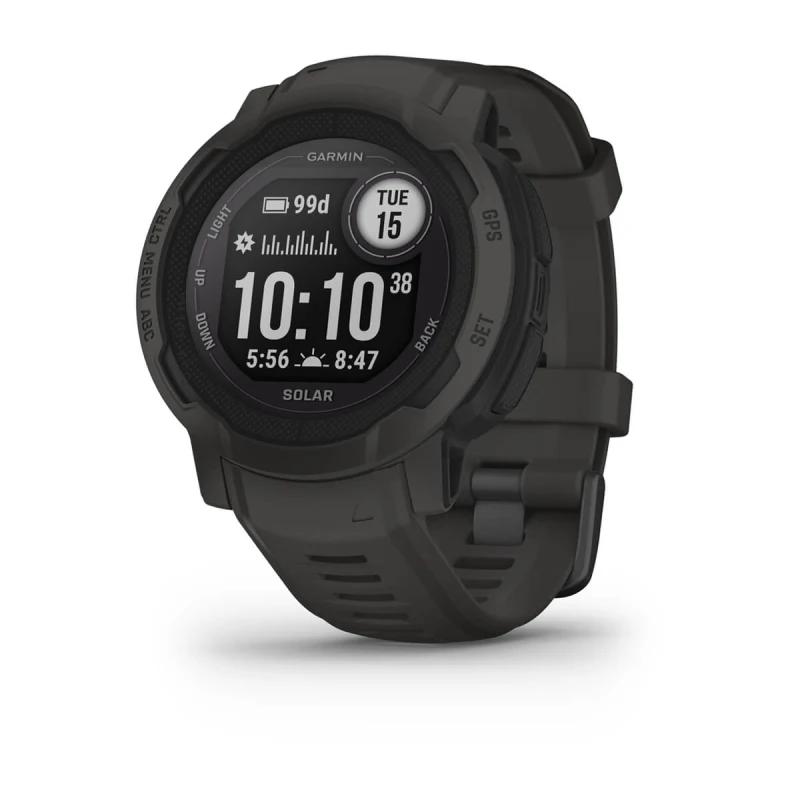
The Garmin Instinct 2 Solar is a rugged, solar-charging GPS smartwatch built for multi-day adventures — strong on durability and battery life, but skips topo maps and a color screen.
Overview
The Garmin Instinct 2 Solar is a rugged, solar-charging GPS smartwatch aimed squarely at people who spend extended time outdoors and don’t want to babysit a battery. It trades some of the premium features found on higher-end watches — no topographic maps, no color screen, no music storage — for simplicity, durability, and a genuinely impressive power story. If your priorities are “will it survive a month in the backcountry without a wall outlet,” this watch has a compelling answer.
Key Specs
| Spec | Value |
|---|---|
| Weight | 53 g |
| Case Size | 45 mm × 45 mm |
| Thickness | 14.5 mm |
| Display | 0.9 in (23 mm) monochrome transflective MIP |
| Battery — Smartwatch | Unlimited w/ solar (3 hrs/day @ 50,000 lux); 28 days w/o solar |
| Battery — GPS | Up to 48 hrs w/ solar; 30 hrs w/o solar |
| Battery — Max GPS | Up to 370 hrs w/ solar (UltraTrac) |
| Water Rating | 100 m (10 ATM) |
| GNSS | GPS, GLONASS, Galileo |
| ABC Sensors | Barometric altimeter, 3-axis compass |
| Build Standard | MIL-STD-810 |
| Connectivity | Bluetooth, ANT+ |
Would the Instinct 2 Solar earn its spot in your pack?
53 g · 1.9 ozAdd the Garmin Instinct 2 Solar to your gear closet and see exactly what it does to your base weight — then build your next packing list around it. Free, in about two minutes.
Free · No credit card · iOS & Android · Trusted by 3,000+ backpackers
Performance
Battery Life & Solar Charging
This is the headlining feature, and the honest answer is: it lives up to its reputation, with some important caveats. Garmin’s “unlimited” smartwatch-mode claim assumes all-day wear with 3 hours per day in 50,000-lux conditions — and in practice, if you stay in smartwatch mode, you genuinely may never need to plug it in.
Where things get more nuanced is during active GPS use. In real life, you’ll rarely see the battery percentage tick upward from solar charging during activity, because the watch draws more power than the panel can provide — what solar actually does is slow the discharge rate, extending your operational window. Even on a clear summer day, the “infinite battery” display can be elusive during activity tracking, but the result is still meaningfully frugal battery drain while recording in good light.
For thru-hikers and big-objective folks who spend most of their day moving under open sky, the payoff is real. One long-term user reported going 45 days away from civilization without charging, using GPS, alarms, and breadcrumb navigation regularly — the solar charging kept it going.
A practical gotcha: battery life varies significantly by health-monitoring settings, and leaving pulse ox on continuously will drain the battery from a quoted 28 days down to around 5 days. Turn it off or set it to occasional readings unless you specifically need continuous SpO2 data.
GPS & Navigation
GPS accuracy landed within a few meters once it acquired a satellite fix, and activity tracking was consistent across varied terrain.
The watch supports GPS, GLONASS, and Galileo simultaneously, which improves fix speed and accuracy in challenging conditions.
Navigation is breadcrumb-only — no downloadable topo maps. Basic breadcrumb mapping is a powerful tool for pre-planned routes and navigation in familiar territory, but if you’re expecting the kind of map display you’d get from a Fenix or a dedicated GPS unit, you’ll be disappointed. The watch is also limited to 50 route waypoints, which means routes longer than roughly 20 km get trimmed — workable for day hikes but potentially frustrating on long traverses.
The UltraTrac mode deserves a mention. It reduces GPS update frequency and temporarily disables the receiver to conserve power, which dramatically extends battery life but also reduces tracking accuracy — better suited to slower hikes than technical trail runs.
Build & Comfort
The fiber-reinforced polymer case and chemically strengthened, scratch-resistant Power Glass lens make it a sensible choice for people who don’t take any prisoners with their gear.
At 53 g, it wears lighter than it looks.
The plastic construction keeps the overall unit quite light, so the added protection doesn’t weigh you down.
Five physical buttons handle all input — no touchscreen. The buttons are tactile and provide predictable interaction even while on the move, and the menu system is easy to follow once you’ve spent a few sessions with it.
Health & Activity Tracking
The feature list goes well beyond standard ABC sensors, covering fitness tracking, sleep metrics, VO2 max estimation, and navigation.
The Instinct 2 is also a full multisport and triathlon watch, with support for power meters, mountain bike metrics, and nearly every sensor type the Fenix series handles.
Heart rate accuracy compared favorably to a chest strap in testing. The watch uses Garmin’s Elevate Gen4 optical heart rate sensor on the back, which is the same generation found on the higher-end Fenix 7 lineup.
Screen
The monochrome transflective MIP display is perfectly readable in bright sunlight — better than AMOLED in that regard — but the smaller screen area makes reading multiple data fields more difficult at a fast pace; you may need to slow down to read the watch accurately if you’ve stacked several metrics on a single page.
Pros & Cons
Pros
- Essentially unlimited battery life in smartwatch mode with regular sun exposure
- MIL-STD-810 rated, 10 ATM water resistance — genuinely rugged
- Lightweight for the protection level at 53 g
- Full multisport tracking: 40+ activity profiles
- Excellent button interface — works with gloves, in rain, mid-scramble
- Garmin Connect ecosystem: rich post-activity data, auto-sync to Strava
- No color screen means better outdoor readability, not worse
Cons
- No topographic maps — breadcrumb navigation only
- 50-waypoint route cap limits usefulness on longer routes
- Solar charging during GPS activity slows drain rather than replenishing battery — the “48-hour GPS” claim requires direct sunlight conditions few real hikes deliver
- Small 0.9 in display gets cramped with multiple data fields
- No multi-band GPS (available on the newer Instinct 2X and Instinct 3)
- Proprietary charging cable is a minor nuisance
- Pulse ox enabled continuously tanks battery life significantly
Who Should Buy This
The Instinct 2 Solar is a great all-rounder for multi-sports adventurers — the type who are hiking and climbing one day, then running and kayaking the next. It doesn’t feel particularly running-centric, so dedicated runners chasing pace data and structured training plans should look at the Forerunner line instead.
It’s the right call for thru-hikers, backpackers, and adventure travelers who want a set-it-and-forget-it watch that won’t die in the middle of a week-long route. Worth noting: the Instinct 3 Solar is now available with multi-band GPS and a built-in flashlight, so if you’re buying new, it’s worth comparing the two — the Instinct 2 Solar may be available at a meaningful discount.
Verdict
The Instinct 2 Solar delivers on its core promise: a tough, capable GPS watch that you can wear for weeks on end without hunting for an outlet. If durability and battery life are your main concerns, it’s hard not to recommend it, and its deliberate simplicity — skipping premium features you’d rarely use on trail — is a genuine design choice, not a cost-cutting compromise. The solar charging story is slightly more nuanced than the marketing implies, but in real-world outdoor use — especially on exposed ridgelines and open trails — the battery benefit is tangible. I’d give it an 8/10: excellent for its intended audience, with points off for the 50-waypoint navigation cap and the absence of multi-band GPS that competitors at a similar price now offer.