Garmin inReach Messenger Review
Garmin's inReach Messenger trades navigation for a 28-day battery and a strong antenna in a 114 g satellite communicator built around your phone.
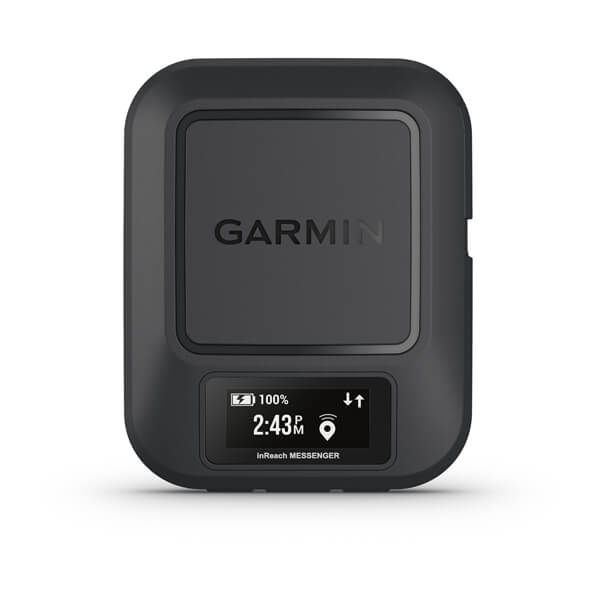
Overview
The inReach Messenger is Garmin’s stripped-down satellite communicator: a flat, 114 g puck that sends texts, shares your location and triggers SOS over the Iridium network, and leaves the mapping to someone else. It is aimed at hikers who carry a phone for navigation and want a long-lasting, simple lifeline alongside it. The trade-off is plain. Garmin cut on-device navigation and the clip that other inReach units carry, and in return the Messenger gets the longest battery life and the strongest antenna in the lineup.
Key Specs
| Spec | Detail |
|---|---|
| Weight | 114 g (4.0 oz) |
| Dimensions | 7.8 x 6.4 x 2.3 cm (3.1” x 2.5” x 0.9”) |
| Satellite network | Iridium, 100% global coverage |
| Display | 1.08” diagonal (1” x 0.43”), monochrome transflective MIP, sunlight-readable |
| Battery | Rechargeable internal lithium-ion |
| Battery life | Up to 28 days in 10-minute tracking mode |
| Charging | USB-C; can reverse-charge a phone |
| Water rating | IPX7 |
| SOS | Interactive SOS to Garmin IERCC, staffed 24/7 |
| Navigation | None beyond TracBack |

Would the inReach Messenger earn its spot in your pack?
114 g · 4.0 ozAdd the Garmin inReach Messenger to your Gear Closet and see exactly what it does to your base weight, then start packing for your next trip.
Free · No credit card · iOS, Android & web · Trusted by 3,000+ backpackers
Performance
Battery. This is the headline. The 28-day rating at 10-minute tracking intervals is double what the inReach Mini 2 offers, and Outdoor Life’s reviewer noted it costs only about half an ounce more than the Mini 2. Real-world numbers are less generous than the spec sheet but still strong: a Bikepacking.com tester running 10-minute tracking on a five-day Arizona ride went from 98% to 70%, roughly 7% per day, including a few messages daily. That works out to about two weeks, which still covers most long section hikes between town stops without a charger. For backpackers already hauling a power bank for a phone, the Messenger is one fewer thing to babysit.
Signal and message speed. The Messenger’s flat-panel antenna takes up most of the chassis, and testers credit it for quick lock-ons. Adventure Alan measured the antenna at 35.9 dBm, against 31.8 dBm for the Mini 2’s helical design, and ranked the Messenger the most reliable of the devices it tested. A reviewer at HikingGuy reported messages leaving faster than on a Mini 2, usually inside a minute, and better results under heavy canopy. The unit supports GPS, Galileo, BeiDou and QZSS, which helps in canyons and thick timber.
The phone is the interface. The on-device screen is tiny and there is no keyboard. Entering a reply means scrolling through characters, which is fine for a canned “OK” and miserable for anything longer. Owners and reviewers agree that the Garmin Messenger app is where the device makes sense. Paired over Bluetooth, the app handles texting, group chats, location sharing, weather forecasts, tracking and SOS. When the phone has cellular or Wi-Fi, the app routes messages over data instead of satellite, which keeps satellite messages for when they are needed. Location sharing always goes over satellite.
Navigation is the missing piece. The Messenger does not pair with Garmin Explore, so there are no maps, waypoints or route following on either the device or the app. TracBack, which retraces your breadcrumb trail, is the only navigation tool. HikingGuy’s reviewer concluded that anyone wanting backup navigation on the device itself should buy the Mini 2 instead.
Carry and durability. There is no clip, strap or carabiner loop. Hikers have solved this by stowing it upright near the top of the pack, such as in the lid pocket, where it works without external mounting. The IPX7 rating covers rain and brief immersion. The reverse-charging feature earns real praise: it can top up a dying phone enough to keep messaging, which matters because many failed rescue communications end with a dead phone.
Cost of ownership. The device launched at $300, and a Garmin satellite subscription plan is required for it to do anything. Budget for that monthly or annual fee on top of the hardware. REI shoppers rate the Messenger 4.2 out of 5 across more than 300 reviews.
Pros & Cons
Pros
- Longest battery life of any inReach, with a real-world drain of about 7% a day at 10-minute tracking
- Strong antenna with fast, reliable message delivery, including under tree cover
- Reverse charging can revive a dead phone
- Messaging switches between Wi-Fi, cellular and satellite automatically through the app
- 114 g with USB-C charging and IPX7 protection
- Cheaper and simpler than Garmin’s navigation-capable units
Cons
- No maps or route navigation; TracBack only
- No clip or mounting point
- Tiny screen and no keyboard, so standalone texting is slow
- Doesn’t pair with Garmin Explore
- Requires a paid subscription
- Heavier than the Mini 2 by about half an ounce
Who Should Buy This
Thru-hikers and section hikers who navigate with a phone or watch and want a dependable, set-and-forget SOS and check-in device will get the most from the Messenger. The battery suits long stretches between resupplies, and the app makes daily texts to family painless. It also suits backpack hunters, paddlers and drivers headed into the backcountry. Hikers who want maps, waypoints or a compass on the device should look at the Mini 2 or a Garmin handheld with inReach built in. Anyone who wants to send photos or voice messages should look at the Messenger Plus, which Garmin introduced in 2024 with 1,600-character messages and media support.
Verdict
The inReach Messenger does fewer things than other inReach units and does them better: its battery, antenna and app experience lead the lineup. For hikers who already carry a navigation phone, it is the best-value way into Garmin’s satellite network. The missing clip and the lack of navigation keep it from a higher score.