Garmin GPSMAP 66st Review
A rugged, AA-powered handheld GPS with a bright 3" display and preloaded topo maps — built for backcountry navigation, not for going light.
Overview
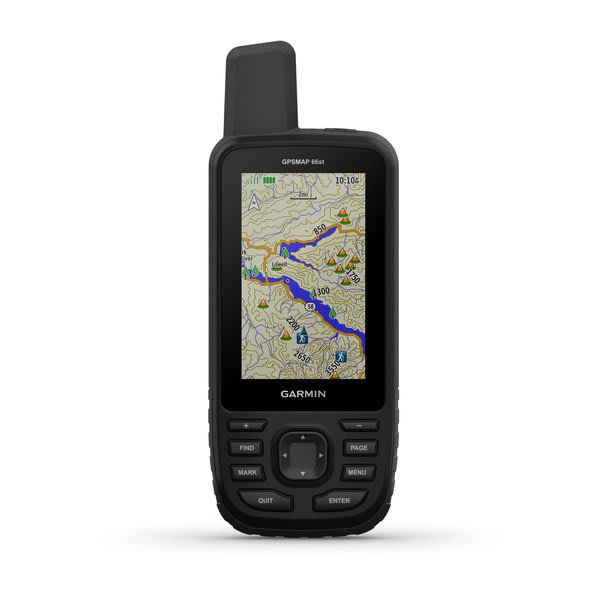
The GPSMAP 66st is Garmin’s mid-tier dedicated handheld GPS — no satellite messaging, no touchscreen gimmicks, just a rugged, button-driven navigator with a big sunlight-readable screen and preloaded TOPO maps. It’s aimed at hunters, backcountry hikers, and anyone who wants a standalone navigation tool that isn’t tethered to a phone battery or cell signal. If you’re counting grams for a thru-hike, this isn’t your device; if you want a bombproof secondary nav tool that runs on AAs you can buy at any gas station, it’s worth a look.
Key Specs
| Spec | Value |
|---|---|
| Weight | 230 g (8.1 oz) |
| Display | 3” sunlight-readable color, 240 x 400 px |
| Satellite systems | GPS, GLONASS, Galileo |
| Internal memory | 16 GB |
| Battery | 2x AA — up to 16 hrs (GPS mode), up to 1 week (Expedition mode) |
| Water resistance | IPX7 |
| Ruggedness | MIL-STD-810 (thermal, shock, water) |
| Sensors | Barometric altimeter, 3-axis compass |
| Wireless | Wi-Fi, Bluetooth, ANT+ |
| Preloaded maps | TopoActive US & Canada |
| Dimensions | 6.5 x 2.4 x 1.4 in |

Would the GPSMAP 66st earn its spot in your pack?
230 g · 8.1 ozAdd the Garmin GPSMAP 66st to your Gear Closet and see exactly what it does to your base weight, then start packing for your next trip.
Free · No credit card · iOS, Android & web · Trusted by 3,000+ backpackers
Performance
Accuracy and satellite lock. The 66st pulls in GPS, GLONASS, and Galileo simultaneously, which in practice means faster fixes and fewer dropouts under tree cover or in canyons than a single-constellation unit. That said, this is single-band (L1 only) hardware, so it’s not in the same league as Garmin’s newer multi-band units. One reviewer who tested the 66sr (the multi-band sibling) directly against the 66i found a consistently 6ft accuracy reading on the 66sr, which beats the 66i’s typical 9-12ft — and the 66st shares the 66i’s older single-band GNSS chipset, so expect accuracy in that same 9-12 foot ballpark rather than the tighter numbers multi-band units achieve. That’s still plenty precise for on-trail navigation; it just won’t shine in the tightest canyon or cliff-wall terrain the way the pricier 66sr does.
Display. The 3” 240x400 screen is the standout feature. Outdoor Gear Lab called it out as a major strength, and the general consensus across reviews is that it stays legible in direct sun without needing to crank the backlight — a real point of friction with phone-based navigation apps. One reviewer measured the 66sr’s screen as noticeably brighter than the 66s/66st at matched backlight percentages, which tells you the 66st’s screen, while good, isn’t the newest or brightest in the lineup.
Battery life. This is where opinions diverge. Garmin’s official rating is up to 16 hours in GPS mode, and independent field tests using AA rechargeables have landed close to that. About 3 hours of active usage with logging every 2 seconds returned a battery time of 14:30 with 2100 mAh batteries, and 17:00 with 2600 mAh batteries. Expedition mode stretches things dramatically — in expedition mode with logging every 15 seconds while active and every 3 minutes otherwise, one user saw about 85 hours of runtime from a single set of AAs. That’s the version of “1 week” Garmin advertises, and it checks out if you’re not staring at the screen constantly. On the flip side, at least one forum poster described a much worse experience, with batteries dying after about three hours of intense use despite everything being switched off — a reminder that battery brand and device firmware version can swing results a lot. The AA format itself is a genuine plus for long trips: no cables, no power banks, just swap in fresh lithiums (which also buy you cold-weather reliability) anywhere in the world.
Build and ergonomics. The unit is rated IPX7 and MIL-STD-810 for shock, thermal, and water resistance, and reviewers consistently describe it as tough — Outdoor Gear Lab’s write-up called it accurate, easy to use, and seems quite bombproof. It’s sized like a chunky smartphone — about the size of a smartphone but a bit thicker, and it fits pretty well into a larger chest pocket but is a bit big for pants pockets. Big, glove-friendly buttons make it usable with cold or wet hands, which matters if you’re using this for winter travel or hunting.
Connectivity quirks. Wi-Fi, Bluetooth, and ANT+ are all onboard for syncing tracks and getting phone notifications, but setup isn’t always smooth. Outdoor Gear Lab noted that while the basic functions were intuitive, some of the more advanced features — like Bluetooth connectivity — were complicated to set up. Some forum users have also reported firmware bugs and glitches on the 66st specifically, so it’s worth updating to the latest firmware right out of the box.
Pros & Cons
Pros
- Bright, genuinely sunlight-readable 3” display
- Triple-constellation GNSS (GPS/GLONASS/Galileo) for reliable fixes
- Runs on universally available AA batteries — huge for extended trips
- IPX7 + MIL-STD-810 rugged construction
- 16 GB internal storage plus preloaded TOPO maps and free BirdsEye imagery downloads on the “t” model
- Big buttons work well with gloves or wet hands
Cons
- No satellite messaging/SOS — for that you need the pricier 66i
- Single-band GNSS means it trails newer multi-band units (like the 66sr) in accuracy in tough terrain
- At 230 g plus batteries, it’s heavy compared to phone-based navigation
- Bluetooth/Wi-Fi setup can be fiddly
- Some users report firmware bugs and inconsistent battery performance
- Now somewhat dated — Garmin’s GPSMAP 67 series has since replaced it with a rechargeable battery and other updates
Who Should Buy This
The 66st makes sense for hunters, backcountry hikers, and off-trail navigators who want a dedicated, weatherproof GPS unit that doesn’t depend on a phone or a charging cable in the field. It’s a poor fit for grams-counting thru-hikers who are happy relying on a phone app and a battery bank, and if satellite SOS messaging is a priority, the GPSMAP 66i or 67i are the better spend. If multi-band accuracy in gnarly terrain matters more to you than AA compatibility, the 66sr is worth the upcharge too.
Verdict
The GPSMAP 66st is a solid, rugged handheld GPS with a genuinely great display and the practical advantage of AA power — but it’s not the newest or most accurate unit in Garmin’s lineup, and reported battery and firmware inconsistencies mean it’s not without rough edges. I’d rate it a 7.5/10: a dependable choice for backcountry navigation if you value AA simplicity over cutting-edge accuracy or satellite messaging.