Garmin fēnix 7 Review
Garmin's fēnix 7 pairs multi-week solar battery life and free offline maps with a bulky 79 g case. Here is how it holds up for long-distance hikers.
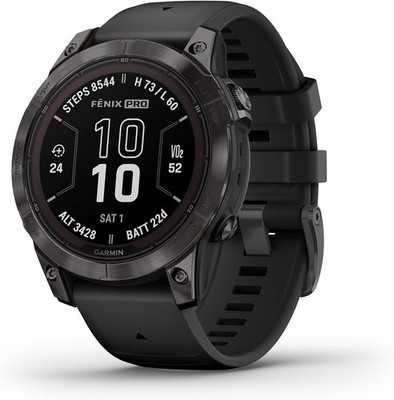
Overview
The fēnix 7 is Garmin’s 47 mm multisport GPS watch with a solar-charging lens, a built-in LED flashlight and a touchscreen layered over the usual five buttons. It was built to replace a phone, a trip-recording GPS and a headlamp backup with a single wrist-worn device. The trade-off is mass: at 79 g it is not a minimalist’s watch, and its software has a reputation for quirks.
Key Specs
| Spec | Detail |
|---|---|
| Weight | 79 g |
| Case size | 47 x 47 x 14.5 mm |
| Display | 1.3 in, sunlight-visible transflective MIP, touchscreen |
| Case material | Fiber-reinforced polymer with titanium bezel |
| Water rating | 10 ATM |
| Battery, smartwatch mode | Up to 18 days (22 with solar) |
| Battery, GPS | Up to 57 hrs (73 with solar) |
| Battery, max-battery GPS | Up to 136 hrs (289 with solar) |
| Battery, expedition mode | Up to 40 days (74 with solar) |
| Flashlight | Built-in LED |

Would the fēnix 7 earn its spot in your pack?
79 g · 2.8 ozAdd the Garmin fēnix 7 to your Gear Closet and see exactly what it does to your base weight, then start packing for your next trip.
Free · No credit card · iOS, Android & web · Trusted by 3,000+ backpackers
Performance
Battery. This is the reason the fēnix line exists. Garmin’s solar figures assume about three hours a day in 50,000-lux conditions, which is a bright, open-sky day. Real-world use lands lower than the headline numbers but still well ahead of mainstream smartwatches. Live Science’s testers got around two weeks while logging 45-minute runs every other day. German outlet Basic Tutorials saw about 14 days in default smartwatch mode and could not reproduce the full 18-day claim. One owner who spends most of the day outdoors reports close to three weeks between charges. A trail-running reviewer found that 2 minutes on the charger bought enough power for more than an hour of GPS tracking, and a full charge takes about 2.5 hours.
GPS mode is where thru-hikers will plan around the spec sheet. iRunFar’s testers say the watch has been through numerous races, including 100-milers, and that the standard GPS-only mode gets through most of them. Turning on multi-band, all-constellation tracking gives the best accuracy but cuts runtime sharply: iRunFar cites about 40 hours for the solar edition, and Basic Tutorials measured roughly 24 hours with all sensors and L5 multi-band running. Music playback is a bigger drain still, with Garmin rating about 10 hours of GPS plus music. For multi-day trips, the expedition mode’s 40-day rating (74 with solar) is the number that matters. In that mode the watch records sparse track points rather than a dense breadcrumb trail.
Navigation. The fēnix 7 moved to a free map manager. Tom’s Guide notes that maps download straight to the watch, with 16 GB of storage on non-sapphire models and 32 GB on sapphire versions. TechRadar’s reviewers called the navigation apps superb. For a hiker, that means a breadcrumb trail, a course to follow and a topographic map on the wrist, all without a phone signal.
Display and controls. The screen is a memory-in-pixel panel rather than AMOLED. TechRadar found it readable in most lighting but short on contrast, with a blue backlight that muddies colors. That same technology is what keeps power draw low, and the display stays legible in direct sun. The touchscreen works well for browsing menus. Garmin kept the physical buttons for use with gloves or wet fingers, and added a guard on the start/stop button to prevent accidental starts or pauses.
Durability. The titanium bezel and fiber-reinforced case carry a 10 ATM rating, so rain, river crossings and swims are not a concern. The fēnix series’ reputation for surviving rock scrapes and years of daily wear is a large part of its appeal.
Sensors and software. Heart-rate accuracy draws the most criticism. Reddit sentiment for the broader fēnix 7 series runs about 71% positive across roughly 700 users, with recurring complaints about inconsistent optical heart rate during intense or non-running activity, software bugs, and sleep or recovery metrics that some users do not trust. Garmin’s later Pro version improved the sensor and display. Meanwhile, TechRadar notes that many of its software features have also reached the older fēnix 7.
Comfort. At 14.5 mm thick, the watch sits tall. Owners and reviewers describe it as bulky for sleep and for smaller wrists; Live Science flagged it as a little bulky for overnight wear. Garmin sells a 42 mm 7S for small wrists and a 51 mm 7X for those who want a larger display and longer battery.
Pros & Cons
Pros
- Battery life of two to three weeks in everyday use, with a solar assist that adds meaningful days in sunny conditions
- Free, downloadable offline maps and strong navigation tools
- Sunlight-readable display with a touchscreen plus physical buttons
- 10 ATM water rating and a titanium bezel
- Built-in LED flashlight for camp chores or a dead headlamp
- Heavily discounted now that newer models exist
Cons
- 79 g and 14.5 mm thick, which is heavy for the ultralight crowd
- Optical heart rate can be inconsistent in hard efforts
- Full multi-band GPS drops runtime to roughly a day
- Reviewers report buggy software and a muted display palette
- Newer fēnix generations offer better GPS and heart-rate sensors
Who Should Buy This
The fēnix 7 suits section hikers and thru-hikers who want one device for navigation, activity logging and health tracking, and who are fine with a watch that is more substantial than a basic tracker. It also suits runners and mountain athletes who want weeks between charges. At this point in the product cycle, it makes the most sense for someone who finds one on sale. TechRadar’s reviewers have said as much, and the fēnix 8 has replaced it at the top of Garmin’s line.
Gram-counters should look elsewhere. Treeline Review’s comparison table lists Garmin’s Enduro 3 at 64 g with a lightweight nylon strap, and simpler watches from other brands weigh less still. Anyone who wants an AMOLED screen or best-in-class heart-rate accuracy should also look at newer models.
Verdict
The fēnix 7 remains one of the better long-trail watches because its battery, maps and build quality hold up where phones and lighter trackers do not. Its weight, bulk and uneven software keep it from being a perfect pick, and the fēnix 8 now leads on GPS and sensors. Buy it on discount for trips measured in weeks rather than days.