Garmin Fenix 5 Review
The Garmin Fenix 5 is a rugged 87 g multisport GPS watch with a two-week smartwatch battery and 60-hour UltraTrac mode, but its GPS and wrist heart rate have limits.
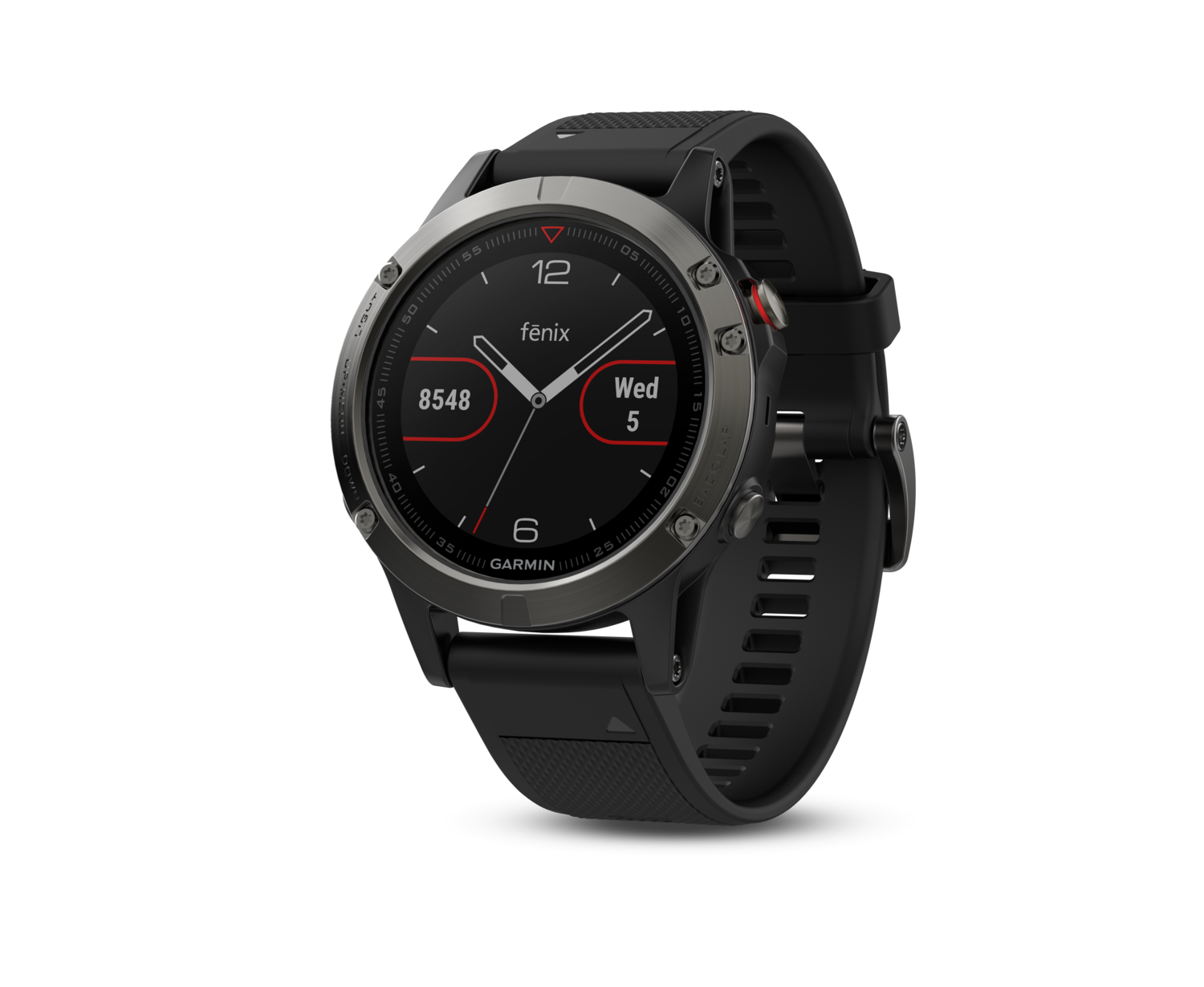
Overview
The Garmin Fenix 5 is a button-driven multisport GPS watch with a barometric altimeter, 3-axis compass and wrist-based heart rate, built for people who want one device on the wrist from trailhead to finish line. It suits hikers and thru-hikers who want a breadcrumb trail, elevation data and multi-day battery without carrying a dedicated handheld. The trade-off is weight and bulk: at 87 g, it is a lot of watch for gram counters, and its GPS and optical heart rate readings are good rather than class-leading.
Key Specs
| Spec | Detail |
|---|---|
| Weight | 87 g |
| Case diameter | 47 mm |
| Case dimensions | 47.0 x 47.0 x 15.5 mm |
| Display | 1.2 in, 240 x 240 |
| Battery (smartwatch mode) | Up to 2 weeks |
| Battery (GPS mode) | Up to 24 hours |
| Battery (UltraTrac mode) | Up to 60 hours |
| Water resistance | 10 ATM (100 m) |
| Sensors | GPS/GLONASS, wrist heart rate, barometric altimeter, 3-axis compass |

Would the Fenix 5 earn its spot in your pack?
87 g · 3.1 ozAdd the Garmin Fenix 5 to your Gear Closet and see exactly what it does to your base weight, then start packing for your next trip.
Free · No credit card · iOS, Android & web · Trusted by 3,000+ backpackers
Performance
Battery. This is where the Fenix 5 earns its place on a trail. Outdoor Gear Lab’s testers ran a continuous GPS activity until the battery died and got just over 20 hours, a little shy of Garmin’s 24-hour claim and about an hour behind the Forerunner 935 in the same test. In ordinary life, with occasional one- to two-hour workouts, the same testers went just under a week between charges. Tom’s Guide measured a 9 percent drop over a two-hour run with GPS and heart rate running, and the same drain over two hours of tracked ski runs. That works out to a full day of hiking with plenty in reserve.
Garmin rates UltraTrac mode, which pings satellites about once a minute instead of every second, at up to 60 hours. Wareable’s early testing was less convincing: its reviewers saw roughly 14 hours of fully tracked hiking and the same drain in UltraTrac, and flagged it as a problem for multi-day hikers. That was an early-firmware review, and the mode is best treated as a trade of track accuracy for endurance, not a guarantee. On a multi-day trip, a small USB charger solves most of the question.
GPS and navigation. Reviewers describe the Fenix 5’s GPS as reliable and usable for hiking. Pocket-lint’s testers saw it lock on within seconds, apart from a 20 to 30 second wait in the Snowdonian hills, and then track a mountain route accurately. Tom’s Guide measured a certified half-marathon course at 13.16 miles. Track-and-lap purists are less impressed. The5KRunner called the accuracy “OK” for the price and reported that the Fenix 5 family was slow to flag off-course wandering in its navigation tests. That’s fine for a trail with a clear tread, less so for precision work. Breadcrumb tracking and the compass handle the basic job of finding the way back to the start.
Altimeter. The barometric altimeter is a core reason to buy a watch like this over a phone-based app. Outdoor Gear Lab’s testing of the related Fenix 5X Plus found the reading accurate over short periods under clear sky. It needed recalibration when a storm rolled in during a hike under tree cover. Expect to re-set elevation at known points like passes and trailheads.
Heart rate. Tom’s Guide found the optical sensor accurate in steady running but slow to respond to changes. Wareable’s HIIT test was harsher: against a chest strap, the wrist sensor stalled well below the true peak. For hiking and steady efforts it is adequate. For interval work, pair a chest strap.
Display and controls. The 1.2-inch, 240 x 240 screen is low-resolution next to a typical smartwatch, a point reviewers raised, but it reads well in bright light. Pocket-lint noted it becomes more visible when light catches it at the right angle. There is no touchscreen. Five physical buttons run everything, and Tom’s Guide pointed out that this is easier with sweaty or gloved hands. Owners moving from touch-screen watches say they miss it at first, then learn the button layout quickly.
Durability. A 100 m water rating, a rugged bezel held by five screws, and the ability to track activities from swimming and paddling to skiing and climbing make this a watch that can take rain, river crossings and a night in the sleeping bag. Bands are easy to swap.
Pros & Cons
Pros
- Two-week smartwatch battery and about 20 hours of tested continuous GPS
- UltraTrac mode rated at 60 hours for longer outings
- Physical buttons work with gloves and wet hands
- Barometric altimeter, compass and breadcrumb navigation in one unit
- 100 m water resistance and a rugged build
- Tracks a very wide range of activities, including swimming
Cons
- At 87 g and 15.5 mm thick, it is bulky and heavy for a wrist-worn device
- GPS accuracy is serviceable but not class-leading, and the Forerunner 935 edged it in testing
- Optical heart rate lags during intervals
- Low-resolution display compared with modern smartwatches
- Altimeter needs periodic recalibration
Who Should Buy This
The Fenix 5 fits section hikers, peak-baggers and weekend backpackers who want navigation basics, elevation and a week-plus of battery on one wrist, and who also run, swim or ski. It is also a sensible pick on the used market for hikers who want Garmin’s outdoor feature set without paying for current flagship watches. Ultralight purists chasing every gram, runners who need track-grade GPS precision, and anyone who wants a touchscreen or onboard maps (that is the 5X’s territory) should look elsewhere.
Verdict
The Garmin Fenix 5 is a tough, long-lasting outdoor watch whose features outstrip its precision: it navigates, logs elevation and survives weather without fuss. Accept the weight and the so-so wrist heart rate, and it is a capable trail companion. A rating of 7.5 reflects strong endurance and versatility held back by bulk and middling accuracy.