Anker PowerCore 5000 Review
A compact, cylindrical power bank at 136g, the Anker PowerCore 5000 is a budget-friendly option for short trips — but dated Micro-USB and a weak mAh/oz ratio limit its appeal.
Overview
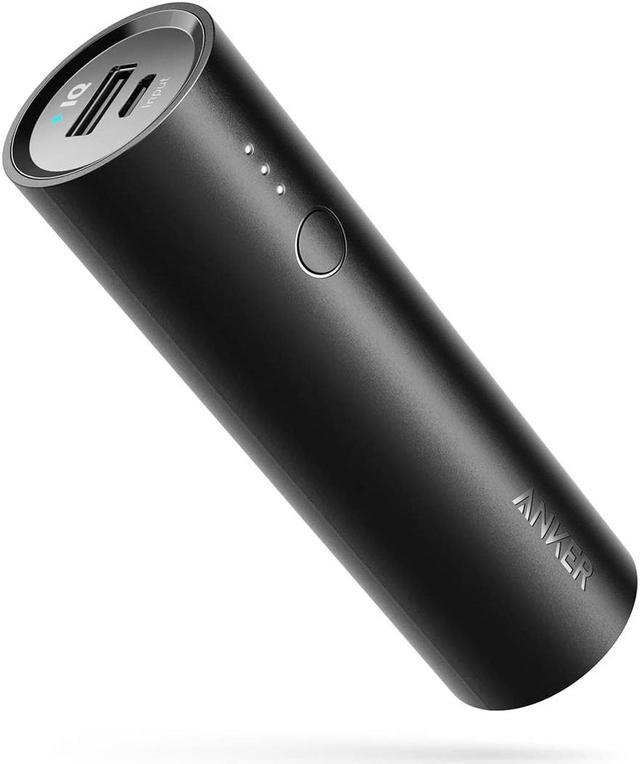
The Anker PowerCore 5000 (model A1109) is a lipstick-style cylindrical power bank aimed at hikers and travelers who need a single phone top-up in the lightest, smallest package possible. It packs a 5,000mAh cell into a cylindrical body measuring about 1.3 inches in diameter and 4.2 inches long, weighing in at 4.71 oz. It’s a no-frills device — one port in, one port out — that makes the most sense for overnight or weekend trips where a single smartphone is your only device.
Key Specs
| Spec | Detail |
|---|---|
| Model | A1109 |
| Weight | 136g (4.8 oz) |
| Capacity | 5,000mAh |
| Input | 5V/2A via Micro-USB |
| Output | 5V/2A via 1× USB-A |
| Ports | 1× Micro-USB input, 1× USB-A output |
| Dimensions | 4.21 × 1.3 × 1.3 in |
| Charging Tech | PowerIQ + VoltageBoost |
| Recharge Time | ~2.5 hrs (with 2A adapter) |
| Warranty | 18-month limited |

Would the PowerCore 5000 earn its spot in your pack?
136 g · 4.8 ozAdd the Anker PowerCore 5000 to your Gear Closet and see exactly what it does to your base weight, then start packing for your next trip.
Free · No credit card · iOS, Android & web · Trusted by 3,000+ backpackers
Performance
Usable Capacity
The headline number to manage here is efficiency. Anker themselves state that the PowerCore 5000’s output efficiency is 60–70%, meaning approximately 30–40% of the rated capacity can’t reach your device due to efficiency losses. That tracks with independent lab testing: at a 2A discharge rate, one test pulled 3,259mAh out of the bank; at 1A it was only marginally better at 3,343mAh. In practical terms, a fully recharged PowerCore 5000 can generally deliver at least one charge to an iPhone 12 with its 2,815mAh battery. In real-device testing, it charged a Samsung Galaxy S8 1.12 times before running dry. That’s a solid one full charge for most modern smartphones — just don’t expect a top-off on day three of a longer trip.
Charging Speed
The PowerCore 5000 uses two technologies: PowerIQ, which detects and delivers the fastest possible charge to any device up to 2A, and VoltageBoost, which compensates for cable resistance to maintain consistent output speed.
In practice, this means it’ll charge a mid-range Android or iPhone at a reasonable pace — not blazing fast, but not frustratingly slow either.
The bank itself recharges in about 2.5 hours with a 2A wall adapter
, which means you can top it up overnight at a trailhead or in town without eating up your whole resupply stop.
Low-Current Device Compatibility
This is the sneaky gotcha for backpackers. The PowerCore requires connected devices to draw at least 30–90mA to continue operating; if a device’s power requirement falls below that minimum threshold, the charging process won’t start or will cut off. If you’re planning to trickle-charge a GPS unit, a headlamp with USB input, or a Garmin inReach, you may find the bank shuts itself off before the job’s done. Test your specific gear before relying on it in the field.
Form Factor
The cylindrical shape is genuinely useful on trail. The USB output port sits on the end of the cylinder, so you can plug in a cable and charge while the bank rides in one hip-belt pocket and your phone rides in another, routing the cable around your waistband. It’s not a groundbreaking system, but it works.
The mAh/oz Math
At ~1,040mAh per ounce, the PowerCore 5000 is not a standout in the efficiency-per-gram category. The Nitecore NB10000 Gen4 delivers roughly twice the capacity for only 0.4oz more — a meaningful trade-off that any weight-conscious hiker should calculate before defaulting to this bank. For a one-night trip, the PowerCore 5000’s capacity — roughly 1 to 2 smartphone charges — is appropriate sizing. Beyond that, you’ll likely want more capacity.
Pros & Cons
Pros
- Genuinely compact and pocketable — the cylindrical shape fits anywhere
- Recharges in ~2.5 hours, easy to top up at a motel or hostel
- Anker power banks are reliable and well-built, consistently outperforming most generic alternatives in safety and long-term battery health.
- Affordable entry price — easy to justify as a backup or secondary bank
- MultiProtect safety system includes surge protection, short circuit prevention, and additional safety features.
- 18-month limited warranty
Cons
-
Micro-USB input only — in a USB-C world, this means an extra cable to pack
-
Single USB-A output port; you can only charge one device at a time
-
Pass-through charging has been disabled to protect battery lifespan
— you can’t recharge the bank and a device simultaneously
-
Poor mAh/oz ratio compared to the best ultralight alternatives
-
No USB-C output limits compatibility with modern charging cables
-
Low-current auto-shutoff is a real problem for GPS devices and other small electronics
-
No Quick Charge or PD support
Who Should Buy This
The PowerCore 5000 is best suited to weekend backpackers and one-night campers who carry a single modern smartphone and want the smallest, lightest insurance policy they can find. Due to its limited capacity, it’s not the best choice for multi-day adventurers loaded up with energy-hungry gadgets — but if you’re heading into the backcountry with just a smartphone, it’s a solid and highly portable companion. If you’re a serious thru-hiker or ultralight purist who runs a phone, a GPS, and earbuds, spend a little more and buy a 10,000mAh bank with a better mAh/oz ratio and a USB-C port.
Verdict
The PowerCore 5000 does exactly what it promises: one phone charge, minimal weight, minimal fuss, minimal cost. Anker products have an excellent reputation among thru-hikers, and the brand’s reliability is genuine. But the Micro-USB input is a real anachronism at this point, the mAh/oz ratio is pedestrian, and the low-current shutoff will catch you off guard if you try to charge anything other than a phone. If the price is right and you only need a single overnight buffer, it earns its spot in your kit — but it shouldn’t be the default choice for anyone doing trips longer than two days.