ACR Bivy Stick Review
A hands-on look at the ACR Bivy Stick, a 100g Iridium satellite communicator that trades a built-in screen for a lower price and phone-based messaging.
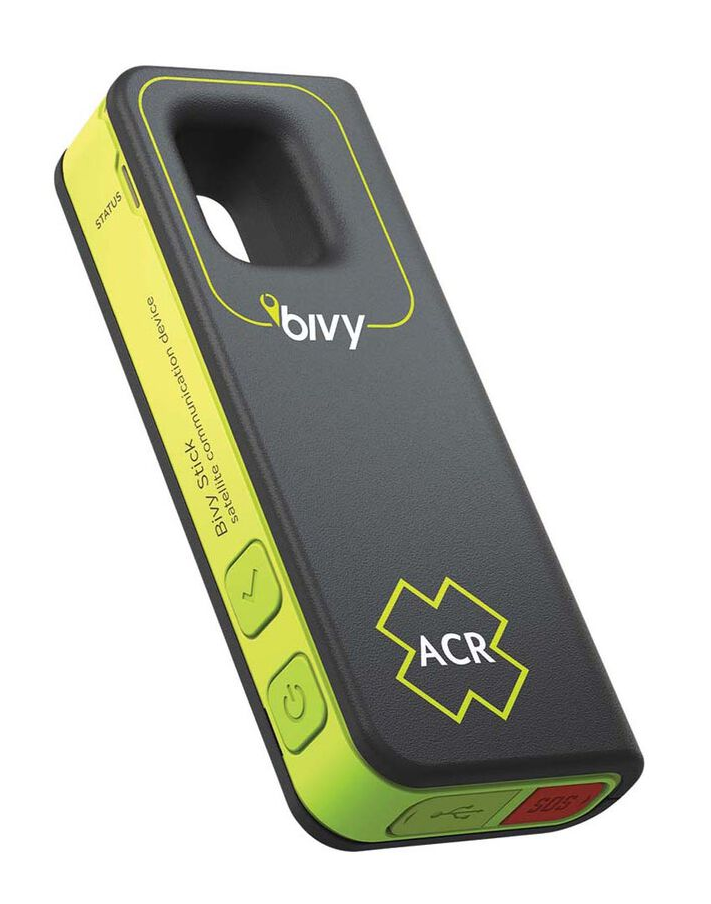
Overview
The Bivy Stick is ACR’s entry into the crowded satellite communicator market — a screen-less, Bluetooth-only device that leans on your phone for its interface instead of building in its own display. At 100g it undercuts most of the competition on weight, and ACR (a company with decades of history in EPIRBs and PLBs) backs it with a 24/7 SOS monitoring center. It’s aimed at hikers, paddlers, and backcountry travelers who want two-way satellite texting and tracking without paying Garmin inReach prices.
Key Specs
| Spec | Detail |
|---|---|
| Weight | 100 g (3.35 oz) |
| Dimensions | 4.47 x 1.85 x 0.83 in |
| Satellite network | Iridium (100% global coverage) |
| Connectivity | Bluetooth (iOS & Android app required) |
| Battery | 1,400 mAh Li-Poly, rechargeable |
| Water resistance | IPX7, MIL-STD-810 |
| SOS monitoring | 24/7 via Global Rescue |
| SKU | 4601 |
Would the Bivy Stick earn its spot in your pack?
100 g · 3.5 ozAdd the ACR Bivy Bivy Stick to your gear closet and see exactly what it does to your base weight — then build your next packing list around it. Free, in about two minutes.
Free · No credit card · iOS & Android · Trusted by 3,000+ backpackers
Performance
The headline feature here is what the Bivy Stick doesn’t have: a screen. Every message, waypoint, and check-in gets composed and read through the companion app on your phone, which is how ACR keeps the device down to 100g and the price well below screen-equipped rivals like the Garmin inReach Mini 2. On the trail, that means the Bivy Stick lives in a shoulder pocket or clipped to a pack strap while your phone (in airplane mode to save its own battery) does the actual typing. It’s a fine trade-off if you already carry a phone as your primary nav tool, but it does mean the device is functionally dead without one — there’s no way to compose a custom message or check a map if your phone dies or gets soaked.
Using the Iridium Short Burst Data satellite network, it enables two-way text messaging, GPS location sharing, SOS communication, and weather updates well beyond cellular coverage.
One genuinely useful wrinkle:
it works anywhere you can see the sky and is able to send text messages to phone numbers or email addresses
directly — you’re not limited to messaging other Bivy users through a proprietary inbox. For solo hikers who need to text a spouse’s regular cell number, that’s a meaningful convenience.
Battery life is one of the stronger points on paper. The Bivy Stick’s battery life is rated up to 120 hours per charge, powered by a 1,400 mAh battery. That’s a real-world estimate rather than a guarantee — actual runtime will depend heavily on tracking interval and how often you’re sending messages, and ACR itself is upfront that battery life depends on usage, but the Bivy Stick can typically last up to several days with normal use. I’d treat “several days” as the honest baseline for anyone running frequent tracking pings, and reserve the 120-hour figure for occasional check-ins only.
The check-in button is a nice bit of design: the check-in button on the device sends unlimited free preset messages and your location without using your phone. That’s handy if your phone is buried at the bottom of your pack or you just don’t want to deal with the app every time you reach camp.
One feature that separates it from most Bluetooth-only competitors is tri-network capability, which seamlessly transitions between cellular, Wi-Fi, and satellite networks depending on availability, saving satellite credits while ensuring you’re always connected. In practice, this should mean fewer burned satellite messages when you’re in and out of fringe cell coverage — a smart way to stretch a message-limited plan.
On durability, ACR rates it IPX7 waterproof, making it resilient in wet or rugged conditions, and the MIL-STD-810 rating suggests it’s built to shrug off drops and temperature swings you’d expect on a multi-day trip. I haven’t seen independent drop-test data to confirm this beyond spec-sheet claims, so treat the ruggedness rating as manufacturer-verified rather than field-proven by a large user base.
Where the Bivy Stick pulls ahead on cost is the subscription structure. Unlike Garmin, which charges a separate activation fee on top of monthly plans, ACR offers no activation fees ever and the most flexible Iridium subscription plans — though you should know going in that a minimum of four consecutive months of Plus or Unlimited plans is required upon activation. That’s a fair trade for skipping the activation fee, but budget for it before you buy.
User-facing reviews of the Bivy Stick specifically are thinner on the ground than for the Garmin inReach line — there’s no large, established r/Ultralight thread dogpiling on it the way there is for the Mini 2. The handful of dedicated reviews I found were broadly positive, with one reviewer calling it “the top spot on my list of recommended devices” after extended testing, but I’d treat that as one data point rather than a consensus. If you’re coming from Garmin’s ecosystem, know that you’re trading a decade of field-proven reliability and a standalone screen for a lighter, cheaper device with a shorter track record.
Pros & Cons
Pros
- 100g weight is genuinely light for a two-way satellite communicator — noticeably less than screen-equipped competitors
- No activation fee, and tri-network switching helps conserve satellite message credits
- Dedicated phone number/email lets you text non-Bivy users directly, not just other app users
- Check-in button works independently of your phone
- IPX7 + MIL-STD-810 rated for durability
Cons
- No built-in screen — fully dependent on your phone’s battery and the Bluetooth connection to compose or read messages
- Requires a minimum four-month subscription commitment upon activation
- Smaller, thinner base of independent long-term user reviews compared to Garmin’s inReach line
- 120-hour battery claim is a best-case figure; heavier tracking use will burn through it faster
Who Should Buy This
The Bivy Stick makes the most sense for hikers who already navigate primarily with a phone app and just want a lightweight, affordable safety net layered on top — not a standalone GPS unit. It’s a strong pick for weight-conscious thru-hikers and backpackers who message infrequently and are comfortable managing everything through an app rather than a device screen. Anyone who wants a device that works when their phone is dead, or who prefers physical buttons and an on-device map, will be better served by something like the Garmin inReach Mini 2.
Verdict
The ACR Bivy Stick delivers real two-way satellite messaging and 24/7 SOS monitoring at a lighter weight and lower cost than most screen-equipped rivals, with a genuinely useful ability to text regular phone numbers directly. The catch is that it’s entirely phone-dependent and comes with a thinner independent review history, so I’d call it a smart budget-and-weight pick for phone-reliant hikers, but not yet the no-brainer pick for anyone who wants a battle-tested, standalone backup. I’d rate it a 7/10.