Trangia Spirit Burner B25 Review
Packstack is reader-supported. When you buy through links on our site, we may earn an affiliate commission. This does not affect the independence or objectivity of our reviews.
A deep dive into Trangia's legendary brass alcohol burner — bombproof, silent, and simple, but not for speed demons.
Overview
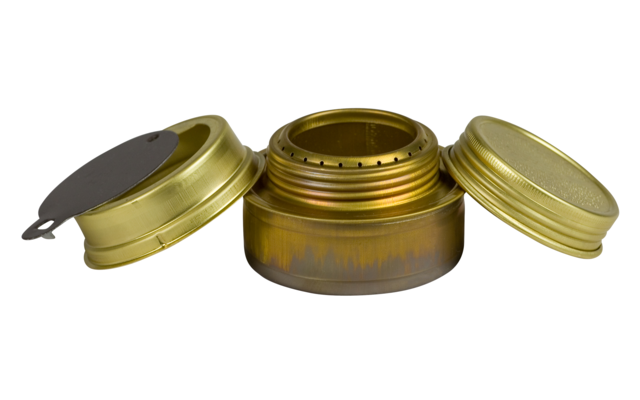
The Trangia B25 is the brass alcohol burner that’s been sitting inside every Trangia storm cooker set since the 1950s, and it’s also sold on its own for anyone building a custom alcohol-stove setup. It’s not a stove in the “screw a canister on and go” sense — it’s a fuel cup with a simmer ring and a lid, meant to be paired with a pot stand or windscreen (Trangia’s own triangle stand, a cross stand, or a DIY setup). If you want dead-simple, maintenance-free cooking and don’t mind trading some speed for reliability, this is the burner people seem to keep buying for decades.
Key Specs
| Spec | Value |
|---|---|
| Weight | 110 g (3.9 oz) |
| Material | Brass |
| Output | 1,000 W / 3,500 BTU |
| Fuel capacity | 100 ml |
| Burn time (full tank) | ~25 min |
| Boil time (1L) | ~10 min (claimed) |
| Dimensions | Ø75 x 42 mm |
| Includes | Burner, simmer ring, cap with O-ring, yellow storage bag |
Would the Spirit Burner B25 earn its spot in your pack?
110 g · 3.9 ozAdd the Trangia Spirit Burner B25 to your gear closet and see exactly what it does to your base weight — then build your next packing list around it. Free, in about two minutes.
Free · No credit card · iOS & Android · Trusted by 3,000+ backpackers
Performance
The B25’s whole reputation rests on being unglamorous and unbreakable, and that tracks with what owners actually report. Multiple long-term users describe it as essentially bulletproof — this stove is essentially bulletproof, perfectly simple, idiot proof, durable, fairly efficient and quiet. That’s not a fluke opinion; a Trailspace reviewer with a decade-plus of use called it “quite simply bullet proof” and noted this stove is quite simply bullet proof and you can always rely on them to heat whatever you need. With zero moving parts — no jets, no pump, no valve — there’s genuinely very little that can fail.
Lighting it is as simple as it sounds. One long-time user’s routine is just take this out, take the top off and light it, with no fiddling with canisters, priming, or attaching anything. A ferro rod works fine for ignition, and once lit, the flame is nearly invisible in daylight — a real safety consideration, since methylated-spirits have a very clear flame because of the lack of impurities in the fuel, and it’s quite possible to have the stove lit without being immediately aware and come in contact with the flame. Get in the habit of waving a hand over it before you reach in.
On boil times, Trangia’s claimed 10-minute liter is roughly in line with what most careful users report, though not everyone hits that number. Backdoor Survival’s test ran long — at just past the 15 minute mark the water was about to boil, so the boil time was twice as long as Trangia claims — but that test used 91% isopropyl rather than denatured alcohol, and isopropyl is explicitly the wrong fuel here. Multiple sources flag this: don’t use isopropyl alcohol, it makes a mess — denatured alcohol or Heet gas line antifreeze burns much cleaner. Use the right fuel and soot buildup mostly disappears — one owner running clean ethanol reported if the distance of the burner to the pot or pan is correct, there is very little soot, while another switching from homemade stoves said flatly there was no soot from this stove — the other stoves that I have used generated too much soot regardless of fuel and were black with soot.
Where the B25 clearly loses to canister and white-gas stoves is raw speed and heat control at the high end. As one reviewer put it, unpressurized alcohol burners “do not burn as hot,” trading roughly slightly longer boil times for the tradeoff of 4 minutes on white gas versus 10 minutes on a Trangia burner. The flip side is near-silent operation and genuine simmer control via the included ring — one common complaint of alcohol stoves is the inability to control heat, and Trangia addresses that with the included simmer ring. Cold weather performance gets debated online, but at least one Alaska-based user reports no issues, noting some people say it is not good in cold weather, but I live in Alaska and I have never had a problem — alcohol stoves are what the mushers use on the Iditarod.
The biggest practical gotcha for new buyers: this is a burner, not a complete stove. Reviewers consistently point out that it’s what you’d expect, but you still need to come up with a pot stand — either a cross stand or a pot stand — and if you’re looking at this, you need a few weeks of YouTube searching to find the setup you really want. Budget for a stand or windscreen before your first trip, or just buy the full Trangia storm cooker set instead.
Pros & Cons
Pros
- Zero moving parts, brass construction — feels and behaves like it’ll outlast you
- Dead simple to light and use, no priming or pumping
- Nearly silent operation
- Simmer ring gives real heat control, rare for an alcohol stove
- Runs on cheap, widely available denatured alcohol fuel
- Very little soot when used with the correct fuel
Cons
- Sold as a bare burner — you need a separate pot stand/windscreen to actually cook
- Slower than canister or white gas stoves (~10 min/liter vs. ~4 min)
- Nearly invisible flame in daylight is a real burn hazard if you’re not careful
- Isopropyl alcohol produces heavy soot and a messy, incomplete burn — must use denatured alcohol
- 110 g is heavier than a soda-can DIY stove, though far more durable
Who Should Buy This
This is the right burner for hikers and campers who value reliability and simplicity over speed — Duke of Edinburgh program leaders, base-camp cooks, and anyone who’s tired of maintaining finicky canister valves or white-gas pumps. It also makes sense as a lightweight, packable backup stove for people who already run gas but want a zero-maintenance failsafe. If you’re chasing the fastest boil times or need to melt snow efficiently in serious cold, look at a canister or liquid-fuel stove instead — this isn’t that tool.
Verdict
The B25 earns its decades-long reputation: it’s about as close to unbreakable as a stove gets, dead simple to use, and cheap to feed. Just budget for a pot stand and the right fuel, and set expectations for a 10-minute boil rather than a 4-minute one. I’d rate it an 8/10 — not because it’s flashy, but because it does exactly what it promises, every single time.