Soto WindMaster Review
The Soto WindMaster is a regulated, wind-resistant canister stove at 60–87 g depending on pot support, with a real simmer and a built-in igniter.
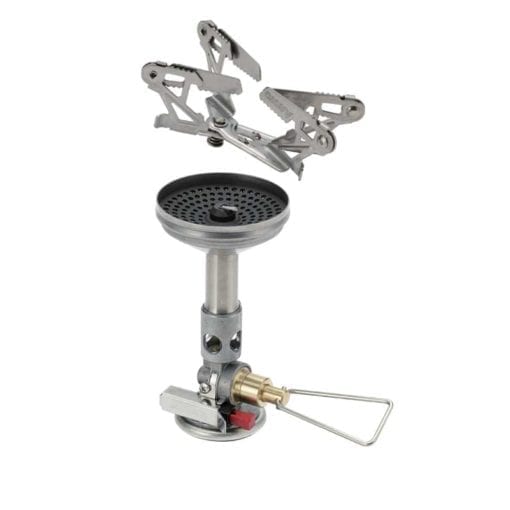
Overview
The Soto WindMaster is a regulated upright canister stove with a recessed, concave burner head that does the job of a windscreen without carrying one. It suits thru-hikers and exposed-terrain backpackers who want a stove that keeps burning when the weather turns, and who will accept a removable pot support in exchange. The headline trade-off: the pot supports detach from the stove, which is how Soto gets the weight down and also the stove’s most common complaint.
Key Specs
| Spec | Value |
|---|---|
| Model | OD-1RX |
| Weight | 60–87 g depending on version |
| Output | 11,000 BTU / 2,800 kcal/h / 3,260 W |
| Burn time | ~1.5 hrs on a 250 g canister |
| Boil time | 2 cups in under 2.5 min in wind |
| Max pot size | 2 L |
| Igniter | Built-in stealth piezo |
| Fuel | Isobutane/butane/propane canister (not 100% propane) |
| Pot support | 4Flex (4-prong) or TriFlex (3-prong), removable |
| Stowed size, 4Flex | 47 × 77 × 44 mm |
| Stowed size, TriFlex | 94 × 10 × 33 mm |
Versions compared
| Image | Version | Weight | vs. lightest |
|---|---|---|---|
 | Stove Only | 60 g (2.1 oz) | lightest |
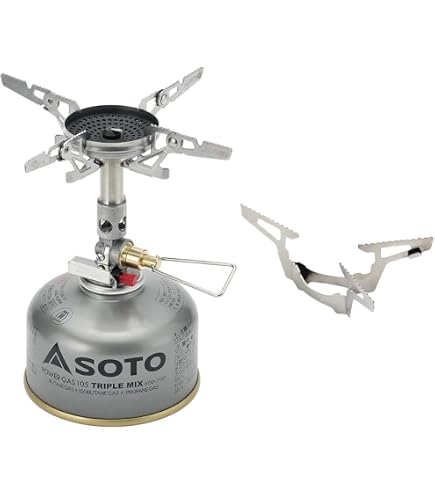 | Stove Only TriFlex | 67 g (2.4 oz) | +7 g |
| with 4Flex with Case | 87 g (3.1 oz) | +27 g |

Build your Gear Closet
View all of your gear in one place, create packing lists and hit the trail with confidence. Available on iOS, Android and the web.
Get StartedPerformance
Wind. The burner head sits slightly below its outer housing, and the low-profile supports hold the pot close to the flame. Together they shield the flame from gusts. Owners report cooking without a windscreen on exposed Scandinavian routes, and one hiker described getting through 50–60 mph gusts in Iceland. It is still an upright canister stove. In sustained alpine gales or deep cold, a remote-canister stove or an integrated system like the MSR Windburner is the better tool.
Boil speed and fuel. In a controlled indoor test with an aluminum pot, 500 ml of room-temperature water reached a rolling boil in 1 minute 53 seconds on 9 g of fuel. A separate comparison clocked 2 cups in 106 seconds and rated the WindMaster the most fuel-efficient stove in the group. Zpacks puts the draw at roughly 7 g (about ¼ oz) per 2-cup boil. Soto rates a 250 g canister at about 1.5 hours of burn, around 30 minutes longer than the MSR PocketRocket Deluxe manages on the same canister, according to one UK reviewer.
Simmer and noise. The flame spreads into a flat disc that hugs the pot, and the valve can be dialed down low without the flame dying. That makes eggs, fish and pasta sauce realistic, not just rehydrated dinners. Testers also rank it among the quieter canister stoves, well below the PocketRocket’s roar. The valve draws one complaint: it can feel touchy near full output and could use more resistance for fine adjustments.
Cold and altitude. The micro-regulator holds output steady as the canister empties and the temperature drops. Hikers in the high Rockies and in winter conditions report reliable performance without warming the canister. Below-freezing temperatures that persist for days still call for a remote-canister stove.
Igniter. The stealth piezo is tucked into the stem, which protects it from knocks and trims weight. One long-term reviewer needed a single replacement over more than a decade of use. Soto does not guarantee operation above 10,000 feet, though hikers have lit it at 11,000. A backup lighter weighs almost nothing and belongs in the kit.
Pot supports. The 4Flex spans about 142 mm (5⅝ in) and gives a wide, stable platform. It also changes the flame pattern in a way that owners credit for the stove’s wind and efficiency numbers. The TriFlex trades that for weight: at 94 mm across (100 mm outer diameter by another spec), it suits small, tall solo pots, and reviewers note it sits a little higher over the burner. Either support clips on and folds flat, but both can fall off and are fiddly to refit. Losing one in the field would end the stove’s usefulness until the next town.
Height. At roughly 3.6 inches, the stove stands tall on the canister. A big pot on a small canister over uneven ground needs some attention.
Track record. The WindMaster has been on the market since 2013. It ranked as the highest-rated stove in the Pacific Crest Trail Class of 2019 survey, drawn from 846 completed responses. Treeline Review, after seven years and more than 5,000 miles of side-by-side testing against other canister stoves, called it the best backpacking stove available.
Choosing a Version
The burner, valve and igniter are identical across all three versions. What changes is the pot support and the packaging.
- Stove Only (60 g): The stem and burner crown with no pot support. A support must be fitted before it can hold a pot, so this suits owners who already have a 4Flex or TriFlex and want a spare or a replacement.
- Stove Only TriFlex (67 g): The stove with the 7 g three-prong support. It is among the lightest fully featured regulated stoves, and the right choice for solo hikers with a narrow pot under about 800 ml. Pots wider than roughly 6 inches are better on the 4Flex.
- With 4Flex with Case (87 g): The stove with the 26–27 g four-prong support and a stow case. It holds pots up to 2 L and is the more stable of the two, so it fits two-person cooking, wider pots and anyone who cooks real meals. The extra 20 g over the TriFlex is small for the stability it buys, and testers who had both tended to keep the 4Flex on by default.
Pros & Cons
Pros
- Wind resistance built into the burner, with no separate windscreen needed
- Regulated output holds in the cold and as the canister drains
- Simmers well, with a flat flame that spreads heat evenly
- Quiet for a canister stove
- Built-in igniter adds no separate lighter weight
- Fuel-efficient, at about 7 g per 2-cup boil
- 67 g with the TriFlex, 87 g with the 4Flex
Cons
- Pot supports are detachable and finicky to refit; losing one is a real risk
- Tall profile raises the center of gravity with large pots on small canisters
- Valve is touchy at high output
- Roughly $70, expensive for a lightweight canister stove; the TriFlex is a separate purchase of about $10 for buyers of the 4Flex model
- Upright design is a poor match for sustained sub-freezing use
Who Should Buy This
Thru-hikers and backpackers working above treeline, on long exposed routes or in wet, windy regions like the Rockies, Cascades, Iceland and Scandinavia. It also suits anyone who cooks rather than just boils water. Solo gram-counters with a small pot should take the TriFlex version. Couples and larger-pot cooks should take the 4Flex. Winter campers, snow melters and anyone who wants pot arms permanently attached should buy a remote-canister stove or a folding-arm model instead.
Verdict
The WindMaster is the best all-round regulated canister stove for three-season backpacking. It is wind-resistant, fuel-efficient, quiet and light enough that its removable supports are the only real nuisance. Buy the 4Flex version by default and the TriFlex only if every gram and a small pot justify it.