SOTO Amicus Cook Set Combo Review
Packstack is reader-supported. When you buy through links on our site, we may earn an affiliate commission. This does not affect the independence or objectivity of our reviews.
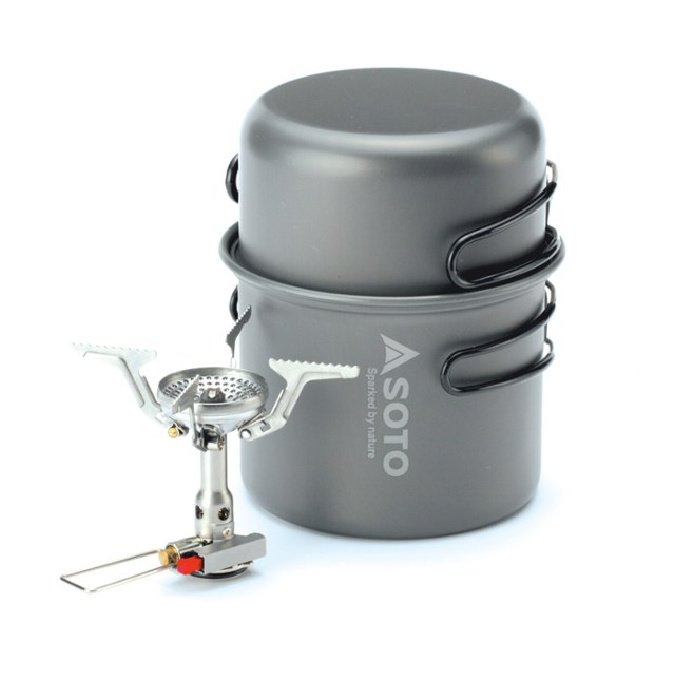
The SOTO Amicus Cook Set Combo pairs a capable ultralight canister stove with a two-pot hard-anodized aluminum cookset at a price that's hard to argue with.
Overview
The SOTO Amicus Cook Set Combo bundles SOTO’s well-regarded Amicus canister stove with a two-piece hard-anodized aluminum pot set — a 1,000ml main pot and a 500ml pot that doubles as a lid. At 317g for the whole system, it’s not the lightest cook setup you can build, but it’s a genuinely complete, trail-ready kit at a price that’s difficult to beat. It targets a wide audience: beginners who want a no-fuss first setup, and experienced backpackers who want a reliable spare or a budget-conscious option for a trip where they don’t want to risk their nicer titanium cookware.
Key Specs
| Spec | Value |
|---|---|
| System Weight (stove + pots) | 317 g (11.2 oz) |
| Stove Weight | 82 g (2.9 oz) with Stealth Igniter |
| Stowed Size (stove) | 4.3 × 4.0 × 7.5 cm |
| Pot Volumes | 500 ml + 1,000 ml |
| Pot Material | Hard-anodized aluminum |
| Heat Output | 10,210 BTU (2,600 kcal/h) |
| Burn Time | ~1.5 hrs with 250 g (8 oz) canister |
| Fuel Type | Isobutane canister (standard Lindal thread) |
| Valve System | Triple O-ring |
| Igniter | Piezo (Stealth Igniter) |
| Pot Supports | 4 spring-loaded, riveted arms |
| Includes | Stove, 500 ml pot/lid, 1,000 ml pot, mesh stuff sack |
Would the Amicus Cook Set Combo earn its spot in your pack?
317 g · 11.2 ozAdd the SOTO Amicus Cook Set Combo to your gear closet and see exactly what it does to your base weight — then build your next packing list around it. Free, in about two minutes.
Free · No credit card · iOS & Android · Trusted by 3,000+ backpackers
Performance
Heat output and boil time are where the Amicus stove earns its stripes. In a head-to-head informal test one REI reviewer documented, the Amicus boiled 2 cups of water in 2 minutes 20 seconds in windy, 68°F conditions, versus 4 minutes 15 seconds for a Snow Peak GigaPower. FarOut’s testing found similar results: the Amicus boiled 2 cups of water in 110 seconds and is one of the lightest stoves tested. It outperformed the MSR PocketRocket and Snow Peak LiteMax in both boil times and fuel efficiency. Those are meaningful real-world numbers.
Wind resistance is the stove’s defining design feature. The stove has a slightly recessed burner and a raised burner crown, which serves to protect the flame from wind — SOTO was the first to engineer this capability. The stove burns efficiently and holds up in windy conditions, though wind does increase cooking times and fuel consumption. It has performed well in high alpine, desert, and boreal forest environments. That said, OGL’s lab testing adds nuance: the Amicus saw about a 20% reduction in fuel efficiency in friendly wind, but completely blew out with moderate to strong gusts, especially at lower simmer settings. The takeaway: it handles everyday camp breezes without complaint, but it’s not a replacement for the WindMaster when conditions get serious.
Simmer control gets above-average marks for this class of stove. The long wire fuel valve allows you to dial down the burner to sustain a low enough flame to simmer without flickering out. The valve adjusts steadily and slowly, providing a huge range of temperatures from barely lit to roaring hot. CleverHiker is a little less enthusiastic, noting the Amicus has some simmer control but probably enough only to gently reheat a meal, and they wouldn’t count on it for anything more complex like sautéing. My read: it simmer better than most cheap stoves, but it’s not a precision tool.
Fuel efficiency sits at average for the category. The Amicus uses approximately 0.28 ounces of fuel per boil. For a solo hiker running mostly freeze-dried meals and coffee, one 100g canister can stretch 3–4 days; a 250g canister will comfortably cover a week. FarOut estimates a maximum of 13 two-cup boils per 100g canister.
The pot supports are a genuine highlight — one of those details that separates SOTO from the crowd. The Amicus uses four pot supports rather than the typical three, and its supports have more and more precisely-made teeth that grip pots better. The moving parts are riveted and notched as opposed to screwed in place, reducing the likelihood of things coming loose. In practice, the stability difference is noticeable, especially with a full 1L pot.
The piezo igniter is the system’s most cited weak point. The stove typically lights on a single push of the red button, and SOTO’s piezo igniters are head and shoulders above those on MSR or Jetboil — but they are still susceptible to environmental wear and tear. Multiple long-term users report the igniter degrading over time. One reviewer’s Amicus igniter gave up the ghost after relatively few uses. A JMT thru-hiker reported the igniter was unreliable as an ignition source, requiring multiple attempts and fuel flow adjustments to light. Carry a backup lighter — it’s not optional, it’s required.
The included pots are functional and cook evenly, but they’re the weakest part of the combo for weight-conscious hikers. For such a small stove, the included pots are on the larger side; typically when people are after an ultralight stove, they choose a pot to match. The hard-anodized aluminum finish is durable for general use, but at least one REI reviewer reported rusting where the walls met the bottom after about a year — which shouldn’t happen with properly anodized aluminum and suggests a possible quality control inconsistency. Worth watching.
One useful bit of kit trivia: the Amicus is compact enough to fit inside the included pot with an 8 oz fuel canister and a mini lighter, so the whole system nests into a tidy package for packing.
Pros & Cons
Pros
- Stove weight (82g) is competitive with the best ultralight canister stoves
- Four riveted pot supports provide outstanding stability vs. three-arm competitors
- Raised burner crown delivers real wind resistance for a non-regulated stove
- Long wire valve gives genuinely usable simmer control
- Full kit nests inside the 1L pot — compact and self-contained
- Excellent value: buying the stove alone costs nearly as much as the full combo
Cons
- Piezo igniter has a documented track record of failing with extended use — always carry a lighter
- 1L + 500ml hard-anodized pots add meaningful weight vs. titanium alternatives
- No pressure regulator means performance drops as canister empties and in cold temps
- Blows out in moderate-to-strong wind at low flame settings
- Pot arm deployment can be fiddly with cold hands
- Isolated reports of pot seam corrosion are worth monitoring over time
Who Should Buy This
This combo makes the most sense for newer backpackers who want a complete, reliable system without the research overhead of matching stove to cookware, and for budget-minded experienced hikers heading on shorter 3-season trips where saving every gram isn’t the priority. For general 3-season backpacking, the Amicus hits a sweet spot between price, portability, stability, reliability, and efficiency. If you’re a gram-counter planning a JMT or PCT thru-hike, you’ll likely swap the aluminum pots for titanium — but the stove itself can absolutely stay in the kit. Skip the combo if you primarily cook in brutal wind or at altitude in cold temperatures; that’s when the WindMaster’s pressure regulator earns its keep.
Verdict
The SOTO Amicus stove is the real product here — it’s a well-engineered, genuinely capable burner that punches above its price class in stability and wind performance. The bundled aluminum pots are adequate but will frustrate weight-focused hikers. Where the combo shines is value: you can find stoves that perform better in any single metric, but it’s hard to find one that performs as well across all metrics at such an affordable price. Carry a backup lighter regardless, treat the igniter as a bonus rather than a primary system, and this is a kit that will serve you well for years. 8/10.