Primus Power Gas Review
Primus Power Gas is a cheap, widely sold three-season canister blend that lights reliably above freezing but fades fast as temperatures and fuel levels drop.
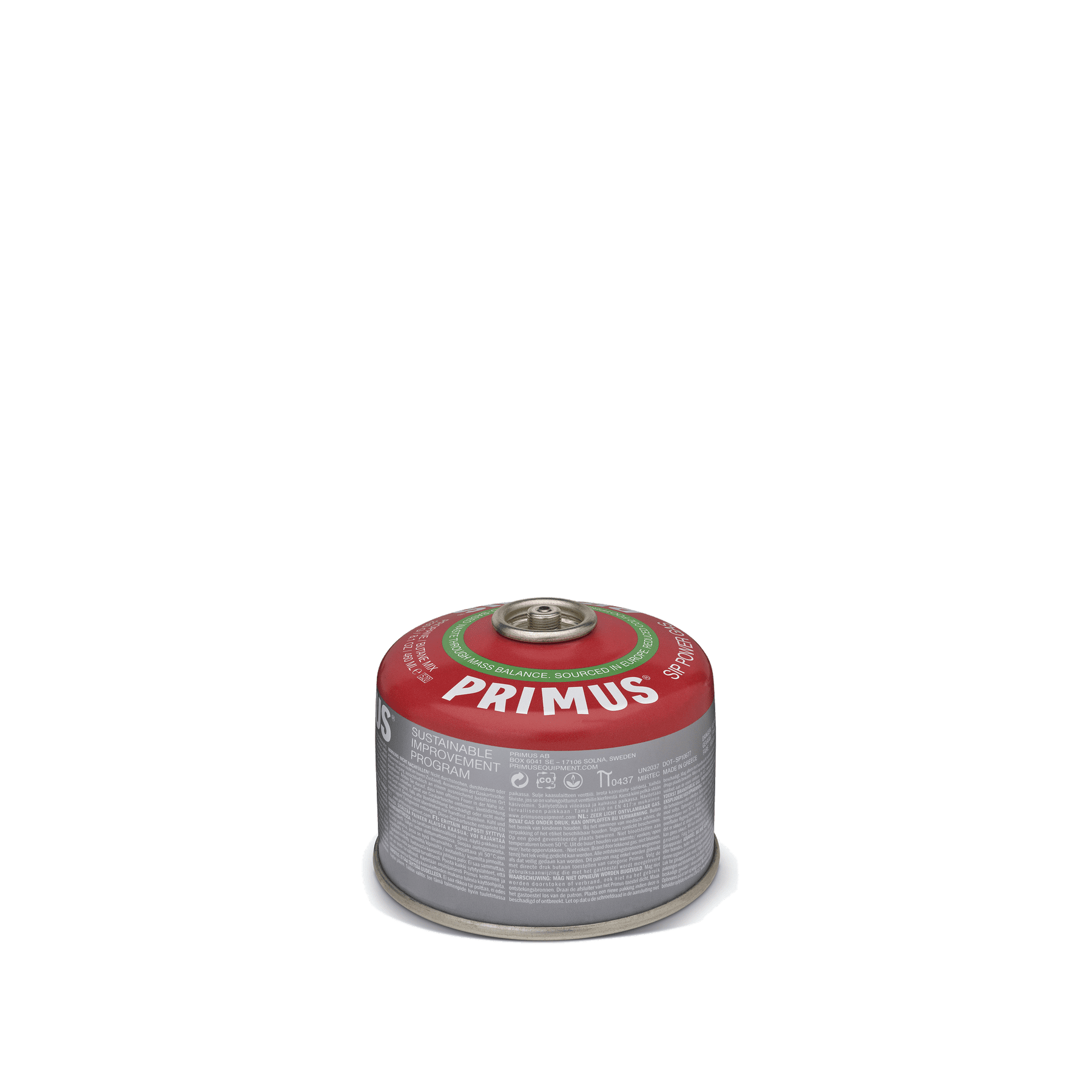
Overview
Primus Power Gas is a threaded, self-sealing canister fuel that screws onto nearly any backpacking stove with a standard Lindal-style valve. Primus calls it its most versatile blend, pitched at spring-through-early-winter trips where the forecast can’t be trusted. The trade-off is chemistry: half the mix is n-butane, which gives ground to isobutane-heavy canisters once the thermometer nears freezing.
Key Specs
| Spec | Value |
|---|---|
| Fuel content | 100 g or 230 g |
| Weight, full | 198–390 g depending on size |
| Fuel mix | 25% isobutane, 50% butane, 25% propane |
| Rated minimum temperature | -15°C (5°F) |
| 230 g dimensions | 4.2” x 3.3” |
| 100 g dimensions | 3.5” x 2.6” |
| Valve | Self-sealing, threaded |
Versions compared
| Image | Version | Weight | vs. lightest |
|---|---|---|---|
 | 230 g 100g Canister | 198 g (7.0 oz) | lightest |
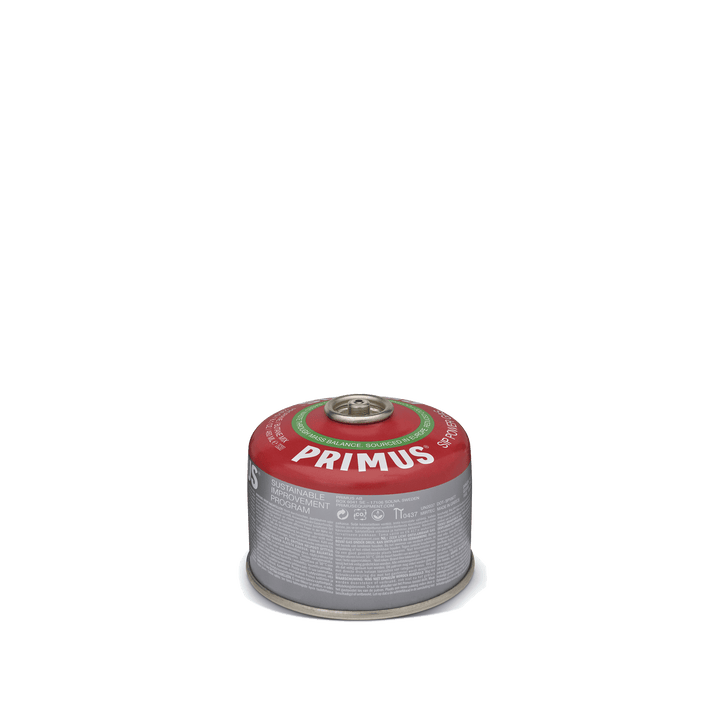 | 388 g | 388 g (13.7 oz) | +190 g |
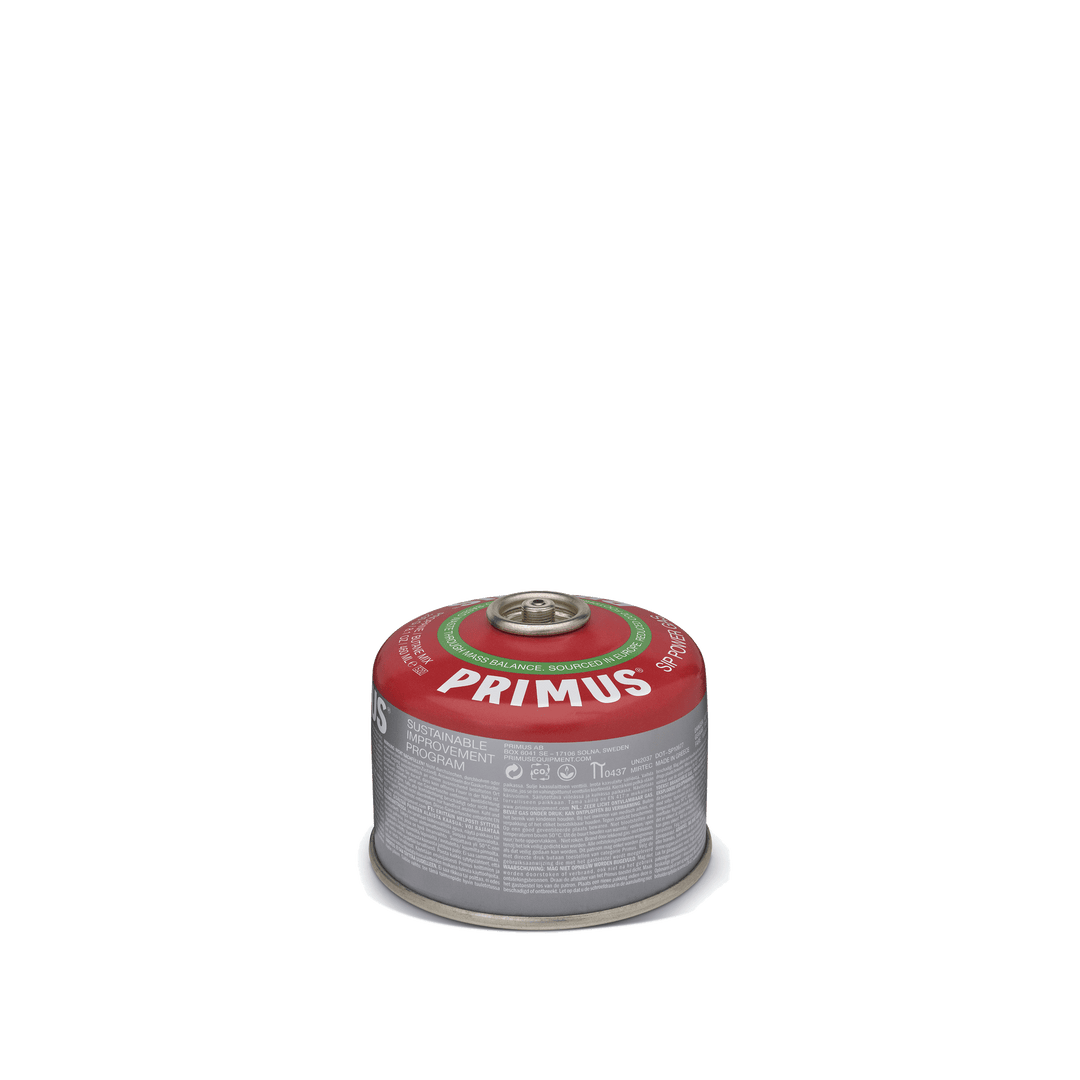 | 390 g | 390 g (13.8 oz) | +192 g |
| 230 g | 390 g (13.8 oz) | +192 g |

Would the Power Gas earn its spot in your pack?
390 g · 13.8 ozAdd the Primus Power Gas to your Gear Closet and see exactly what it does to your base weight, then start packing for your next trip.
Free · No credit card · iOS, Android & web · Trusted by 3,000+ backpackers
Performance
Fuel chemistry. In a cold canister, the butanes are the weak link. Isobutane boils at roughly 11°F (-12°C), while n-butane boils near 31°F (-1°C). Below that, the n-butane stops contributing and the stove runs on whatever propane is left. Power Gas carries 25% propane to get things started, but 50% n-butane is dead weight on a frosty morning. Primus’s own Winter Gas, an isobutane/propane blend, is rated down to -22°C. Power Gas is rated to -15°C, and that figure marks the point where the canister will still fire, not the point where it performs as it does at 10°C.
Cold-weather numbers. How much the blend suffers depends on how full the can is. In a freezer test at -20°C with full 230 g canisters, UKClimbing’s reviewer boiled a litre of water in 9:35 on Power Gas and 9:06 on Winter Gas, a modest gap. Primus’s freezer-room testing at the same temperature shows the gap widening as canisters empty: Winter Gas delivers about 9% more power after an hour of cooking and about 15% more after two. At -8°C with quarter-full canisters, a UKC-reported test timed Power Gas at 10:20 against 6:40 for Winter Gas. A JetPower canister in the same test hadn’t boiled after 12 minutes. A half-empty Power Gas can in the cold is where the blend shows its limits.
Owner reports line up with the numbers. Trailspace reviewers praise the fuel in warm weather and at altitude. One who used it on winter day hikes with a Jetboil Flash described erratic burning and hard lighting compared with Jetboil’s own fuel.
Above freezing. This is where Power Gas earns its place. Trailspace owners note it costs about a dollar less than competing canisters, and the blend suits spring-to-fall cooking. Primus says it still delivers enough power to run a stove below freezing. That holds for short boils, not for long snow-melting sessions where evaporative cooling chills the can. On cold mornings, a canister kept in a jacket pocket or sleeping bag vaporizes more readily.
Compatibility and fuel tracking. The self-sealing valve lets a hiker unscrew the canister mid-meal without a leak. Empty weight works out to about 160 g for the 230 g can and about 98 g for the 100 g can, so a pocket scale at camp is the only reliable way to gauge what remains. The threaded valve won’t fit pierce-type stoves.
Environmental footprint. Primus describes all of its fuel as climate-compensated through carbon offsets. The SIP Power Gas sold in the US uses biogas made from food waste and is produced and filled in Europe. Offsets remain a debated tool, but few canister brands make any claim at all.
Choosing a Version
The four listings come down to two canister sizes.
- 230 g Power Gas 100 g canister (198 g full): The overnight and weekend size, and a good match for small stoves and pot sets designed to nest a short canister. The shell accounts for roughly 98 g of the total, so a bigger share of what’s carried is packaging. Best for solo trips of one or two nights.
- 230 g canister (390 g full): The standard backpacking size and the better value per gram of fuel. It suits solo hikers on multi-day trips and pairs well with partners cooking together.
- 388 g and 390 g listings: These are the same 230 g canister. Primus US lists it at 390 g, while some retailers round it to 388 g. Both carry 230 g of fuel in the same 4.2” x 3.3” body, and there is no difference in performance.
Pros & Cons
Pros
- Fits virtually every threaded canister stove
- Self-sealing valve allows mid-meal removal without leaks
- Dependable above freezing, with enough propane for reliable lighting
- Usually priced below premium isobutane blends
- 100 g size is compact and light for short trips
- Primus backs its fuel with carbon offsets
Cons
- 50% n-butane fades faster than isobutane blends near and below freezing
- Output drops noticeably as the canister empties in the cold
- Shell weight is high on the 100 g size, around 98 g of the 198 g total
- No gauge; fuel tracking needs a scale
- Won’t work with pierce-style stoves
Who Should Buy This
Spring-to-fall backpackers who want a dependable, widely available canister at a fair price will be well served, especially solo hikers who can match the 100 g or 230 g size to trip length. Anyone whose overnight lows regularly reach freezing, or who plans extended stove time for melting snow, should buy Primus Winter Gas or an isobutane/propane blend such as MSR IsoPro instead.
Verdict
Power Gas does what a three-season canister should: it lights, it burns, and it costs little. Push it toward winter conditions and the butane-heavy mix becomes the reason to buy something else. A solid default for warm and shoulder-season trips, and the wrong choice for cold ones.