Kovea Spider (KB-1109) Review
The Kovea Spider is a compact, affordable remote canister stove with inverted-canister cold-weather capability — a serious four-season option that punches above its price.
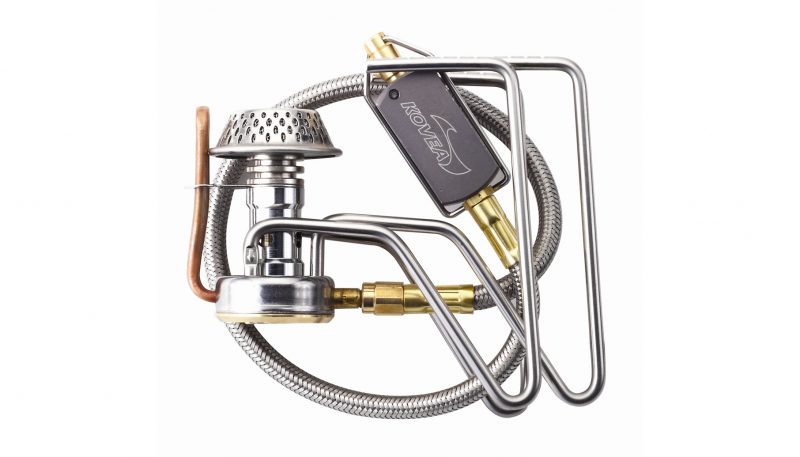
Overview
The Kovea Spider (KB-1109) is a remote canister gas stove built in Korea — by the same manufacturer that produces stoves for MSR and Snow Peak. It runs on standard Lindal-valve isobutane-propane canisters in normal upright mode, but its real party trick is a preheat tube that lets you invert the canister and feed liquid fuel directly to the burner, unlocking reliable performance well below freezing. At 168g and a price typically around $50–60, it occupies a genuinely rare position: a four-season-capable remote canister stove that doesn’t ask you to pay MSR or Optimus prices for the privilege.
Key Specs
| Spec | Value |
|---|---|
| Model | KB-1109 |
| Weight | 168g / 5.9 oz |
| Packed Dimensions | ~94 × 94 × 51 mm (3.7 × 3.7 × 2 in) |
| Heat Output | ~6,100 BTU/h (1.79 kW) |
| Gas Consumption | ~130 g/h at max |
| Fuel Type | Isobutane-propane, Lindal valve |
| Ignition | Manual (piezo igniter included) |
| Cold-Weather Mode | Inverted canister / liquid-fuel operation |
| Country of Origin | South Korea |

Would the Spider earn its spot in your pack?
168 g · 5.9 ozAdd the Kovea Spider to your Gear Closet and see exactly what it does to your base weight, then start packing for your next trip.
Free · No credit card · iOS, Android & web · Trusted by 3,000+ backpackers
Performance
Cold-Weather Operation
This is the stove’s defining capability, and it earns it. The remote canister design lets you run a full windscreen around the burner — something you absolutely cannot do safely with an upright canister stove — and the preheat tube vaporizes liquid fuel before it reaches the burner head, allowing operation at temperatures where a conventional canister stove would fizzle out. Reviewers and long-term users have pushed the Spider to -10°F (-23°C) with success, though there’s a catch: you need to prime it first. Let it burn upright for about 30 seconds before inverting the canister so the preheat tube can warm up; skip that step and you’ll get flare-ups, especially in deep cold.
One key field note: the fuel hose gets noticeably stiff at around 10°F, but the stove still functions in inverted mode at that temperature. It’s not a liquid-fuel stove like an MSR Whisperlite, so melting large quantities of snow will take longer — but for one or two people boiling water or cooking meals, it’s more than adequate.
Boil Times and Efficiency
The 6,100 BTU/h output is the lowest of the main remote canister competitors — the MSR WindPro II puts out ~7,500 BTU/h and the Optimus Vega ~8,800 BTU/h. In real-world terms, Gear Institute testing averaged 5:26 per liter in moderately windy conditions, slowing to 9:00/liter at full wind exposure without a windscreen. Add a windscreen and that same near-empty canister dropped to 3:32/liter. That gap tells you everything: a windscreen isn’t optional with this stove, it’s required gear if you want reasonable performance. In cold-temp testing (0°C to 10°C), one reviewer averaged around 7:30 to boil 500ml with a hard-anodized aluminum pot — slower than a hot-rod stove, but the fuel efficiency over a 9-day trip for two people was impressive enough that a single 450g canister covered the trip.
Packability and Stability
This is where the Spider quietly wins the argument. It is far more compact than any of its remote canister competitors. The three legs fold down and the hose wraps around the body; the whole thing fits inside a 780ml Snow Peak titanium pot alongside a 110g canister. The MSR Windpro II, at 187g, can’t manage the same trick. The wide, low-slung leg stance also gives it excellent stability under large pots — wider cookware is actually recommended here, since a narrow pot won’t catch enough of the dispersed flame from the small burner head.
Flame Control
The burner head is small, which led to some early skepticism about hot spots, but the flames angle outward and distribute heat well enough for real cooking — not just boiling water. Simmer control is genuinely good, which matters if you’re doing anything beyond rehydrating a freezer-bag meal.
Durability and Build Quality
The steel and brass construction is solid. The legs lock into place with a positive snap, the fuel connection feels secure, and multiple long-term users report zero mechanical issues over years of use. The design hasn’t changed since its 2012 release — which, rather than being a red flag, reads as evidence that Kovea got it right the first time.
Pros & Cons
Pros
- Lightest stove in the remote canister class at 168g, beating the WindPro II (187g) and Optimus Vega (228g)
- Exceptionally packable — stove plus 110g canister fits inside a 780ml pot
- Reliable inverted-canister cold-weather operation, tested to -10°F (-23°C)
- Remote canister design means safe windscreen use, a significant efficiency advantage
- Precise simmer control; genuinely capable of real cooking, not just boiling
- Solidly built from steel and brass; no reported durability issues over years of use
- Significantly cheaper than comparable remote canister stoves ($50–60 vs. $90–120+)
Cons
- 6,100 BTU/h output is the lowest in its class — not a fast boiler
- No windscreen included; one is practically essential for reasonable performance
- Fuel hose stiffens noticeably at very low temps
- Requires a proper priming sequence before inverting in cold weather — skip it and expect flare-ups
- Wider pots work better; narrow cups don’t catch the spread flame well
- Not widely available in US retail stores; often ordered online or imported
Who Should Buy This
The Spider is the right call for three- and four-season backpackers who encounter genuinely cold or windy conditions and want a canister stove that handles both. It’s also a smart pick for anyone who prioritizes system packability — if fitting stove plus fuel inside your cook pot is important to your kit organization, nothing in this class comes close. Budget-conscious hikers upgrading from an upright canister stove will find it a dramatic improvement in cold and wind for a fraction of what MSR or Primus charge for similar capability. If you’re a summer-only, boil-water-fast hiker, a lighter upright canister stove is more appropriate — the remote setup and extra weight only pay off when conditions are actually rough.
Verdict
The Kovea Spider has been on the market since 2012 with essentially no design changes, and that’s not an accident — it’s a stove that works. The BTU output is modest and the wind performance without a screen is poor, but pair it with a simple foil windscreen and you have a capable four-season remote canister setup that out-packs and undercuts its European and American competition on price. At 168g and around $50–60, it’s hard to argue with the value.