Jetboil JetPower Fuel Review
Jetboil JetPower is a propane/isobutane canister fuel available in 100g, 230g, and 450g sizes. Solid four-season performance with broad compatibility — but some trade-offs worth knowing before you buy.
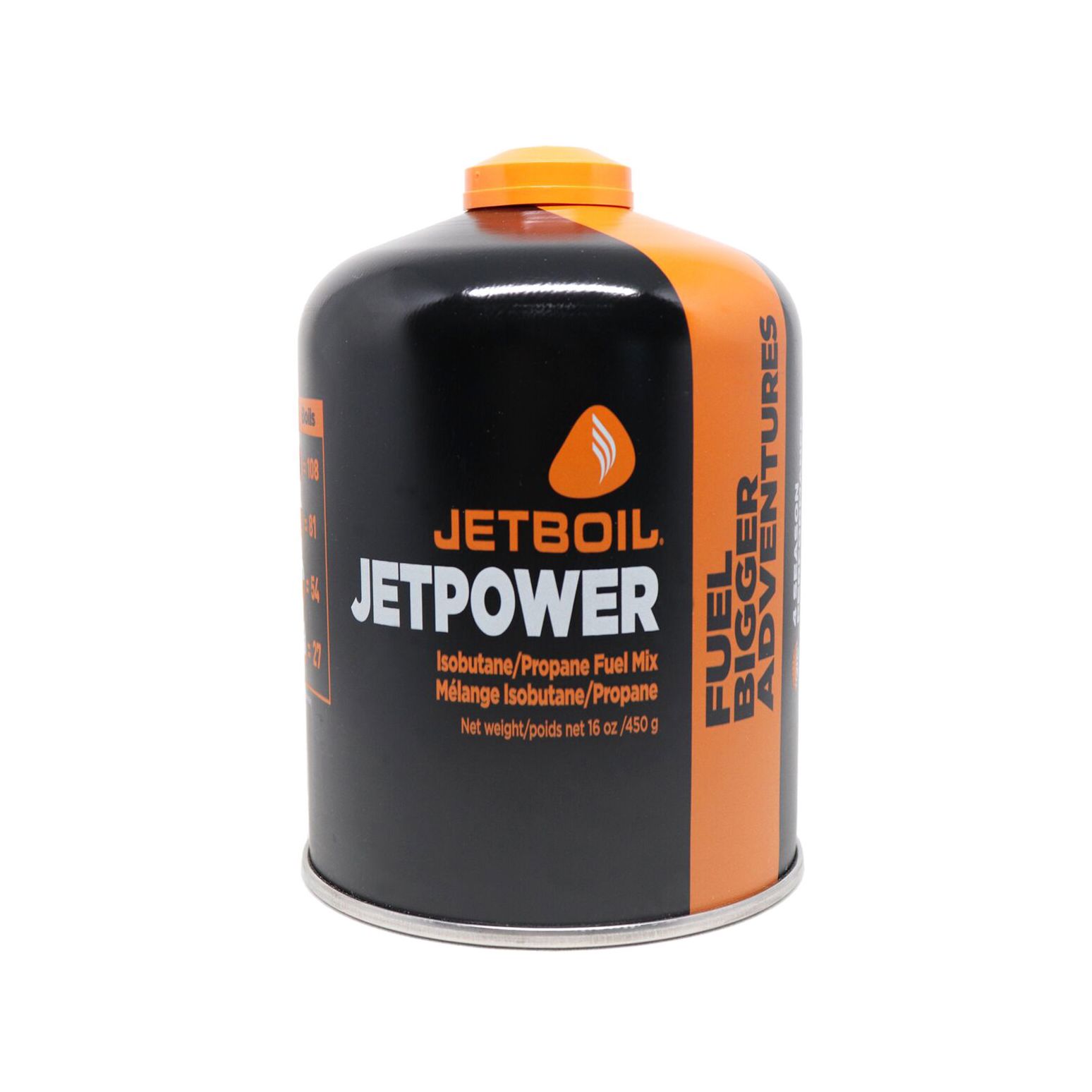
Overview
Jetboil JetPower is the brand’s own propane/isobutane canister fuel, designed to pair with the full Jetboil stove lineup — Flash, MiniMo, MightyMo, Zip, and more. It’s a standard EN417 Lindal-valve canister, which means it also works with virtually any other canister stove on the market. Three sizes cover everything from a fast-and-light overnight to a week-long group trip. If you already own a Jetboil system, this is the fuel Jetboil recommends; whether it’s the best fuel is a different conversation.
Key Specs
| Spec | Detail |
|---|---|
| Fuel Blend | 80% Isobutane / 20% Propane |
| Available Sizes | 100g, 230g, 450g |
| Gross Weight (100g) | 199g / 7.01 oz |
| Gross Weight (230g) | 380g / 13.40 oz |
| Gross Weight (450g) | 666g / 23.50 oz |
| Dimensions (100g) | 9 cm dia × 7 cm tall |
| Dimensions (230g) | 11 cm dia × 10 cm tall |
| Dimensions (450g) | 11 cm dia × 15 cm tall |
| Boil Yield (100g) | ~12L (manufacturer, ideal conditions) |
| Boil Yield (230g) | ~24L (manufacturer, ideal conditions) |
| Boil Yield (450g) | ~48L (manufacturer, ideal conditions) |
| Valve Standard | EN417 (Lindal valve) |
| Recyclable | Yes, with Jetboil CrunchIt tool (sold separately) |

Would the JetPower Fuel earn its spot in your pack?
198 g · 7.0 ozAdd the Jetboil JetPower Fuel to your Gear Closet and see exactly what it does to your base weight, then start packing for your next trip.
Free · No credit card · iOS, Android & web · Trusted by 3,000+ backpackers
Performance
The Fuel Blend
JetPower uses a propane/isobutane blend — a combination that pairs the cold-weather performance of propane with the lower pressure of isobutane.
In practical terms,
propane provides higher vapor pressure for better performance in cold weather, while isobutane maintains more constant pressure as the fuel level gets low.
That’s the theory, and it holds up well above freezing. Below freezing, you’re in the same boat as every other canister fuel on the market.
Cold Weather Limitations
This is where expectations need to be managed. All canister stoves suffer a performance drop in cold weather — the colder the fuel, the lower the vapor pressure, and the lower the burner output. When temperatures drop below freezing, canisters typically need to be kept warm in a coat pocket or sleeping bag so they’re ready to use. Jetboil recommends keeping the canister in a warm pocket between uses and removing it immediately prior to heating your food. Insulating the canister by not setting it on a cold surface also helps.
Some users praise the blend’s cold-weather consistency — the Jetboil branded gas seems to be more efficient than others on the market, particularly in really cold conditions, with one user noting the canister lit up reliably every time in snowy mountain conditions. Others found the opposite: in low temperatures at or below freezing, it barely burns and when it does it sounds like it’s about to die at any moment. My read: the 20% propane does give JetPower a functional edge over pure butane blends in the cold, but for serious winter mountaineering you’d want a liquid-feed stove regardless.
Real-World Boil Yields vs. Manufacturer Claims
Jetboil’s stated yields — 12L per 100g canister — are tested under ideal lab conditions. Real-world numbers are lower. One user testing 500mL boils at 55°F with a Jetboil MiniMo used roughly 7g of fuel per boil, yielding around 14 half-liter boils per 100g canister — short of the claimed 24 boils listed on the canister side label (note: the label uses a smaller reference volume). Another user testing the Flash system got 16 boils, still far short of the manufacturer figure. The bottom line: plan on about 12–16 half-liter boils per 100g canister in normal conditions, not 24. Cold weather and simmer cooking will reduce that further.
Cross-Compatibility
The critical requirement for compatibility with Jetboil stoves is that the fuel uses a screw-thread Lindal valve. The recommended blend is 80% isobutane and 20% propane.
MSR IsoPro is compatible with Jetboil stoves and is a suitable alternative for JetPower — both are high-performance fuels with the same gas blend and valve type.
Jetboil’s own FAQ acknowledges as much:
if you are unable to find their fuel on the trail, Brunton, Gigapower, MSR, Primus, and Snow Peak have the same mixture and valve.
This is worth knowing at resupply towns.
The Fill Weight Issue
One legitimate complaint from the ultralight community: Jetboil decided that their canister should hold 10% less fuel than the same physically sized canisters from MSR, Snow Peak, and others — Jetboil holds 100g while others hold 110g. That’s a whole extra boil. It’s a small difference in absolute terms, but it’s a real one when you’re counting grams and boils on a longer trip.
Packability
JetPower 100g fuel canisters pack into the cookpot on most Jetboil systems
, which is a genuine convenience perk — you won’t leave the fuel behind if everything nests together. The 230g canister is the sweet spot for most backpackers:
one user reported a 230g canister lasting about a week of comfort-level cooking for hot beverages morning and evening plus water-based meals for two people.
Pros & Cons
Pros
- Standard EN417 valve works with any compatible canister stove, not just Jetboil
- 80/20 isobutane/propane blend handles a wide temperature range better than pure butane alternatives
- Three sizes cover weekend trips through basecamp use
- 100g canister nests inside most Jetboil cooking cups
- Canister is recyclable with the Jetboil CrunchIt tool
- Widely stocked at REI, outdoor specialty shops, and online retailers
Cons
- 100g canister contains only 100g of fuel vs. 110g in same-size MSR and Snow Peak canisters
- Manufacturer boil yields are optimistic; real-world numbers run 15–30% lower
- Cold weather performance still degrades significantly below freezing — canister warming required
- No integrated fuel gauge; you need to weigh or float the canister to track remaining fuel
- Cannot be shipped by air; some resupply limitations for remote destinations
- Priced at a slight premium vs. functionally equivalent alternatives like MSR IsoPro
Who Should Buy This
JetPower is the right call if you already own a Jetboil system and want a straightforward, no-compatibility-headaches fuel that’s easy to find at most outdoor retailers. It’s a solid three-season canister fuel for solo backpackers and small groups doing trips in the 1–7 day range. If you’re a dyed-in-the-wool gram counter, the 10g fill disadvantage vs. MSR or Snow Peak is worth factoring into your planning — or just buy the 230g size and stop worrying about it.
Verdict
JetPower does exactly what canister fuel is supposed to do: it burns reliably, packs small, and works with your existing gear. The 80/20 isobutane/propane blend is a proven formulation, and the three size options give you flexibility to match fuel load to trip length. That said, there’s nothing here that sets it apart from MSR IsoPro or Snow Peak GigaPower at the same price point — and the 10% lower fill on the 100g canister is a small but real disadvantage for ultralight planners. It earns a 7.5/10: genuinely good fuel, just not uniquely good.