Fire Maple Blade 2 Titanium Backpacking Stove Review
The Fire Maple Blade 2 (FMS-117H) is a 135g titanium remote-canister stove with an inverted-canister preheat tube — making it a rare ultralight option with genuine cold-weather capability.
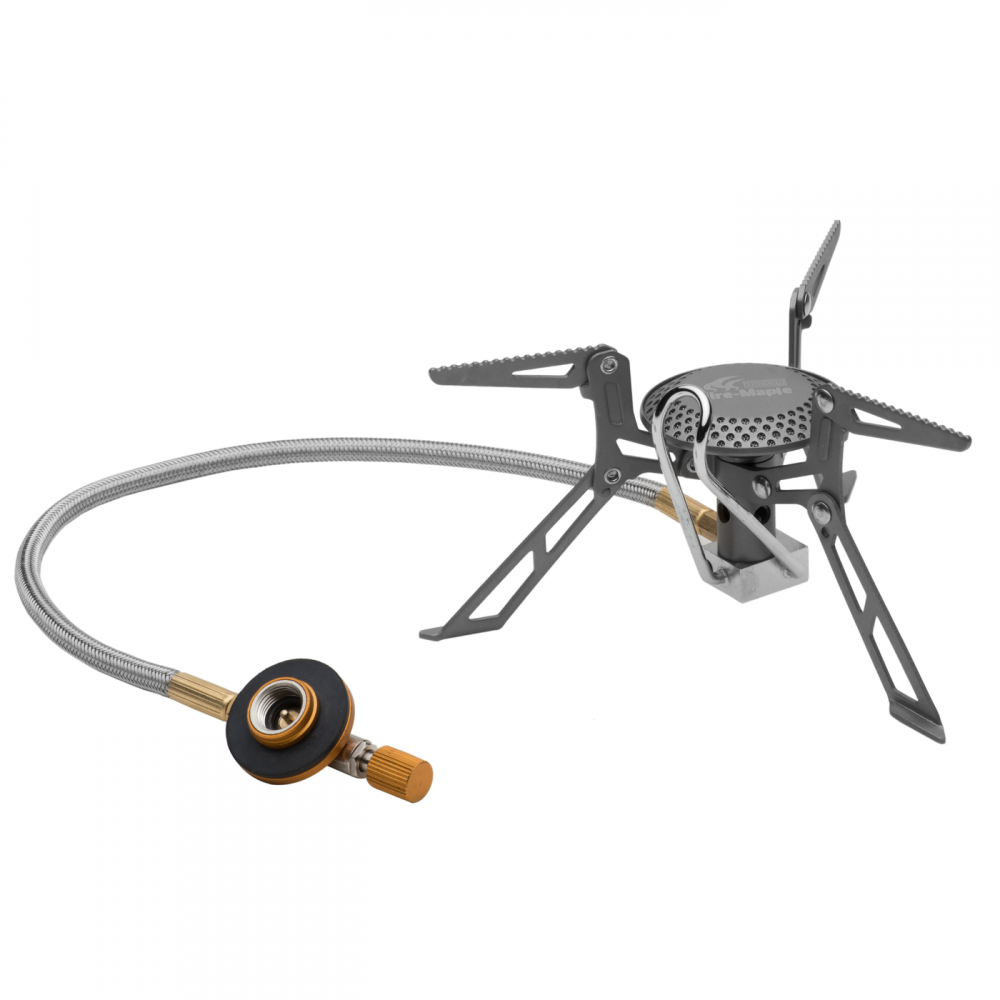
Overview
The Fire Maple Blade 2 (model FMS-117H) is a titanium remote-canister backpacking stove built for hikers who need real cold-weather performance without hauling a boat anchor. It combines a titanium frame and legs from Fire Maple’s lighter FMS-117T Blade with a copper preheat/generator loop borrowed from their heavier FMS-118 Volcano — giving you inverted-canister capability in a package that weighs roughly as much as a handful of quarters. If you’ve been eyeing the MSR WindPro II but winced at the weight and price, this is the stove the r/Ultralight crowd tends to point you toward instead.
Key Specs
| Spec | Value |
|---|---|
| Model | FMS-117H |
| Weight (advertised) | 135 g / 4.8 oz |
| Power Output | 2,800 W / 9,550 BTU/h |
| Boil Time (500 ml) | 3.42 min |
| Max Pot Diameter | 10 in (254 mm) |
| Pot Support Spread | 145 mm |
| Material | Titanium (legs, frame, burner head) |
| Ignition | Manual (no piezo) |
| Inverted Canister | Yes (preheat tube required & included) |
| Fuel Hose Length | 315 mm braided |
| Warranty | 3 years |

Would the Blade 2 Titanium Backpacking Stove earn its spot in your pack?
135 g · 4.8 ozAdd the Fire Maple Blade 2 Titanium Backpacking Stove to your Gear Closet and see exactly what it does to your base weight, then start packing for your next trip.
Free · No credit card · iOS, Android & web · Trusted by 3,000+ backpackers
Performance
Cold-Weather and Inverted Canister Use
This is the Blade 2’s reason for existing. The stove combines a remote canister design with a preheat tube to deliver a steady, high-output flame in freezing conditions — it’s aimed squarely at alpine missions where liquid-feed mode is a necessity, not a nice-to-have. The mechanics are simple enough: at temperatures below -10°C, a standard canister stove may not work at all; inverting the canister feeds liquid fuel into the preheat tube, which warms it and causes it to vaporize before it reaches the burner head.
In practice, you’ll want to light it upright first. The manufacturer recommends starting with the canister upright and letting the stove warm up for about 5 minutes before flipping the canister once the preheat tube is hot. Real-world users report it works faster than that — some in Europe mention under 30 seconds is enough to get the preheat tube warmed up — though conditions will vary. Either way, it’s not an instantaneous process, and in a true sub-zero emergency you’ll appreciate having the routine down cold (no pun intended).
One note worth flagging: some users initially thought the preheat tube was bent in transit because it sits at an angle away from the burner; it’s apparently the intended design, and it does work as advertised once the tube is sufficiently heated. It looks a little odd but doesn’t affect function.
Stability and Footprint
The remote-canister layout keeps the center of gravity low — a big upgrade over tall canister-top stoves. The titanium legs unfold to a 145 mm base and support up to 3 kg (6.6 lb), which is enough for a full 2–3 L pot of water with food. The wide burner also helps avoid center hot spots that can scorch food — a real advantage over narrow-head remote stoves like the Kovea Spider. One practical quirk: the valve control is quite small when using an inverted canister, but it’s simple enough to lift the canister slightly when adjusting the flame.
Pot arms on these stoves can loosen over time. If the arms feel floppy, the fix is straightforward: dismantle and peen down the rivets, and they’ll feel much sturdier. It’s a minor annoyance but something to check out of the box.
Burner Head and Simmering
The wide, convex burner head provides a broad spread of heat well-suited to wider pots, but the shape makes the flame more susceptible to wind.
A windscreen goes a long way here, and the remote-canister setup means you can wrap one tightly around your cookware without worrying about overheating the canister.
The lower burner profile on remote-canister stoves is already less susceptible to side breezes than canister-top designs, but a windshield will meaningfully improve fuel efficiency.
On simmering: it’s possible, but don’t expect to run a gentle risotto on this stove. The wide burner head has a high output and the very lowest simmers aren’t really achievable. A BPL forum member noted it was hard to achieve a true simmer for things like dry baking. For boiling water and hot meals on trail, it’s totally fine. For precision cooking, manage expectations.
Weight — the Honest Story
Fire Maple advertises the Blade 2 at 135 g. Independent hands-on reviews consistently find it a bit heavier. Fire Maple specifies 135 g for the FMS-117H, but independent weighing shows 140 g — the extra 5 grams almost certainly owing to the improved canister connector and preheat tube hardware compared to earlier generations. That’s still about 2 oz lighter than the MSR WindPro II, so the weight story remains favorable. Just don’t be surprised if your scale reads 140 g.
Ignition
No piezo here, which will bother some people and matter not at all to others. Fire Maple’s reasoning is sound: piezo igniters often fail in extreme cold anyway, and by removing them they eliminate a failure point. Their recommendation is to always carry a flint steel or a Mini Bic lighter. I’d argue a BIC lighter lives in your kit regardless, so this is a non-issue unless you’re a “one fewer thing to pack” absolutist.
Pros & Cons
Pros
- Genuine cold-weather capability via inverted canister and preheat tube — a rare feature at this weight
- Titanium construction keeps real-world weight around 140 g, still roughly 2 oz lighter than the MSR WindPro II
- Wide 145 mm pot support handles pots up to 10 inches with stability
- Remote canister layout lowers center of gravity and allows full windscreen use
- Upgraded canister connector with gas-tight gasket and swiveling hose makes inversion easy
- Strong 3-year warranty for a budget-oriented brand
- 2,800 W output (9,550 BTU/h) boils water quickly
Cons
- Advertised weight of 135 g is optimistic — expect closer to 140 g on your own scale
- No piezo igniter; always need a lighter or striker
- Deep simmering is difficult; high-output wide burner isn’t precise enough for delicate cooking
- Convex burner head is more wind-susceptible than narrower designs; windscreen is essentially mandatory in any breeze
- Pot arms are riveted and can loosen with use; may need the occasional tightening
- Preheat tube angle looks strange out of the box — not a defect, just unusual
Who Should Buy This
This stove is built for three-season backpackers who want to stay capable when temperatures dip below freezing, without paying MSR WindPro II money or carrying MSR WindPro II weight. It’s also the right tool for solo alpine travelers who need reliable high-output heat in sub-zero conditions and are comfortable with the two-step warm-up procedure for inverted canister use. If you’re a strict warm-weather hiker who never camps below freezing, the simpler and lighter Fire Maple Petrel Ti (95 g, no preheat tube) is a better fit. If you need a stove that simmers accurately for gourmet backcountry cooking, look elsewhere.
Verdict
The Blade 2 fills a genuine gap: it’s one of the lightest titanium remote-canister stoves on the market that can actually run with an inverted canister in sub-zero conditions — a feature set that otherwise costs you significantly more weight and money with the MSR WindPro II. The real-world weight of ~140 g is slightly more than advertised, the pot arms can loosen, and don’t expect low-and-slow simmering. But for fast-and-light alpinists and three-season hikers who want a cold-weather safety net, it’s a hard stove to argue against at this price point.
Rating: 8/10