Coleman C100 Xtreme Gas Cartridge Review
A 100g EN417 screw-top canister with a 60/40 butane/propane mix rated to -27°C — solid on paper, but real-world cold-weather reports are mixed.
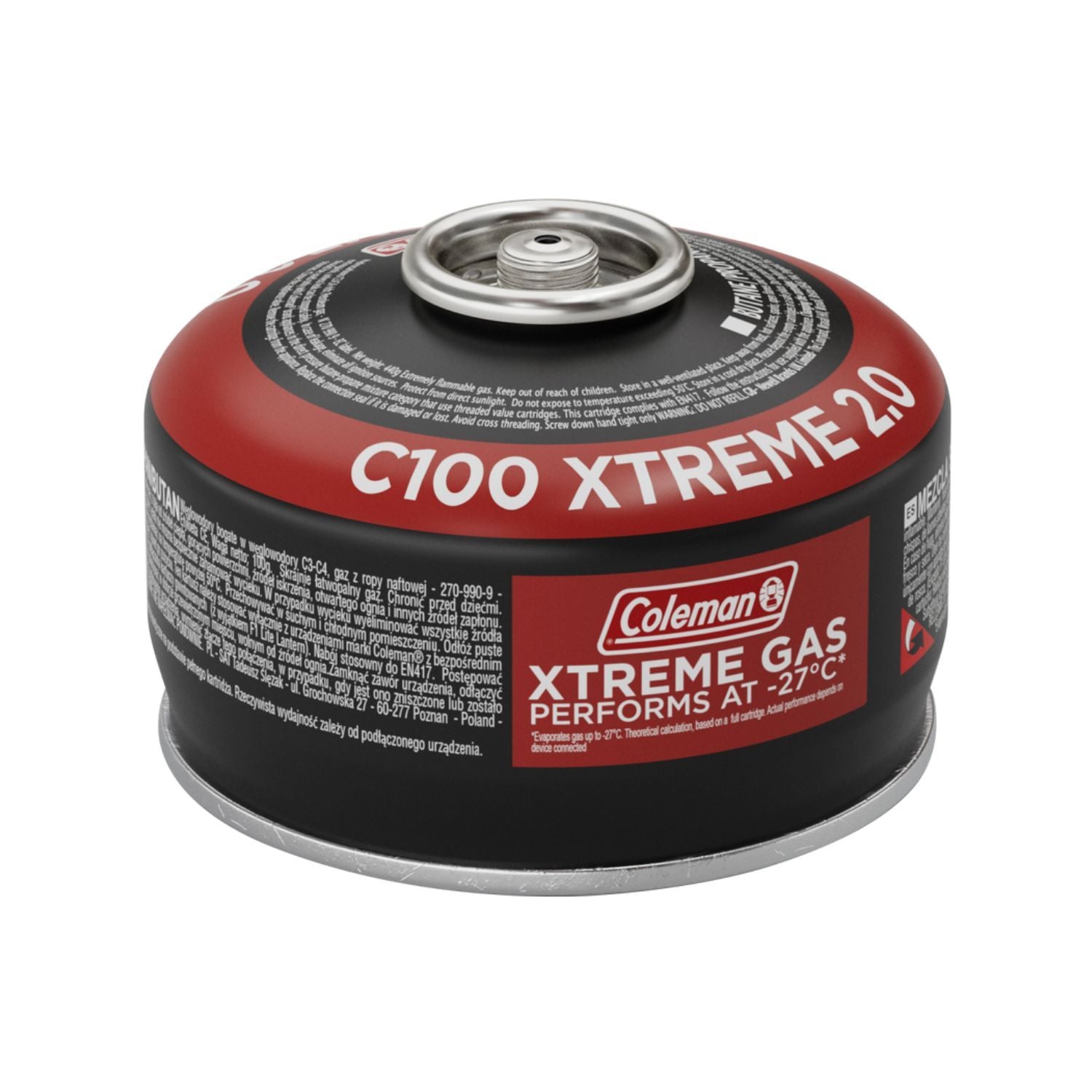
Overview
The Coleman C100 Xtreme is a 100g EN417 screw-thread gas canister aimed at cold-weather campers, winter trekkers, and anyone running a standard screw-on canister stove in shoulder-season or alpine conditions. It uses a 60/40 butane/propane blend and Coleman’s resealable double-safety valve, and it’s positioned as the cold-weather upgrade over Coleman’s standard “Performance” canisters. If you’re already running an EN417 stove (Coleman F1, MSR PocketRocket, Soto WindMaster, etc.) and just need fuel that won’t quit at altitude or below freezing, this is the category it’s competing in.
Key Specs
| Spec | Value |
|---|---|
| Gas content | 100 g |
| Total cartridge weight | 194 g |
| Gas blend | 60% Butane / 40% Propane |
| Temperature rating | -27°C (claimed) |
| Dimensions | Ø 90 x 70 mm |
| Valve type | EN417 standard screw thread |
| Safety valve | Double safety, resealable |
| Compatibility | Any EN417 screw-top stove/lantern |

Build your Gear Closet
View all of your gear in one place, create packing lists and hit the trail with confidence. Available on iOS, Android and the web.
Get StartedPerformance
Coleman’s own marketing is confident on the cold-weather claims. Retailer copy across the board repeats the same line: the Xtreme cartridge is ideal for the more adventurous trekker or explorer offering fast and reliable boil times even in very cold temperatures, even continuing to function as low as -27°C. On paper, the 60/40 butane/propane mix backs that up — -27C is possible if there is enough propane in the mix, it would need to be 40% propane, and you would need to use it inverted to maintain that operating temperature, but quite feasible. That’s an important caveat: hitting the rated performance in genuinely sub-zero conditions likely assumes an inverted-canister setup, not a standard upright screw-on stove.
That caveat matters, because real-world reports on Coleman’s canister gas are decidedly mixed. One user on the Backpacking Light forum flagged the -27°C claim as rather far fetched, noting no mention of special paper like the Primus Winter Gas — a reference to the vapor-pressure boosting wick technology some competitors use. More concerning is a documented field failure: a GO Outdoors reviewer described how the canister sputtered and coughed for about 30 seconds, before proceeding to completely block the gas valve of my PCS rendering it unusable, four hours into a cold and wet 50 mile trek in the mid Wales mountains, adding that they’ve since heard of others suffering similar woes with this particular Coleman gas. A separate blog review of Coleman’s Performance line (not the Xtreme specifically, but the same brand and canister family) reported a cartridge failing at a claimed 4°C, well within its advertised operating range, and concluded the failure (in cold weather) was Coleman’s product alone.
Not every account is negative — general cold-weather gas guidance confirms that a canister with 10% propane and 90% isobutane over a canister with 30% propane and 70% n-butane is the safer bet in the cold, and Coleman’s Xtreme blend at 40% propane is genuinely propane-heavy compared to Coleman’s standard mix. One thing worth understanding about butane/propane blends generally: the propane will burn off at a faster rate than the n-butane, leaving you with nothing but n-butane toward the end of your canister, and butane is a poor performer in cold weather. Practically, that means the back half of any butane/propane canister — Xtreme included — will perform worse in the cold than the front half, regardless of what the label promises. If you’re planning a genuinely cold trip, don’t count on the last 20-30g of any screw-top canister to deliver full output.
Beyond the extreme-cold edge cases, the size and format are sensible: at Ø90 x 70mm and 194g total weight for 100g of gas, it’s a compact, easily packed option and fits the same footprint as most other 100g/110g EN417 canisters, so it drops into any stove sack or cook kit without fuss. The resealable double-safety valve works as advertised for disconnect/reconnect — no complaints turned up specifically about leakage on reconnection, which is the main failure mode that design is meant to prevent.
Pros & Cons
Pros
- Compact, standard EN417 footprint — works with any screw-top stove, not just Coleman’s own
- Propane-heavy 60/40 blend genuinely helps in cool (not extreme) conditions
- Resealable double-safety valve disconnects/reconnects cleanly, no reported leakage issues
- Widely available at UK outdoor retailers (Decathlon, GO Outdoors, Go Outdoors, Ultimate Outdoors)
Cons
- Multiple independent user reports of canister failure well within the advertised operating range, including one that damaged a stove valve mid-trip
- The -27°C claim appears to assume inverted-canister use rather than standard upright operation, which most EN417 stoves don’t support
- Like all butane/propane blends, performance degrades noticeably as the canister empties and the propane fraction burns off first
- Reliability track record is more inconsistent than established alpine-focused competitors (MSR, Primus Winter Gas)
Who Should Buy This
This canister makes sense for three-season UK/European hillwalking and camping where temperatures dip toward freezing but rarely go seriously sub-zero, and where you value having a widely-stocked, EN417-standard fuel option on hand. If you’re planning a genuine winter mountaineering trip or expedition-style cold exposure, the mixed field reports on reliability are enough that I’d want a proven cold-weather specific fuel (or an inverted-canister stove setup) rather than betting the trip on this canister’s -27°C label alone.
Verdict
The Coleman C100 Xtreme is a perfectly serviceable EN417 canister for cool-weather UK camping, with a genuinely useful propane-heavy blend, but the -27°C claim needs a large asterisk — it likely requires inverted use, and there are enough real user reports of failures at far milder temperatures that I wouldn’t stake a serious cold-weather trip on it. Fine as a backup or shoulder-season fuel; I’d look elsewhere for genuine winter mountaineering.