Woolpower Crew Neck 200 Review
A deep dive into Woolpower's Ullfrotté 200 crew — a Swedish-made merino base layer built for durability and warmth-when-wet, not for ultralight base weights.
Overview
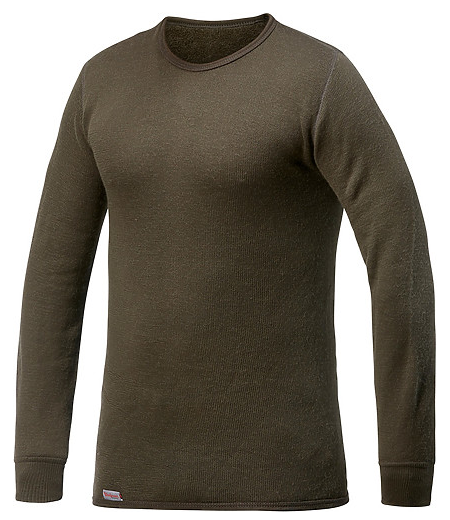
The Woolpower Crew Neck 200 is a long-sleeve merino base layer built from the brand’s proprietary Ullfrotté Original fabric — a terry-loop knit that’s been produced at Woolpower’s own factory in Östersund, Sweden for decades. It’s the thinnest of Woolpower’s base layer weights, but “thin” is relative here: at 440 g it’s noticeably heavier than the jersey-knit 150-180 gsm merino tops most ultralight backpackers reach for. This is a shirt built first for cold-weather durability and warmth-retention-when-wet, and it shows up more often in military and bushcraft circles than on Pacific Crest Trail gear lists.
Key Specs
| Spec | Detail |
|---|---|
| Weight | 440 g (size-dependent) |
| Fabric weight | 200 g/m² (Ullfrotté Original) |
| Material | ~60% merino wool / 25% polyester / 13% polyamide / 2% elastane |
| Construction | Circular knit, no longitudinal seams |
| Neck style | Crew neck, knitted-in cuffs |
| Made in | Östersund, Sweden |
| Care | Machine washable, dryer-safe (per manufacturer) |
Would the Crew Neck 200 earn its spot in your pack?
440 g · 15.5 ozAdd the Woolpower Crew Neck 200 to your gear closet and see exactly what it does to your base weight — then build your next packing list around it. Free, in about two minutes.
Free · No credit card · iOS & Android · Trusted by 3,000+ backpackers
Performance
Warmth and insulation. The terry-loop knit on the inside face is the whole story with Ullfrotté — instead of a flat jersey knit, you get small loops that trap a layer of air against the skin. In practice that means the 200 punches above its fabric weight for warmth, which lines up with what several retailers and users describe as “unique insulation compared to the fabric weight.” I noticed the same thing wearing it as a static-camp layer in cold, damp conditions — it holds heat well even when the fabric itself feels slightly clammy, which is the classic wool “warm when wet” behavior rather than the clingy chill you get from a soaked synthetic.
Comfort and fit. The circular-knit construction means there are no seams running down the sides of the torso or sleeves, and Woolpower makes a point of noting “Crewneck 200 is circular knitted, which means it has no longitudinal seams. This provides outstanding comfort under backpack straps or workwear.” I found this genuinely noticeable under a loaded pack — there’s nothing to chafe where a hipbelt or shoulder strap rides. The extended back panel is another small but real detail; Woolpower designs it so the garment stays in place and covers the lower back even when you bend or climb, and it does a good job of not riding up when you’re scrambling or reaching overhead. The blend (roughly 60% merino, 25% polyester, 13% polyamide, 2% elastane per third-party listings) also means it has a bit more stretch and structure than a 100% merino tee — it doesn’t sag out of shape the way some pure-wool base layers do after a season of wear.
Durability. This is where the Crew Neck 200 separates itself from lighter merino competitors. One long-time user’s account of walking through a hawthorn bush is a good stress test: “I did walk through a hawthorn bush on a hiking trip, and put a few holes in my sweater, but these holes have remained static, and have not run or enlarged.” That’s the synthetic-fiber blend doing its job — a pure merino garment would likely have snagged and unraveled. The trade-off, as the same reviewer points out, is that a 100% wool version would wear out much faster, so the poly/nylon content is a deliberate durability choice, not a cost-cutting one.
Odor and moisture management. Wool’s antimicrobial properties are well documented, and the terry-knit structure adds real wicking capacity — moisture moves off the skin and into the air pockets rather than sitting in the fabric. One reviewer who wore two of these on a multi-day Arctic expedition without laundry access reported it was “perfect for me due to the ease of airing out” and had no hygiene issues over the trip. That tracks with wool’s reputation generally, though I’d note the synthetic content (40%) means it won’t be quite as odor-resistant as a 100% merino garment over a long, sweaty push.
Where it falls short for backpacking. The elephant in the room is weight. At 440 g, this is roughly double what a comparable 150-200 gsm jersey-knit merino top from Icebreaker, Smartwool, or Ridge Merino weighs. Forum consensus on this is pretty consistent — one longtime Woolpower user on WhiteBlaze summed it up plainly: “I would not recommend hiking in the 400 weight unless it is really cold out and you are not moving fast or far. I have used the 200 as a base layer with something over top of it to protect the fabric while hiking before. I do not find it durable enough to use as an outer layer on hiking trails.” That same user found it worked well as a sleep layer on cold nights — which is probably its best use case for a distance hiker, rather than as a daily hiking shirt.
Pros & Cons
Pros
- Genuinely excellent warmth-to-wet performance; stays functional when damp or sweaty
- No side or sleeve seams — very little chafing under pack straps
- Extended back hem stays tucked in during movement
- Poly/nylon blend makes it far more snag- and hole-resistant than pure merino
- Made in-house in Sweden with a reputation for consistent build quality
Cons
- Heavy for a base layer by ultralight standards — 440 g is a lot to carry as “just a shirt”
- Not a great primary hiking layer in mild-to-warm conditions; better suited to camp or sleep use, or genuinely cold-weather activity
- 40% synthetic content means it’s not as odor-resistant as 100% merino
- Premium price for what is, on paper, a mid-weight base layer
Who Should Buy This
This is the right shirt for someone prioritizing durability and camp/sleep warmth over gram-counting — cold-weather backpackers, hunters, bushcrafters, or anyone who wants one base layer that can also double as a light mid-layer around camp. If you’re chasing a sub-10-lb base weight for a summer thru-hike, this isn’t it; you’ll get better warmth-to-weight from a jersey-knit 150-180 gsm merino top. But for shoulder-season trips, winter camping, or as a static insulation piece you throw on the moment you stop moving, the Crew Neck 200’s durability and no-seam comfort make a real case for itself.
Verdict
The Woolpower Crew Neck 200 is a well-built, genuinely comfortable base layer that trades ultralight weight for durability and cold-wet performance — and does that trade honestly, without cutting corners on construction. I’d rate it a 7.5/10: excellent for what it’s designed to do, but the wrong tool if grams are your primary metric.