Sea to Summit Ultra-Sil Nano Tarp Poncho Review
The Sea to Summit Ultra-Sil Nano Tarp Poncho is a 230g, 4-in-1 piece of rain gear that doubles as pack cover, groundsheet, and emergency tarp — ideal for ultralight backpackers.
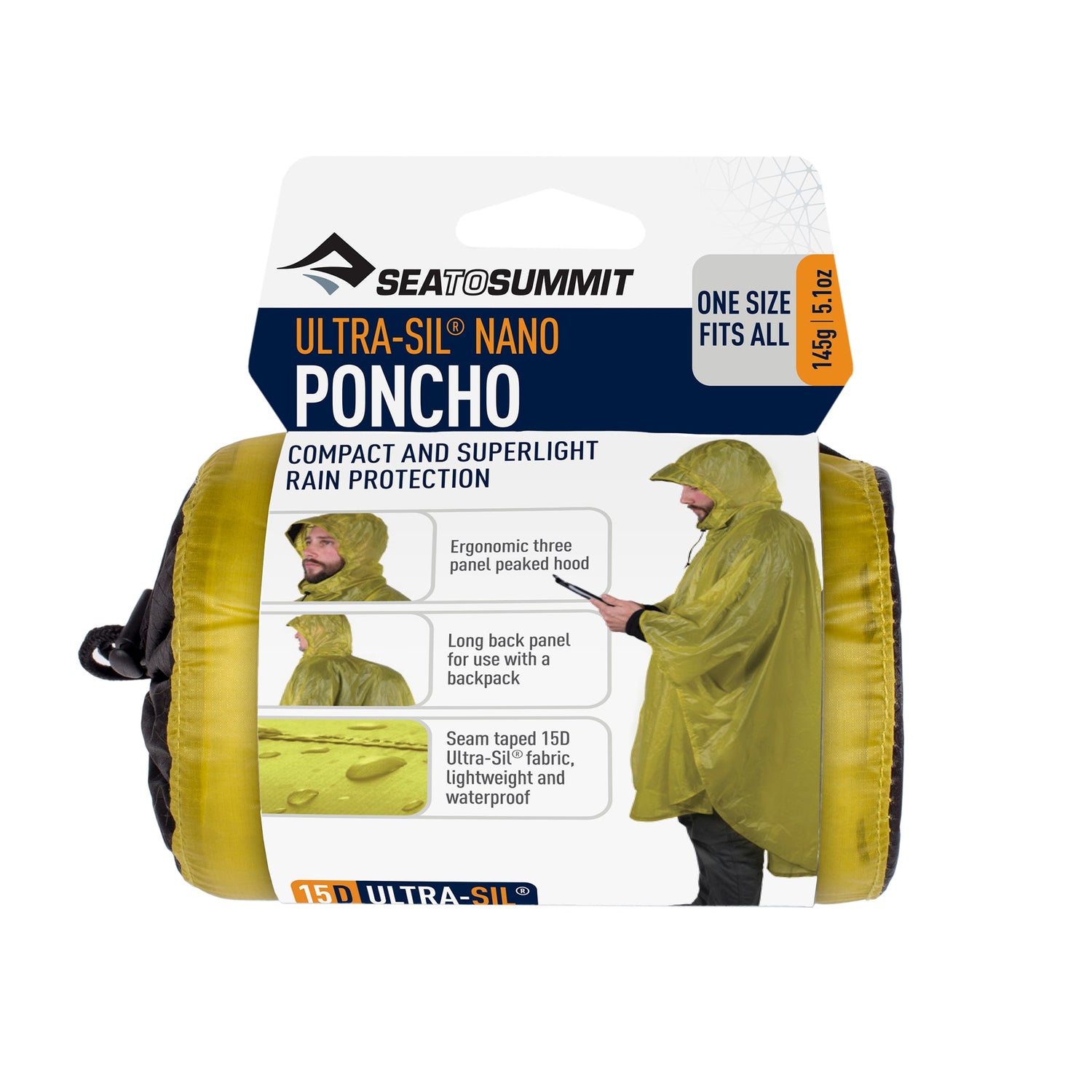
Overview
The Sea to Summit Ultra-Sil Nano Tarp Poncho is a 4-in-1 piece of kit — raincoat, pack cover, groundsheet, and emergency shelter — all folded down into something the size of a large can of soup. At 230g (8.1 oz), it’s one of the lightest multi-use rain solutions on the market, built for ultralight backpackers and thru-hikers who refuse to carry a separate rain jacket, pack cover, and tarp. The trade-off, as we’ll get into, is that it asks you to accept some real-world limitations in exchange for that versatility.
Key Specs
| Spec | Value |
|---|---|
| Weight | 230g / 8.1 oz |
| Fabric | 15D Ultra-Sil Nano (siliconized + PU-coated nylon) |
| Hydrostatic Head | 1,200mm |
| Dimensions (deployed) | 57 × 104 in / 145 × 265 cm |
| Packed Size | 3 × 5.25 in / 7.5 × 13.5 cm |
| Construction | Double-stitched, tape-sealed seams |
| Hood | 3-panel peaked hood with drawcord tail hem |
| Closure | Side snaps |
| Colors | Pacific Blue, Lime |
| Warranty | Lifetime (defects in materials/workmanship) |

Would the Ultra-Sil Nano Tarp Poncho earn its spot in your pack?
230 g · 8.1 ozAdd the Sea to Summit Ultra-Sil Nano Tarp Poncho to your Gear Closet and see exactly what it does to your base weight, then start packing for your next trip.
Free · No credit card · iOS, Android & web · Trusted by 3,000+ backpackers
Performance
Rain Protection
The headline waterproofing number — 1,200mm hydrostatic head — will raise eyebrows next to a Gore-Tex jacket rated at 28,000mm. But context matters here. When a poncho is worn over a backpack, rain simply runs down the fabric; the material is never subject to the sustained pressure of pack straps that causes jackets to wet out. So 1,200mm goes further in practice than on paper.
The 15-denier Ultra-Sil fabric is a siliconized nylon with a polyurethane inner coating for waterproofing, rated to a 1,200mm hydrostatic head.
In light-to-moderate rain, that’s generally sufficient.
During a steady downpour tested in the Appalachians, the poncho kept both the wearer and their pack dry, with the hood providing good coverage.
Where it starts to show its limits is in sustained heavy downpours — a handful of users report soaking through after prolonged exposure, which aligns with what you’d expect from a 1,200mm rating under real-world stress.
The arms are the poncho’s most honest limitation. With trekking poles in hand, your arms are mostly exposed, and water can wick up your sleeves into your torso. Your lower legs are also uncovered. If you’re moving fast with poles in cold rain, that gap matters.
Wind Performance
A tarp-poncho is not designed for use in very windy conditions. In windy environments, a belt or accessory strap is essential to prevent the poncho from flapping.
Sea to Summit say that clearly in their own FAQ, and it’s worth taking seriously.
On steep inclines with a heavy pack, the extra material can become genuinely annoying — though in a breeze, that same loose fabric provides welcome ventilation.
Ventilation & Condensation
The 15D nylon fabric is not breathable in the technical sense, but the poncho design provides excellent ventilation through air circulation. Unlike rain jackets that rely on fabric breathability — which often fails in wet conditions — the poncho’s open design allows moisture to escape naturally.
That’s the theoretical argument. In practice,
some condensation build-up inside the poncho during periods of high humidity is noticeable
, especially on steep uphills. For most hikers, it’s a better trade than fighting a wet-out membrane, but it’s not a dry system.
As a Tarp
The poncho easily converts from rainwear to a 2-person shelter with guy attachment points.
As a shelter, it functions as a regular rectangular tarp with guy-outs for a flying diamond or lean-to configuration. The dimensions are a bit small for a full A-frame with sides to the ground, so practice before your first trip.
Trekking poles can be used to create a makeshift shelter when deployed as a tarp.
It won’t replace a properly-sized silnylon tarp for anyone expecting bomber overnight shelter, but as a genuine emergency option it punches well above its weight class.
Packed Size & Weight
Sea to Summit saved 3 ounces and 30% of packed size compared to the older 30D Ultra-Sil predecessor.
The Tarp Poncho packs down to 3 × 5.25 inches in the included stuff sack.
One user noted it fits into the hip belt pocket of their pack
— though your mileage will vary by pack. For context, the simpler (non-tarp) Ultra-Sil Nano Poncho weighs around 145g and packs to 2.5 × 5.25 inches — you’re paying about 85g extra for the tarp functionality, which seems like a fair trade for most thru-hikers.
Durability
The 15D fabric is thin and requires careful use, but it’s more durable than it initially feels. It’s suitable for trail hiking and normal backpacking, but not recommended for bushwhacking or routes with extensive abrasive contact with branches and thorns.
One user flagged that
a snap broke after a few years of light use, rendering the poncho less functional
— something to watch on a piece where the side snaps are integral to rain performance. That said,
Sea to Summit products are guaranteed against defects in materials or workmanship for the lifetime of the product
, so a warranty claim should cover hardware failures.
Pros & Cons
Pros
- Genuine 4-in-1 functionality: poncho, pack cover, groundsheet, emergency tarp
- Weighs just 230g — 3 oz lighter than the previous 30D version
- All seams are double-stitched and tape-sealed, addressing the most common failure point on lightweight rain gear
- Open poncho design provides better ventilation than any non-vented rain jacket
- Large enough to cover a big pack; at 5’9”, the bottom hits just below the knees
- Lifetime warranty from Sea to Summit
Cons
- 1,200mm HH is marginal in sustained heavy rain
- Arms and lower legs are exposed — a real issue in cold, windy, wet conditions
- No pockets (by design, but still)
- Shelter dimensions are smallish for a full A-frame pitch
- Wind makes it flap and is difficult to manage solo
- Getting the poncho over a large pack solo can be awkward in sudden weather
Who Should Buy This
This is built for the gram-counter who hikes primarily in temperate climates — think Pacific Northwest summer, Appalachians, or trail routes in Southeast Asia — where rain is frequent but temperatures stay reasonable. The Nylon Tarp Poncho version is perfectly adequate for recreational hikers; thru-hikers will prefer the lighter, more compact Ultra-Sil Nano version. If you’re heading into sustained cold-and-wet alpine conditions, or regularly hike in wind, this is not your primary rain system. Pair it with arm protection (lightweight fleece or a wind shirt) and you have a workable all-weather system at a remarkably low system weight.
Verdict
The Ultra-Sil Nano Tarp Poncho does something genuinely useful: it consolidates three or four items into one at a weight that barely registers. The 1,200mm waterproofing and arm exposure mean you need to be honest about when it’s the right tool — it thrives in moderate rain on warm, calm days, and struggles in cold, windy downpours. Go in with clear expectations and it earns its place in the pack; go in expecting a Gore-Tex jacket alternative in all conditions and you’ll be disappointed. 7.5/10.