Simond MT100 Hooded Down Jacket Review
Decathlon's Simond MT100 pairs 800-fill duck down with a 295 g weight at a price that undercuts most rivals by half. Here's where it shines and where it cuts corners.
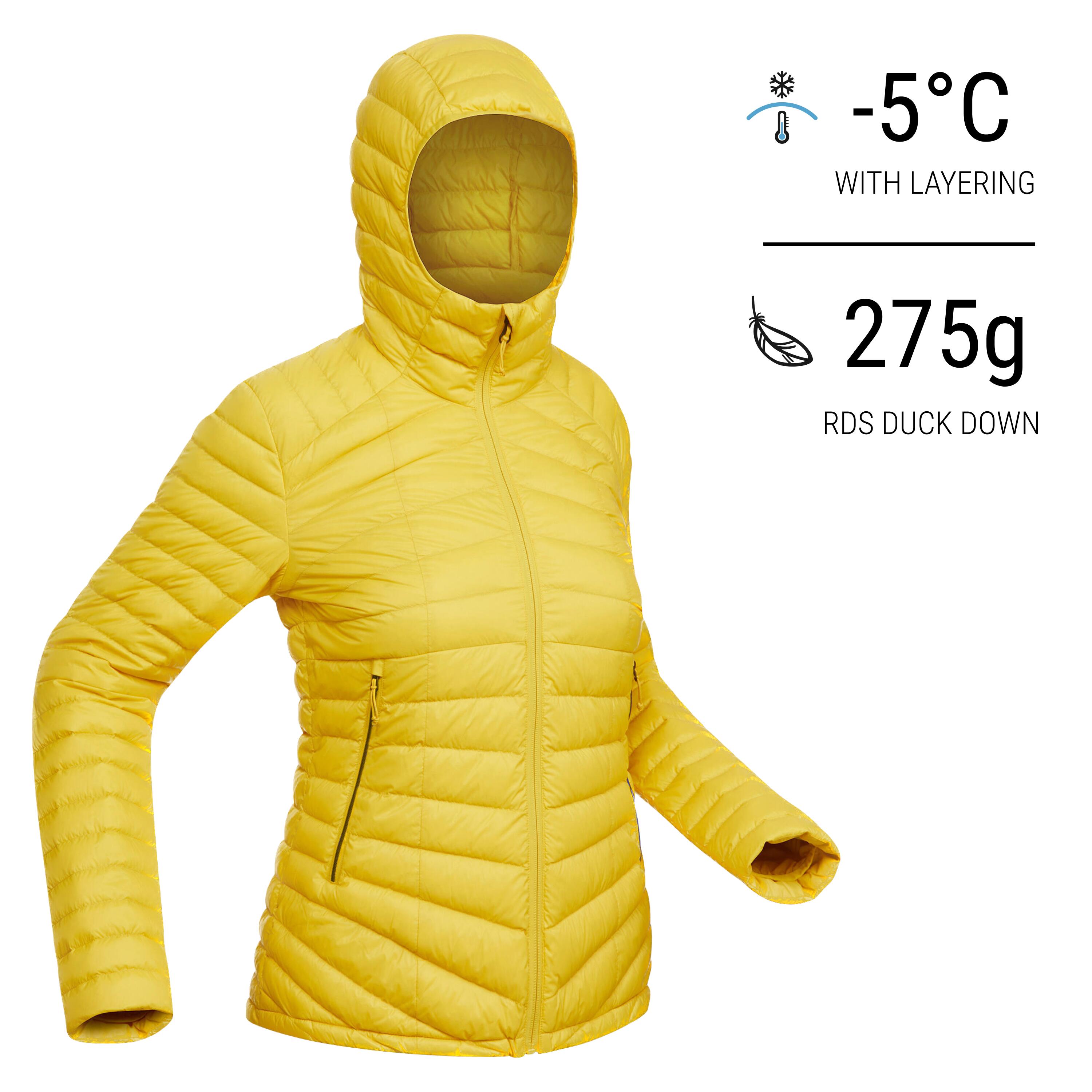
Overview
The Simond MT100 (known until recently as the Forclaz MT100, and before that the Trek 100) is a no-frills hooded down jacket that has built a cult following among budget-minded backpackers. It pairs 800-fill-power RDS-certified duck down with a 15D shell at 295 g, a spec sheet that usually costs two or three times the $119 list price. The trade-off is a stripped-down feature set: a loose, non-adjustable hood, no chest pocket, and a shell that gives up quickly in rain.
Key Specs
| Spec | Detail |
|---|---|
| Weight | 295 g (10.4 oz) |
| Insulation | 800-fill-power RDS-certified duck down |
| Insulation weight | 3.1 oz (size L) |
| Shell | 15D polyamide with DWR finish |
| Hood | Yes, elastic-bound, not adjustable |
| Pockets | Two zippered hand pockets, internal drop pockets |
| Stowing | Packs into a hand pocket with double-sided zipper and clip loop |
| Manufacturer temperature guidance | Down to 23°F when active, 41°F when static |
| List price | $119 (frequently discounted to the $75–80 range) |

Build your Gear Closet
View all of your gear in one place, create packing lists and hit the trail with confidence. Available on iOS, Android and the web.
Get StartedPerformance
Warmth. Decathlon rates the jacket to 23°F while moving and 41°F at rest, and reviewers’ experience lines up with the second number more than the first. SectionHiker found it kept a wearer comfortable to about 40°F on its own, and down to 23°F only when worn over a fleece mid-layer. Outdoor Gear Lab scored warmth at 6.0 out of 10 and described the jacket as far from the warmest in its test group. CleverHiker’s testers, wearing it through chilly Colorado fall weather, found it warm enough for everything from day hikes to camp chores. The narrow baffles are typical of lightweight puffies. They keep the down evenly distributed, but they don’t build the loft of a heavier belay jacket. Treat it as a three-season layer for camp and rest stops, not a winter piece.
Weight and packability. At 295 g, the MT100 sits among the lighter jackets in Outdoor Gear Lab’s lineup, which scored men’s packability at 7.5 and women’s at 9.0. It stuffs into its own hand pocket, and the zipper opens from both sides so the pocket can be turned into a pouch with a clip point for hanging off a pack. That’s more convenience than many pricier jackets offer. On thru-hiker forums, the jacket is praised for its warmth-to-weight and warmth-to-price ratios. Down this good is rarely seen below the premium tier.
Fit and comfort. The cut runs small, and nearly every reviewer says the same thing: size up. SectionHiker’s tester normally wears a large and recommended an XL. CleverHiker and Outdoor Gear Lab reached the same conclusion. Testers like the padded collar and the soft elastic on the cuffs and hood opening. The one recurring complaint is the cuff design. A down baffle drapes over the elastic and can sit across the tops of the hands, which CleverHiker called its biggest gripe, though a minor one. Internal drop pockets get a nod for holding a hat, gloves or a water filter close to the body.
The hood. The hood is oversized and has no adjustment. It’s big enough to go over a climbing helmet, but the elastic edge is too loose to seal around the face, so heat escapes. SectionHiker recommends wearing a wool or fleece beanie underneath on cold nights. The jacket also has no chest pocket, so a phone has to ride in a hand pocket.
Weather resistance. The DWR-treated 15D shell is the jacket’s weakest area. DuskHiker described its performance against precipitation as below average, and said breathability is modest. In drizzle it buys a few minutes, not an afternoon. Outdoor Gear Lab was kinder, scoring weather resistance at 7.0 for the men’s version, but nobody recommends it as a rain layer. Carry a shell, or keep it for dry conditions.
Pros & Cons
Pros
- 800-fill RDS-certified duck down at a price that normally buys 650-fill
- 295 g with a compact, self-stuffing pocket and clip loop
- Soft collar and cuffs; internal drop pockets
- Frequently on sale at $75–80, well below the $119 list price
- Large hood fits over a helmet
Cons
- Runs small; most buyers need to size up
- Hood is non-adjustable and loose around the face
- No chest pocket
- Cuff baffle can droop over the hands
- DWR shell and modest breathability limit its use in wet weather
- Not warm enough on its own for sub-freezing camps
Who Should Buy This
Backpackers and thru-hikers who want a camp and rest-stop puffy for three-season trips, and who would rather spend $80 than $250. It also suits travelers and anyone who wants a packable layer for cool mornings. Hikers who expect a lot of cold, wet weather, or who want an adjustable hood and a chest pocket, should look at pricier options such as the REI Co-op Magma 850 Hoodie, which topped Outdoor Gear Lab’s group at 8.5. Anyone hoping to sleep or hike in sub-freezing temperatures with this alone will be disappointed.
Verdict
The MT100 delivers premium-tier down and a sub-300 g weight for roughly a third of what the big names charge. The loose hood and thin shell are the price of that bargain, and size up when ordering. For dry, cool-weather backpacking, it’s one of the best values in down insulation.