Scarpa Drago XT Review
Scarpa's Drago XT adds structure and a locked-in heel to the famously soft Drago, trading a little sensitivity for more edging power and versatility.
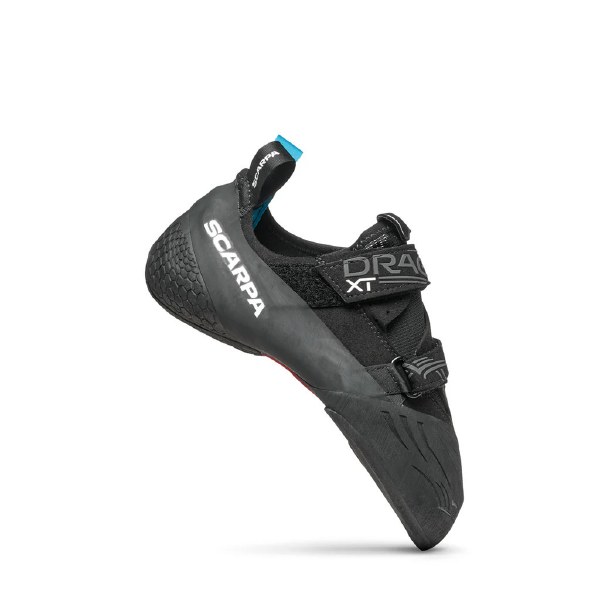
Overview
The Drago XT is Scarpa’s revamp of one of the most beloved soft, downturned climbing shoes on the market. It keeps the original Drago’s steep-wall, high-sensitivity DNA but adds a dual-Velcro closure, a re-engineered heel, and a slightly stiffer midsole aimed at climbers who want that Drago feel with more edging power and support. It’s built for boulderers and steep sport climbers who live on overhangs, pockets, and heel hooks rather than vertical slab or crack terrain.
Key Specs
| Spec | Detail |
|---|---|
| Weight | 200 g (per shoe, ½ pair, size EU 41) |
| Upper | Microsuede |
| Midsole | Flexan 1.0 |
| Outsole | Vibram XS Grip2, 3.5 mm |
| Last | FZR — highly downturned, highly asymmetric |
| Closure | Dual Velcro (“double jacket”) |
| Size range | EU 35–45 (half sizes) |
| Country of origin | Italy |

Build your Gear Closet
View all of your gear in one place, create packing lists and hit the trail with confidence. Available on iOS, Android and the web.
Get StartedPerformance
Fit and downsizing. The FZR last is aggressive — highly downturned and highly asymmetric — and reviewers consistently note it runs narrow through the midfoot with a distinctly snug heel cup. One reviewer who switched from Tenaya Indalos said these shoes have a very tight heel and a fairly narrow fit throughout, noticeably tighter than the Tenaya’s, especially in the heel. If you have a wider foot, plan on trying these in person or sizing carefully — Scarpa’s own guidance for climbing shoes is that the choice of downsizing by a size depends on the desired fit, and other retailers suggest going a half to full size down depending on foot width.
Heel. This is where the XT most clearly differentiates itself from the standard Drago. Scarpa redesigned the heel cup with a honeycomb-textured rubber that testers describe as noticeably stickier and more secure. UKClimbing’s reviewer found the heel on the XT fits a lot more snugly than the original Drago, and considerably more snugly than other Scarpa shoes, calling it a significant improvement in fit, sensitivity, and precision. Bergfreunde’s reviewer echoed this, praising more stable heel hooks and calling the heel rubber “amazing.” Evening Sends put it bluntly: the original Drago could feel a little mushy on hooks, but the XT locks in more securely, thanks to better tensioning, more structure, and a laser-etched texture that grips regardless of heel angle.
Edging and precision. The XT’s SRT toe construction — a continuous rubber tension band wrapping the toe box and forefoot — replaces the old midsole approach. According to Evening Sends, this setup pulls the shoe into a downturned shape, giving power to the big toe and precision on small holds without sacrificing softness. GearJunkie’s two-month test backed this up on real limestone: they found the XT slightly stiffer and less asymmetrical than the standard Drago, which provides more edging ability and a bit more comfort under load — at the cost of some sensitivity and shoe conformity, though the XT ends up effective on a wider variety of routes and problems.
Smearing and overall sensitivity. The XT doesn’t abandon what made the original Drago a benchmark. The 3.5mm XS Grip2 sole extends about a third of the way down the shoe, and per UKClimbing, that coupled with the horseshoe midsole gives good balance, letting you smear and edge in equal measure. It’s not quite as soft and moldable as the original Drago, but it’s still firmly in “soft shoe” territory compared to stiffer edging-focused models.
Durability and maintenance. One quirk worth knowing: the tacky heel hexagons are grippy enough to pick up trail debris. UKClimbing’s reviewers note the heel hexagons are so sticky they’ll pick up little bits of debris as you walk around, so it’s worth brushing them off occasionally. Like most soft Scarpa shoes, expect the thin sole to wear faster than a stiffer edging shoe, though Scarpa shoes are generally resole-friendly.
Pros & Cons
Pros
- Dramatically improved heel hook security and stickiness compared to the original Drago
- SRT toe construction adds edging power without feeling like a stiff, dead shoe
- Dual Velcro closure gives a more dialed, adjustable fit than the original’s single strap
- Versatile enough to bridge steep bouldering and technical sport climbing in one shoe
- Made in Italy, resole-friendly construction
Cons
- Narrow, low-volume fit won’t work for wide or high-volume feet — try before you buy if possible
- Loses a touch of the original Drago’s legendary sensitivity and conformity
- Sticky heel rubber attracts trail grit and needs occasional brushing
- Soft sole means it will wear down faster than stiffer edging-oriented shoes
- Premium price point typical of top-tier performance shoes
Who Should Buy This
The Drago XT makes sense for climbers who already loved the original Drago’s steep-wall performance but wanted more confidence on heel hooks and small edges — think boulderers projecting powerful, technical lines and sport climbers on pocketed limestone or steep tufa terrain. If you split your time between bouldering and lead climbing and don’t want to own two specialty shoes, several reviewers pointed to the XT as the one that performs well at the higher end of both disciplines. Climbers with wide or high-volume feet, or those who primarily climb vertical or slabby terrain, should look elsewhere.
Verdict
The Drago XT takes what made the original Drago a cult favorite — extreme sensitivity and smearing ability — and bolts on a genuinely better heel and more edging precision without turning it into a different shoe. It’s not a replacement for the standard Drago’s softness on the most delicate smears, but for most steep, technical climbing it’s the more complete tool. If the narrow FZR last matches your foot, this is an easy recommendation for anyone climbing hard on overhanging rock.