Petzl Bindi Review
The Petzl Bindi is a 35g rechargeable headlamp with 200 lumens and a full feature set — ideal for ultralight backpackers, trail runners, and anyone needing a capable backup light.
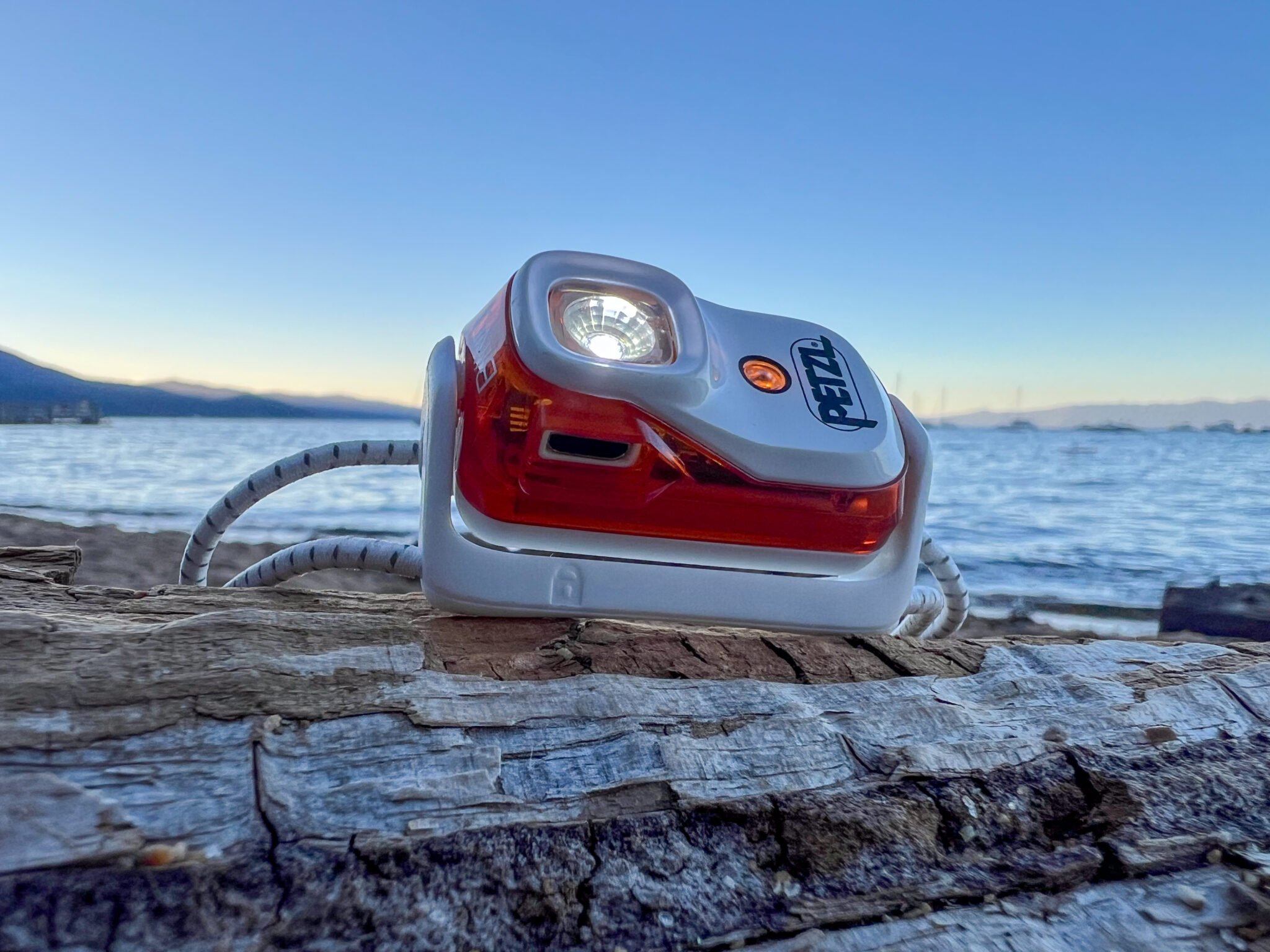
Overview
The Petzl Bindi is a minimalist, USB-rechargeable headlamp that packs 200 lumens, a red light, an emergency strobe, and dual locking modes into a 35g housing the size of a matchbox. Petzl designed it for everyday athletic use — urban training runs, dawn patrols, camp chores — where low weight is the priority and extended multi-hour burn time isn’t the primary demand. It’s most accurately described as the lightest capable headlamp on the market rather than the most capable light headlamp, and understanding that distinction is the whole ballgame.
Key Specs
| Spec | Value |
|---|---|
| Weight | 35 g / 1.2 oz |
| Max Output | 200 lm |
| Standard Output | 100 lm |
| Low Output | 6 lm |
| Beam Distance | 36 m |
| Burn Time (Max) | 2 hours |
| Burn Time (Standard) | 3 hours |
| Burn Time (Low) | 50 hours |
| Red Light Burn Time | 33 hours |
| Red Strobe | 200 hours / visible 400 m |
| Reserve Mode | 3 lm for 90 min (auto-activates at low battery) |
| Battery | Li-Ion 680 mAh, built-in |
| Charging | Micro-USB |
| Water Resistance | IPX4 |
| Lock Modes | 2 (digital + physical) |

Would the Bindi earn its spot in your pack?
35 g · 1.2 ozAdd the Petzl Bindi to your Gear Closet and see exactly what it does to your base weight, then start packing for your next trip.
Free · No credit card · iOS, Android & web · Trusted by 3,000+ backpackers
Performance
Brightness & Beam
Two hundred lumens is a modest ceiling by 2025 standards — most trail-running headlamps sit at 300–600 lm — but context matters here. At max power, the beam projects around 36 meters and is competitive with headlamps that weigh three times as much. At 100 lm (standard mode), the Bindi illuminates a trail well enough for hiking on a dark night, though not for route-finding off-trail; the dimmest white setting is bright enough for reading and tasks within arm’s reach.
White mode casts a flood beam that’s noticeably brighter at the center than the periphery, which feels natural whether you’re in camp or moving along a trail.
The single LED offers enough throw and flood that most users won’t feel they’re missing anything on moderate terrain.
Where the Bindi genuinely struggles is on technical terrain at speed.
Moving confidently on tricky terrain demands more power than the Bindi offers.
It’s best suited for athletic pursuits in urban environments where ambient light helps, and isn’t recommended for moving quickly over technical or rough terrain where high illumination is needed.
Battery Life & Charging
The 2-hour max-power burn time is the Bindi’s most significant practical constraint. It’s well suited for in-camp use on backpacking trips where you don’t need a long-burning, high-intensity light, but it doesn’t have a big enough battery for hiking all night or long multi-hour trail runs. On the flip side, the low (6 lm) mode tested at over 52 hours in independent field use — that’s a meaningful safety cushion. And Petzl’s reserve mode is a genuinely useful feature: when the battery nears empty, it automatically switches to a 3-lumen white mode that burns for 90 more minutes — just enough to get you settled for the night, and a fairly unique safety feature given the Bindi’s limited power capacity.
One note on charging: the Bindi still uses micro-USB in 2025, which is a real frustration. Petzl left the port exposed without a cover, and while it’s reportedly more solid than most micro-USB ports, it’s nonetheless a fragile connector with no weather sealing. If you already carry a USB-C power bank for your phone, you’ll need a separate cable — or an adapter. That’s an irritant Petzl should have resolved by now. On the positive side, Petzl uses regulated output on the Bindi, meaning you get the full rated lumens for the full rated duration — many competing headlamps advertise longer runtimes but are pushing only 30% power toward the end of their cycle.
UI & Controls
The control sequence is fully digital but easy to cycle through by pushing the button repeatedly, even if you can’t remember the exact order.
A single press turns on white light and subsequent presses scroll through the three modes; a long hold toggles to red, and pressing again fires the red strobe.
The simplicity of a single control button made switching between settings effortless on the move
— something that sounds trivial until you’re trying to adjust brightness with cold fingers at 5 AM.
Two locks — one digital, one physical — prevent accidental activation when the lamp is packed.
The physical lock rotates the housing so the button is recessed inside the cradle. Both work reliably; the dual system feels like thoughtful engineering for such a small package.
Fit & Comfort
Petzl replaced the traditional head strap with an adjustable stretch cord, which is how they shed so much weight without sacrificing the ability to direct the beam.
In practice,
the tiny tilting housing stays stable even while running, and the stretch cord is nearly unnoticeable for a couple of hours of wear; it also fits over climbing helmets.
The catch:
if you overtighten the shock cord, the thin elastic can cause discomfort.
The headband takes some getting used to — it pinches if made too tight, and because it’s tightly integrated with the cradle, it’s not easily replaceable.
The good news is that the light’s mass is low enough that you rarely need it very tight at all.
The bungee cord system also lets you hang the Bindi around your neck or attach it to things like trekking pole handles
— a handy trick for tent cooking when you don’t want it on your head.
Durability
A minority of user reports flag reliability concerns. Some users report the lamp dying within a year — charging appears to register normally but the light won’t function. This doesn’t appear to be widespread, but it’s worth keeping in mind given the non-replaceable battery. Petzl guarantees the Bindi for three years and 300 charging cycles.
Pros & Cons
Pros
- Ultralight in every sense — the lightest headlamp in CleverHiker’s test pool at 1.2 oz, 0.4 oz lighter than the closest competitor
- Regulated output means rated lumens for rated duration — no gradual dimming surprises
- 90-minute auto reserve mode is a meaningful safety net and fairly unique among headlamp manufacturers
- Full feature set: white light, red light, red emergency strobe, battery meter, and dual accidental-activation locks
- Single-button UI is fast and intuitive to use on the move
- Bungee cord can be worn around the neck or used to attach the lamp to gear
Cons
- Micro-USB charging port (not USB-C) is outdated and exposed — no port cover
- 2-hour max-power burn time limits usefulness on longer dark hours
- At 200 lm, the lowest maximum output among headlamps in its class; this limits its range of uses
- Non-replaceable integrated battery — can’t swap cells in the field
- Shock cord headband can pinch if overtightened and is not easily replaced
- Price feels high relative to competitors like the Nitecore NU25 UL, which offers more output and features for less money
- Light bleed from the clear bottom of the housing can reflect on eyeglass lenses
Who Should Buy This
The Bindi earns its place in three specific roles: as a primary light for ultralight thru-hikers who camp in shoulder-season and don’t need more than a few hours of illumination per night; as a trail running headlamp for dawn/dusk bookends on runs under two hours; and as a backup or emergency light for alpinists and backcountry travelers who want real output in a package that weighs less than three AAA batteries. As one reviewer put it, it’s the rare piece of gear that lets you “carry your extra batteries in another headlamp.” If you regularly need to hike for multiple hours in the dark — think late-season PCT miles or nighttime weather windows in the mountains — look at something with a larger battery or swappable cells.
Verdict
The Petzl Bindi is the clearest example of weight-to-capability optimization in the headlamp category, and it earns that status honestly — the feature set is real, not stripped down. The micro-USB port and 2-hour max burn time are the two things that keep it from being an unconditional recommendation; both are design decisions Petzl could improve in a future revision. If those constraints fit your use case, you won’t find a lighter setup that still works this well. Rating: 7.5 / 10.